Software
Houzz Logo Print
bengz6westmd

Rain, rain, go away

8 years ago
last modified: 8 years ago
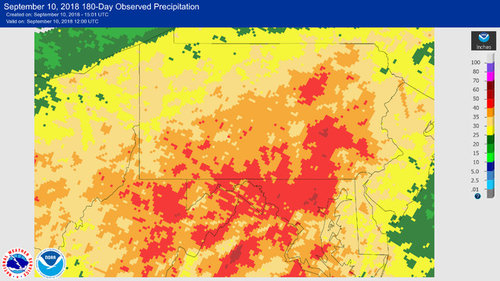
Much of Maryland and parts of Pennsylvania, Virginia & West Virginia continue getting drenched. Notice the deep red on the map is for 40+ inches of rain over the past 180 days. Even spots of 50+ inches are present. Hurricane Florence is forecast to stall over the southern Appalachians & could dump several feet of rain there.


Comments (26)

  • 8 years ago

    The first part sounds like a good problem to have depending on your soil type and elevation.

    I got 9" of rain over 2 weeks recently and this burden was finally lifted from my shoulders as if I was liberated. I hadn't had that feeling from precipitation as it relates to gardening for almost a decade.


    The second part sounds disastrous...hopefully is moves more quickly or weakens.

    bengz6westmd thanked whaas_5a
  • 8 years ago

    A big part of Wisconsin has had way too much rain over the past few weeks, with significant flooding and property damage. The Madison area has been especially hard hit. We had 6" over a 30-hour period about a week ago, but other than some minor erosion on banks, it was all good. Green and lush around here. We're currently in a gorgeous stretch of weather -- sunny, mild, and low humidity.

    bengz6westmd thanked maackia
  • 8 years ago

    Parts of East and Southern Minnesota have been flooded also.

    Not sure but the area by Jay Cooke state park by Duluth, that was severely flooded several years ago have had some substantial rains lately also but I haven't heard what's going on there.


    We finally, in the stretch of 3 weeks, got a couple of half inch, a couple of quarter inches and one near an inch of rain, which helped a lot but now no rain in the last week and a half so it's getting dry again. The nights have been cool in the 50's with 70-75 for highs and periods of clouds so that helps.


    bengz6westmd thanked User
  • 8 years ago

    How are the mosquitoes? There are insane swaths of them right now.


    Various populations of birds that typically eat them are declining rapidly. Where my purple martins at! I haven't seen them since this spring.


    bengz6westmd thanked whaas_5a
  • 8 years ago

    We had some early this summer but it was the first time since we moved to town (6 years Oct) that we had any mosquitoes to speak of.


    Out at my old place in the country, there are different levels of bad and this year was a 10 but it's been dry and cool enough lately that they have tapered off.


    Mosquitoes are actually a tropical and sub tropical insect and conditions have to be pretty close to perfect for them to thrive. We had 37d the other night and they don't survive for long with cool nights and low humidity levels. Needless to say, Fall is my favorite time to be out in the country.

    bengz6westmd thanked User
  • 8 years ago

    We had roughly a two week period in late July/early August where the mosquitoes were miserable. They haven’t been a problem since, but with the rain we’ve had recently and the forcasted warm, humid weather by weeks end, I suspect we haven’t seen the last of them.

    Bill, I too look forward to cooler temps and the arrival of fall. I lived in the Phoenix area for three years and badly missed the distinct four seasons.

    bengz6westmd thanked maackia
  • 8 years ago
    last modified: 8 years ago

    Bill, mosquito species thrive anywhere there's water. Hordes of 'em harass caribou/reindeer in the arctic tundra every summer. Hordes in the boreal forests in the summer too. The coldest of cold & ice doesn't bother their eggs. Malaria was common in the eastern US when the Europeans first arrived.

  • 8 years ago
    last modified: 8 years ago

    The statement 'mosquito species thrive anywhere there's water' should be more like 'mosquito species exist anywhere there's water' and need warm temperatures to thrive.

    I've been to the Arctic Circle in July. The trip from Fairbanks was warm and sunny with large mosquitos everywhere we stopped, along the way.

    Mosquitos prefer and are most active when the temperatures are in the 80's.

    As temperatures drop below 80, they begin to slow and at 50d< they will shut down completely, usually for the winter. Believe me, we can tell the difference in late summer after night time temps go below 70 and daytime temps are in the 70's.

  • 8 years ago
    last modified: 8 years ago

    Bill, no, as long as the water melts, they can hatch. Why do you think they thrive in arctic tundra and boreal areas? The only "warmth" they need is enough to get above freezing temps for a reasonable stretch. The eggs hatch <i>en masse</i> in boreal lakes & bogs.

  • 8 years ago
    last modified: 8 years ago

    " The only "warmth" they need is enough to get above freezing temps for a reasonable stretch. "

    I really doubt that. Even in my area, it has to get warm enough, for long enough (guessing mid 60's or above for a couple of weeks), before the mosquitoes hatch out and are a nuisance here in the spring.

    I'm surprised with all the information pertaining to mosquitoes that's put out from the state and federal government sights, there would be any question to what I've posted. Here's an excerpt from Connecticut,gov.

    Connecticut : " Where do mosquitoes go during the winter?
    Mosquitoes are cold-blooded creatures and do not generally bite in temperatures below 50F. In Connecticut, some adult mosquitoes become inactive with the onset of cold weather and enter into hibernation before the first frost. Other mosquitoes die in the fall but have winter-hardy eggs, which hibernate as embryos. "

  • 8 years ago

    It was 51 degrees this morning and I was viciously attached by swatches of mosquitoes.

  • 8 years ago

    Great youtube HERE about Alaskan mosquitos. I don't know about the temperature but there is snow on the ground. These look like super mosquitos to me, hope to never see them around here.

  • 8 years ago

    When we were there, is was warm and sunny, beginning of July (mid 70's?).

    We learned that the perma frost was primarily in the peat areas.

    The gravel or mineral soils didn't stay frozen all year and there was large areas of rock and gravel the further north we got. Plenty of places for water to pool and get heated by the sun.

    So while perma frost exists, it's not everywhere across the region.


    Those could possibly be the kind of mosquito that hibernate,

    so are ready to go as soon as the temps rise mid June? idk.

    I read something about sporadic massive mosquito hatches, can happen from time to time.


    All I do know is the arctic, isn't as cold and dismal as one might think, during the summer.

    The sun is hot and temps get into the 80's in July. And you can have snow on the higher elevations with summer like conditions further down.


    Mosquito season in Alaska, is from mid June until end of July, the reason is, temps start dropping again in August, especially at night.


  • 8 years ago


    HERE is an interview about gene drive being used to control mosquito populations. Now here's what I need to know, can this be used on Japanese beetles, gypsy moths, EAB's, ticks, fleas, how about white-tailed deer or mustangs in the western states?

    It will be interesting to see where this technology is headed. It may solve one problem and create others in the process.

    bengz6westmd thanked sam_md
  • 8 years ago

    beng12,

    How did you end up with all the rain? Any damage? Loss of plants?

    bengz6westmd thanked User
  • 8 years ago

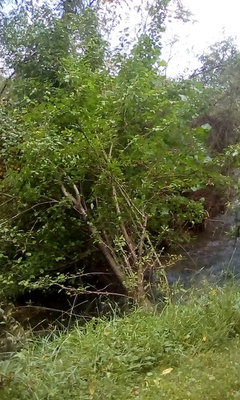
    Well, my grafted pear on the stream bank fell partly into the stream -- pic below. Still holding the bank some, so leave it alone for now. Shumard x Nuttall oak & rock chestnut oak have foliage mostly ruined by fungi, but they'll be OK. European beech planted in a too-wet spot yrs ago pretty much dead -- guessing root-rot. While traveling, I see trees leaning/falling into streams & rivers & sections of nearby mountains have turned completely brown prematurely -- guessing fungi-infection. Still, not major issues. The trees that like wet soils look very good.

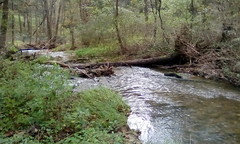
    Stream beyond my lot has fallen trees & piles of debris along banks:


  • 8 years ago

    Well, not a complete catastrophe anyways. Do you get these kinds of rain frequently? or was this the 100 yr flood?

    I envy you having a creek right on the property.

    The best I could come up with is a couple of acres that are inherently wet/low, filled with ash and silver maples and located on the SW corner of my land about 1/8 mile from a small river.

    But I've always liked the sound of trickling water.


    bengz6westmd thanked User
  • 8 years ago
    last modified: 8 years ago

    Prb'ly not a 100 yr flood, which I'd say would be a one-time event instead of long-term rains. A 100 yr flood would be like downtown Johnstown, PA in July 1977 w/10 inches in an afternoon & historical flooding. Johnstown also had an even more catastrophic, famous flood in late May, 1889 after similar heavy rains. Still, my Sept 12.48" beats the (I'm ~60 miles west of) Hagerstown, Md's wettest month (Oct 1976) by a few tenths, and its record goes back to 1890 or so. But such a record is only for one single spot and some nearby, unrecorded spots could easily have greater-amount records.

    Over the yrs here the stream (too small to be a creek) has meandered noticeably, one side eroding and the other side accumulating sediment, some holes filling up w/rocks & sediment or new holes dug out, etc.

    Edit: This got me thinking and I realized I had some old NWS spreadsheets from some other locations. Found nearby (just 12 miles to my west) Cumberland, Md's records and my Sept amount does not beat out its record amount -- 12.94" in August 1915.

    Edit2: More records in my library. Chambersburg, PA (25 miles north of Hagerstown) had 14.49" in Aug 1911. So my amount is looking less impressive in the big picture.

  • 8 years ago

    In my neck of the woods, a river is anything that flows year round, a creek can too but it is usually very small and also called a 'crick'.

    A lot of our water runs underground in what's called 'veins'. Must have something to do with the depth of the sand. Then travels towards the rivers and empties into the rivers as 'springs'. A real lack of small streams in my country (some county 'ditches' have been dug).

    So if we get a lot of rain, it all disappears on top but the rivers will then rise and if enough rain will 'flood'.

    Glad to hear the damage wasn't too bad.

    bengz6westmd thanked User
  • 8 years ago

    beng12, I don't know about you but for us NO STINK BUGS! I think it's because of all the rain.

    bengz6westmd thanked sam_md
  • 8 years ago

    I am seeing lots of dead looking areas on grass this year. Is this from the wet weather or ridiculously HUMID summer. I am referring to "cool" season grasses in the MidAtlantic (Zone 7ish), that should still be vibrantly green. Maybe mowing practices? It's been soooo wet that it seems that the grass never really dries out at the time of mowing.

    bengz6westmd thanked User
  • 8 years ago

    unless It’s saturated potentially grubs

    bengz6westmd thanked whaas_5a
  • 8 years ago

    Saturated is a possibility this year around these parts!

    bengz6westmd thanked User
  • 7 years ago

    I guess there is a species of mosquito that can take the cold: Aedes communis or Snow mosquito. They also have a reputation for being a pollinator. So I was half right. :-)

    https://www.fs.fed.us/wildflowers/pollinators/pollinator-of-the-month/aedes_communis.shtml

  • 7 years ago
    last modified: 7 years ago

    Insects are very resourceful, and their rapid reproduction means that they built to evolve and adapt. I did a little research and found that there are over 3,000 species of mosquito and around 176 in the USA alone. I know that there have also be foreign species inadvertently introduced, and they too are successful. In NJ we did not used to host the Asian Tiger Mosquito (Aedes albopictus) and the other infamous disease carrier, Aedes aegyptii. Now they are both within the state range. Even the more subtropical species manage to get through the winter. Expect to hear more about mosquito born illnesses soon..., been a very WET year in a lot of the country. Season seems to peak August into October locally. Decided to put DEET on after having seen your post and reading and before venturing into the yard.