Software
Houzz Logo Print
gle2011

Shiplap Installation in the Basement

8 years ago
last modified: 8 years ago

Hi,

We live in Central Massachusetts and have a walkout basement.

I had a moisture problem during our construction; the seams of the poly plastic covering the fiberglass bat insulation were not taped and moisture built up behind the poly plastic.

All of the insulation had to be removed and a mold remediation company was called in to encapsulate the start of black mold once the sheathing had dried out to a number below 10 on a wood moisture meter.

I now run a full house de-humidifier which keeps the relative humidity in the basement at 45%.

The mold remediation company recommends I do not have the insulation company cover the new fiberglass insulation with poly plastic.

All of the unfinished basements in the new development only have sheets of clear poly plastic covering the un-faced fiberglass bat insulation; and I would like to cover insulation in some way.

I am hoping to avoid the dusty mess caused by the sanding of the joint compuound on wallboard joints.


So my question is can I installl shiplap or tongue and groove pine directly over the fiberglass bat insulation; nailing it directly onto the wooden studs or do I have to install drywall to the wall first?

Thanks

Comments (18)

  • 8 years ago
    last modified: 8 years ago

    You are required to have insulation covered with an intumescent coating. Or drywall. Drywall is cheaper. Shiplap is going to look especially goofy in an underground space. Not suitable at all.

    gle2011 thanked User
  • 8 years ago

    You're late - I ripped 100' of shiplap out of my basement about 10 years ago. It really has that 1950's feel. Use sheetrock and paint it.

    gle2011 thanked geoffrey_b
  • 8 years ago
    Not helpful, but can't resist. Ask Joanna Gaines.

    I have the same configuration. Personally I would not install sheetrock. Would lose the ability to run wiring and other services, and would lose the ability to inspect the house sill and other wooden members for termites/ carp ants, etc.
    gle2011 thanked sofaspud
  • 8 years ago

    Hi sofaspud,

    What do you have covering the insulation?

    I was thinking about using Tyvek..

  • PRO
    8 years ago
    last modified: 8 years ago


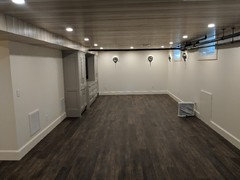
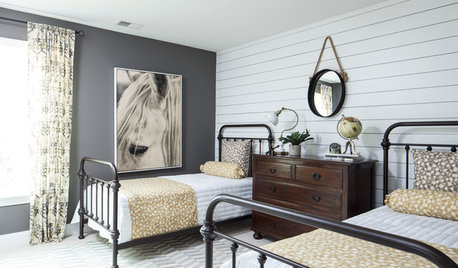
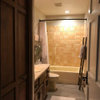
    We ship-lapped the ceiling of this basement remodel in Rhode Island a couple months ago. They decided against painting it, and instead went with a pickled finish.

  • 8 years ago
    Plastic sheeting just like you.
  • 8 years ago
    last modified: 8 years ago

    Barnes Custom Builders - sorry I do not like that at all. Very cave-like and claustrophobic. Just MHO.

  • 8 years ago

    Plastic sheeting or tyvek is flammable. So is insulation. You need to get that covered with drywall immediately. Regardless of what you want to cover that drywall with.

  • 8 years ago

    Barnes Custom Builders,

    What do you recommend to use to cover the un-faced bat wall insulation?

    Are the walls in your picture sheetrock and mudded seams or are the walls plastered?

    Do you do work in Massachusetts?

    Thanks

  • 8 years ago

    I am being told by the town building inspector that the un-faced bat insulation must be covered with plastic.

    ???Massachusetts Building Code???


  • 8 years ago

    45% Humidity is too high - IMO.


    You should first have a plan - what do you want to do with the basement? I would expect some electrical outlets and wall switches for lights.


    Sheetrock is the most common thing. If it is carefully taped, there is not that much sanding required.

    gle2011 thanked geoffrey_b
  • 8 years ago

    The plastic is only a vapor barrier. To make that habitable space requires covered n’t that with drywall.

    gle2011 thanked User
  • 8 years ago

    The space is only going to used as a storage area, and possibly a small exercise area.

    My biggest concern is too make sure I don't have a re-occurrence of the mold issue.

  • 8 years ago
    last modified: 8 years ago

    Mold doesn’t occur in a properly constructed dry basement, no matter the wall covering. And it will occur in an improperly waterproofed or drained basement, no matter the wall covering.

    Your issue lies lies outside the basement walls, and under it.

    If you are creating habitable space here, there are building codes that must be followed. That goes for an exercise room or any other room. Not following those codes leads to an unsellable house down the road. And $$ wasted on the interim hacks.

    gle2011 thanked User
  • 8 years ago

    Maecom Technology,

    The studded walls have not been re-insulated yet following it's removal and mold remediation.

    The insulation company that is going to be doing the work told us if un-faced fiberglass bat insulation is used (which is the standard insulation done by the builder) then the insulation must be covered with a plastic.

    The mold remediation company recommends not using the plastic or paper faced bat insulation.

    I was hoping to either sheetrock the walls without a plastic vapor barrier or to shiplap the walls without using a vapor barrier.

    Thanks

  • 8 years ago
    last modified: 8 years ago

    Dampness issues aside, if you are going to use the space for storage and maybe a small workout area, why are you considering installing shiplap at all? Maybe you just have some on hand and want to use it up?

    Shiplap is very trendy right now - translation: in 5 years it's going to look very 2018-ish. Sheetrock, on the other hand, is standard.

    gle2011 thanked littlebug zone 5 Missouri
  • 8 years ago

    Shiplap was a consideration because of the ease of installation vs. the sheetrock seam joint sanding and dust clean-up.