Software
Houzz Logo Print
hyehouse

natural stone range hood?

8 years ago

Hi Houzzers,


For those of you who have this type of hood, would you recommend it? I love the old world look of a limestone hood, but worry about permanent staining. Is this a big issue for you? Thanks so much!!

Alexia

Comments (35)

  • 8 years ago

    Really bad idea unless you have the 20’x40’ kitchen with the 60” LaCanche in the 120” stone mantel alcove as the showpiece. It just looks sad and silly in a smaller scale.

  • 8 years ago

    I do have a very large kitchen which is why I can accommodate this piece. I was asking about maintenance issues not asking about design or scale. But thanks!

  • 8 years ago

    hyehouse - Do you have a scaled diagram of your planned kitchen which you can post?

  • 8 years ago

    I do have a diagram of the planned design, yes, but I don't need help wth scale. Just any feedback regarding maintenance and whether a natural stone like limestone is a bad idea for a range hood due to permanent staining. Thanks for your comment.

  • 8 years ago
    last modified: 8 years ago

    My stainless steel hood does get some build up of grease over time, and then needs wiping. I'd assume the same to be true for any type of hood. Even the most powerful vent isn't going to prevent all grease from escaping. So, make sure the hood can be cleaned. Lime stone doesn't sound like a great fit. But other types of stone or man-made material might work. Maybe Dekton has a pattern that you like?

    hyehouse thanked M
  • 8 years ago

    Perhaps get a sample of the stone and prop it up behind your current cooktop and then let it get gunky (or manually gunk it up). Perhaps seal half of it. Then see if it is cleanable. Limestone is so porous...but perhaps with the proper sealer it could work.

    hyehouse thanked Fori
  • 8 years ago

    Perhaps get a sample of the stone and prop it up behind your current cooktop and then let it get gunky (or manually gunk it up). Perhaps seal half of it. Then see if it is cleanable. Limestone is so porous...but perhaps with the proper sealer it could work.

  • 8 years ago
    hanging stone always looks incongruous to me. it should be a base...
    that said, good idea to ask about the cleaning issues. there's a reason why commercial goods are usually made from smooth, cleanable stainless...

    my kitchen has a stainless hood. happy with the cleaning. I'd hate scrubbing stone...
    hyehouse thanked Oliviag
  • 8 years ago

    A stone that is smooth (polished) and that can be sealed or which is intrinsically non porous would be expected to be lower maintenance than limestone, if it is naturally as rough as the stones forming my fireplace's hearth. Note that limestone (and marble perhaps) will also be susceptible to acids. Soapstone and granite would seem to be better choices, with soapstone impervious to grease penetration and chemical attack in general.

    hyehouse thanked kaseki
  • 8 years ago

    thanks to all of you so much! i love the idea of getting a sample and "gunking" it up. And opting for more impervious natural stone like soapstone may be a good choice. I like the practicality of stainless but not the look. But I will be open to all these great ideas.

  • 8 years ago
    last modified: 8 years ago

    "I love the old world look of a limestone hood"

    Can you pls provide photos of this look? I am curious as I've not seen that look for a hood. I think of old world as what was before mass manufacturing, so a kitchen might have a hammered metal hood over their stove that maybe a blacksmith would make. I too would be worried about limestone cleaning and maintenance. Also chipping. I hope someone on this forum who has one will see this post and can give their experience.

    hyehouse thanked Miranda33
  • 8 years ago

    Why not call someone who specializes in these hoods and ask ...
    http://francoisandco.com/products/architectural/range-hoods/rh-inspiration/

    hyehouse thanked chispa
  • 8 years ago

    [Gardenwebber firstmmo[(https://www.houzz.com/discussions/have-you-ever-seen-a-marble-rangehood-dsvw-vd~2687983) did a marble one, but I don't recall seeing a final reveal or comments on how it was holding up.

    hyehouse thanked AvatarWalt
  • 8 years ago

    Limestone is marble before heat and compression turn it into marble. If you think living with soft, porous, etchable, marble gets a bad rap, just try living with limestone anything. But limestone over a grease and mess producing cooking zone is especially foolish. Especially when one considers the additional costs associated with a 20K fail that will just need to be redone in a few years time.

  • 8 years ago

    In Europe, they build entire houses from limestone. Within a couple of years, the formerly white building looks black. And people rarely do anything about it. I figure, if that's what you like in your hood, go for it.

    Not my preferred design choice, but certainly defensible. I have on occasion seen it in historic kitchens that used to cook over open fire.

    On the other hand, of you prefer the clean look of newly installed rock, pick one of the other suggestions made in this thread

    hyehouse thanked M
  • 8 years ago

    There are also artisans out there who can fabricate a stone-look hood. I have no first-hand knowledge but a web search yielded a few hits.

    hyehouse thanked zmith
  • 8 years ago

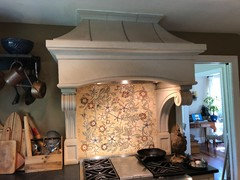
    Here are some pics. One of the whole hood, one corbel and one of the top section.


  • 8 years ago

    Wow, Cleo07, I deeply appreciate the time you took to answer my question. Your hood is the exact look I have had in mind and it is lovely.. I don't mind some discoloration that comes about from a well-used kitchen. My concern was that it would turn black, which yours has not. I am grateful for your advice about the sealing, support for, and ideal capture size for the hood. You also provided me with an idea regarding the labor cost and cost of the hood. Thank you also for the photos. You have helped me immeasurably.

  • 8 years ago
    last modified: 8 years ago

    “Cast limestone” = cultured marble with a few holes in it. A far cry from a genuine carved stone anything.

  • 8 years ago
    last modified: 8 years ago

    “Cast limestone” = cultured marble with a few holes in it. A far cry from a genuine carved stone anything.

    For your reading pleasure:

    Scagliola, pronounced “sca-lee-oh-lah,” is a centuries-old technique for creating ornamental stonework that mimics fine marble and limestone. It remains highly prized for its historic value and exquisite artistry. The technique came into fashion in Italian Baroque buildings of the 17th century and continued to flourish in Europe and America through the 20th century. Some of the finest examples can be found in luxurious European residences and ornate churches.

    François & Co. Scagliola is created by hand, using the meticulous techniques and materials of the original masters. The subtle nuances and aged patina of our Scagliola are the result of the application of multiple layers of pigment, made of a proprietary mixture of limestone dust and marble chips. The stone may then be hand-polished many times over a period of days, depending on the complexity of the piece.

    Our Scagliola marble is made up of cured marble chips and marble dust. The honing and polishing process uses successively finer grades of stone and water, producing a dense, substantial texture. Rubbing with pigmented putty fills in pinholes and repeated polishing results in a flawless surface and brilliant shine, yielding a complex texture and richness of color that can surpass even that of natural veined marbles.

    By emulating and adapting the historical Scagliola technique, Thierry François has created an original process which gives man-made limestone the appearance of natural, hand-cut stone, or even marble. This extraordinary stone inlay and “crosshatch” technique is one-of-a-kind.

    Known as Pierre Dure and Scagliola, the stone inlays are meticulously applied in small batches. This intricate, artisanal approach is what gives each piece its antique character. Stains and pigments contribute to the aged patina, resulting in the finest grade of handmade stone available.

    Scagliola by Francois & Co.

  • 8 years ago
    last modified: 8 years ago

    Here are some resources that you might find helpful vis-à-vis the care and maintenance of stone, as well as an interesting article on Portland stone, a British limestone:

    Natural stone stain guide

    Portland stone (limestone)


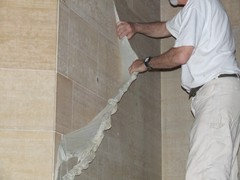
    ABR Waterless Cleaning Poultice

    hyehouse thanked Sammy
  • 8 years ago

    Well said, Sammy. Thank you for your very helpful description of the artisanal process. I am going to be looking into the Scagliola technique and checking out Francois and Co website.

  • 8 years ago
    last modified: 8 years ago

    Sammy-thank you for the info on the peel away stain removal...do you think this would work on kitchen Stains as well? I see the uses on exterior stone but not sure if it translates to airborne grease and other Stains.

    edited to add a word and fIX spelling

  • 8 years ago

    Sounds as if it is intended for both indoor and outdoor use. And sounds as if it takes off quite a good amount of grime. So, yes, I think it's a fair bet that it would help in a kitchen. It might not be perfect. But it'll probably do a lot better than a lot of alternative options.


    If you do use it, please report back on results. This might be a new entry for "answers to obscure questions on Houzz" :-)

  • PRO
    8 years ago

    We've used limestone for hoods and fireplace surrounds a number of times. They can be sealed like any stone.

    Eclectic Remodel and Decor · More Info


    New Construction - Oak Brook · More Info


  • 8 years ago
    last modified: 8 years ago

    Alexia - please don't hate me for what I am about to say, but this forum is for freedom of speech to talk about opinions on kitchens/appliances. To me, there is nothing "old world" about the hoods pictured here. In an older home in America or Europe, no one would be installing a limestone hearth over their cooking area. It is similar in my mind to when the "Tuscan look" was fashionable. People liked their kitchens to look like an aging villa in Tuscany, or what they imagined that look to be, even though they lived in typical suburban homes or city apartments.

    If you are OK with the idea of a faux decor, and you are OK with not being able to wipe the surface easily, go for it. But perhaps you have an older home and were looking to stay with the period. A limestone hood would not do that. They also tend to look incongruous next to current cabinetry. I think you'd need to forego upper cabinets to make it look less incongruous.

  • 8 years ago

    Hi Shannon, I have a home that is French traditional and I have a very large kitchen. In the photos of old country manors I have seen, I have observed this type of hearth made from natural stone. I am okay with it getting weathered over time and from usage as I've said above. but worry about black stains. I do appreciate your opinion and the time you took to write it. :)

  • 8 years ago

    Shannon, you are right that it looks a little fake. And that's for a simple reason. People used to have these types of hoods, when they cooked over open fires in the kitchen. And you can still occasionally find that in old farm houses in Europe -- although, it won't really be used for this purpose any more. It's just a nice large fireplace to socialize next to.


    A open fire place has a very different configuration than a modern gas range. So, obviously, the hood will be in a very different place and will almost certainly be smaller. That's what looks "fake" to me.


    But honestly, people pick up design/style elements from different periods all the time; and then they modify them for what they need today. This is not an unusual decision and I am absolutely OK with that. If this is the style that hyehouse wants to go for, then why not!

  • 8 years ago

    hyehouse- I love your style! You might like this house in Provence - they have a limestone hood. There are some close-up pics in the gallery. It looks to be getting a nice patina, but no black. Poiriers

    My friend has a cast-stone hood. Hers is over a gas range and has been in use for 5-6 years. No black.

    I plan to go with Limestone...will likely have it fabricated by Materials Marketing.

  • 8 years ago

    One hopes that the designers of the Poirier's kitchen provided enough hood flow and MUA to support the required ventilation. To ensure capture and containment, the entire area under the stone, not just the slot area of the insert, needs to have a flow velocity of at least 90 ft/min (90 CFM/sq. ft.). I think this might be sufficient to make up for what appears to be a relieved hood entry area at the center which might be 7 feet from the floor (and not very deep front to back) and thereby dependent on significant air flow to entrain the portion of the expanding cooking plumes that might otherwise miss the hood aperture.

  • 8 years ago

    Kaseki, as a practical matter, how does one do ventilation in such a broad area? Two inserts next to one another? A custom insert with a big external blower? Seems like an alarming amount of MUA might be needed.

  • 8 years ago
    I know I'm in the minority, but I will say it again. Stone, unsupported, looks very artificial and contrived, to me. Stone should have support... it's a foundation, a wall, but it doesn't just hang out there in the open air. imo.
    off my soapbox. sorry.
  • 8 years ago
    last modified: 8 years ago

    AvatarWalt

    When the word "practical" is invoked, one should consider commercial practice as that generally leads to the most efficient approach. However, if one wants residential off-the-shelf components, then a really long hood of this type could be addressed by two inserts. They could have individual controls so long as the user (cook) understood the general issues of "what do I do with the fan settings when cooking between two inserts."

    Either way, if one is cooking at both ends (with dual inserts) or anywhere underneath with a single giant insert, the flow rate has to be sufficient for full capture and containment, and this easily translates to a pair of large residential blowers, or an even larger commercial blower. The latter is not a bad thing as it will have several advantages, so long as its roof appearance is not precluded by aesthetic considerations.

    Yes, just as the hood air flow rises, so must the MUA capability rise, and depending on the environment, so does the heating and/or cooling requirement for the MUA rise.

    An 8 ft by 2.5 ft aperture is 20 sq. ft. This should have a flow rate at full power of 1800 CFM, requiring a ventilation blower with zero static pressure rating in the general area of 2700 CFM (and a similar MUA blower unless ducting is short and combustion appliances are separately MUA'd). I would seriously consider having a commercial like setup with this requirement. MUA heating will depend on too many factors to pontificate about, but one would expect to require an upgrade of the electrical drop from the street. Gas heating might be possible instead.

    As usual, review of the Greenheck guide is advised for perspective.

    http://www.greenheck.com/media/pdf/otherinfo/KVSApplDesign_catalog.pdf

  • 8 years ago

    Addendum: The 90 CFM/sq. ft. should be sufficient for wokking, searing, grilling, etc. at residential levels. Some cooking styles might not cause high velocity cooking effluent plumes. For them, lower flow rates may be sufficient.

    As an example, the Poirier's cooking zone doesn't have a salamander mounted to the back wall, but instead has a set of hanging pans that presumably the cook would be prefer to remain uncoated by grease. This suggests that in this particular kitchen, a lot of greasy cooking with hot plumes is not performed, at least on the cooktop. What happens when an oven door is opened on a pair of blackened ducks is another question, but this level of oven grease exposure is difficult to deal with for any kitchen.