Software
Houzz Logo Print
srqmove

Growing in my lawn

7 years ago
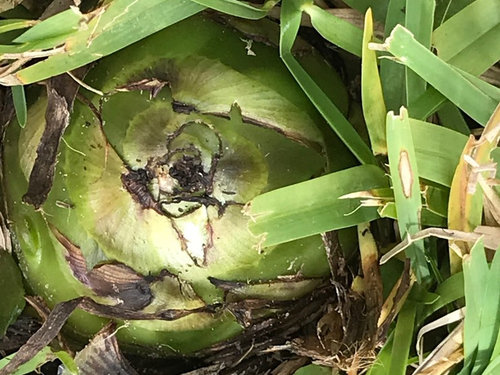
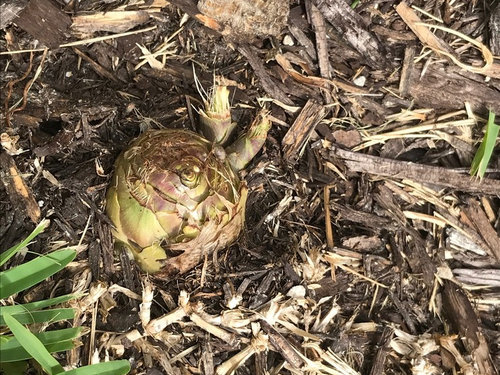
Just noticed these bulbs growing in my lawn. THis was sodded about 6 months ago. I pulled one apart and it smelled sort of like a cucumber. There are several clustered together.

What the heck are they, and how do I get rid of them?

Toxic to my dog?

Thanks


Comments (17)

  • 7 years ago
    last modified: 7 years ago

    The 2nd one reminds me of the base of a coontie plant (zamia) that's been mowed down. is it hard or soft?I have them sprouting in my yard often, brought by birds, I think. It can take them some time to develop a large base like that.

    Maybe let it grow, so the leaves can be observed, which would really help in ID-ing it.

    The first pic reminds me of a sprouting crinum bulbil - also mowed over.

    You can do an image search for those plants to see if there might be some growing nearby.

  • 7 years ago

    Thank you.

    They are quite hard. That's one thing that worries me - it would be easy to step kn and possibly twist an ankle - esp for my small dog.

  • 7 years ago

    Dig them up and put them somewhere they can grow. When they get leaves, ask again.

  • 7 years ago

    Okay I agree that it is a bulb of some sort likely left there by previous owners. Perhaps it is the mysterious cucumber bulb of Florida ;-)

    However, you have disease problem with your St Augustine. The tan spots with dark brown rings are fungal lesions. I suspect you are among the 20 million Floridians who water every day. That is wrong. Read below. Beyond that the particular disease you have ie easily cured by applying 20 pounds per 1,000 square feet of plain cornmeal. You can get it at the grocery store in 25 pound bags in the Hispanic foods section as masa or you can get it in 50-pound bags at a local feed store for about the same price as the 25-pound bag in the grocery store. You do not want corn gluten meal. That is a great fertilizer but not great for curing the fungal disease. And before someone comes along with the famous mythbuster from Oregon, just know that I have had success 16 years in a row using corn meal and the mythbuster has never tried it once.


    Watering: Deep and infrequent is the mantra for watering. This is for all turf grass all over the place. Deep means 1 inch all at one time. Put some cat food or tuna cans around the yard, and time how long it takes your sprinkler(s) to fill all the cans. Memorize that time. That will be the time you water from now on. My hose, sprinkler and water pressure takes 8 full hours to fill the cans. Your time will likely be less. I like gentle watering. As for watering frequency, that depends on the daytime air temperature. With temps in the 90s, deep water once per week. With temps in the 80s, deep water once every 2 weeks. With temps in the 70s, deep water once every 3 weeks. With temps below 70, deep water once a month. Note that you have to keep up with quickly changing temps in the spring and fall. This deep and infrequent schedule works in Phoenix and in Vermont, so it should work for you. The reason for deep and infrequent is to grow deeper, more drought resistant roots and to allow the soil to dry completely at the surface for several days before watering again. If it rains, reset your calendar to account for the rainfall.

  • 7 years ago

    THank you.

    There were no previous owners to leave anything behind. It was a lot that had been empty for at least 20 years, and a new house built on it. As for the grass, we know it's not right, and have already fired the landscaper who put it in - we have two more lined up to give us estimates to fix and maintain. It's quite a small lot, and I think most of the companies don't want to deal with anything this small. We are watering using a RainBird system, and it is set for twice a week, but with a rain sensor to stop it if there's enough rain. There are been way too much rain here.

  • 7 years ago

    They look like bulbs that may be an invasive called "chinese crown orchid"

  • 7 years ago

    I found this site on the Chinese Crown Orchid that has a picture of the bulb, and I do think that's right. It may have come in with the sod, or it may have been spread on a lawnmower. If you had dirt brought in before the sodding, it may have come in that. Anyway, it's a pretty orchid, but very invasive planted in-ground. If you'd like to keep it, dig it up and put it into a pot and cut off the seed pods before they ripen and spread everywhere.


    http://www.wildsouthflorida.com/chinese.crown.orchid.html

  • 7 years ago
    last modified: 7 years ago

    I looked it up too and the pix really do resemble the bulbs of that orchid.

    I like the idea of digging them out, potting them up and letting them grow out.

  • 7 years ago

    GP W - if you have a lot of them and want to get rid of them, I'll buy a couple from you. I'd love to have a cold-hardy orchid.

  • 7 years ago
    last modified: 7 years ago


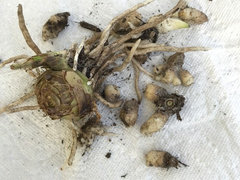
    Looks like quite the rhizome system growing there. Lots of small bulbs that look like garlic cloves. The main bulb is maybe a hair larger than a golf ball,


  • 7 years ago

    PM me. We'll make a deal on some bulblets.

  • 7 years ago
    last modified: 7 years ago


    Looks like the site only allows one photo? Can't figure out how my 2nd photo is not showing.

  • 7 years ago
    last modified: 7 years ago

    I was just thinking the same, dg. It can take a bit to load large files, and it can sometimes be hard to tell when they've finished uploading.

  • 7 years ago

    It finally allowed posting of a 2nd photo, which I posted in a separate comment. But it was not even allowing that single photo for a while. But there it is - another view. I've probably got dozens of these small bulbs now - how the heck do I get rid of them?

  • 7 years ago
    last modified: 7 years ago

    No pic again.

    But I'd say a trowel or hand hoe is your friend here...

  • 7 years ago

    You just keep digging every one that comes up. I don't think there is anything that will kill them that won't kill the grass.


    If you had new construction, they probably used fill dirt to build up the lot, which could have hundreds of them in it.