Software
Houzz Logo Print
jacoblockcuff

Soil Blocking Questions

I’m intrigued by soil blockers. They look like a neat concept! They can be a little pricy, not something I’m a fan of, but I can easily get around that by just using a pot, compacting the soil inside, and dumping it out to get a soil block. I have tested this and it works very well. I may attempt to make a soil blocker of some kind out of some scrap metal we have around.


A concern for me was that the compacted soil would not allow for much root growth, but it still seems very fluffy and loose after the block is made. I imagine this is where the quality of the mix comes in. My mix is a typical mix I use, 50/50 homemade compost (ingredients including food scraps, garden waste, lawn waste, chicken manure, leaves, straw, ash, etc.) and peat. It seems to do fine for this, but I imagine that adding some vermiculite, perlite, or sand would be even better for this, giving more aeration for the compacted soil.


To those of you with experience growing in these soil blocks, how has it panned out for you? Are they working? Are the plants liking them? Are there any real advantage s you’ve found to using these, or disadvantages? Very interested in this!


Comments (14)

  • 7 years ago

    I've always been a little confused about soil blockers. I mean, in a seedling pot or cup, you've got a soil block that just happens to have a wall around it. What's wrong with walls? What are the advantages of a block of soil without walls?

  • 7 years ago

    Well, I think it’s more of getting away from the plastic pots. I have nothing against plastic, but unless willing to shell out a bit more money, they’re very flimsy and break easily, needing replaced so often. I’m on a very limited budget and would love to avoid this. I’m also interested as to whether there’s less transplant shock not needing to be removed from a pot.

  • 7 years ago

    Large paper dixie cups work great. No flimsiness. Snip them off with scissors when ready to remove the plant, and if you have a shredder, compost them. Otherwise, throw them in the city compost or recycle bin. Soil blockers look like a gimmicky way to spend money.

  • 7 years ago

    You can also use toilet tissue rolls or cut down paper towel rolls. Completely biodegradable :-)

  • 7 years ago

    I hadn't thought about air pruning. Good point. Roots exposed to air for extended periods of time are going to die. Walls keep roots from being exposed to air. Not that you should have a lot of roots sticking out the sides, but dead roots are less useful to the plant than root-bound roots.

  • 7 years ago

    I really like my small soil blocker, I think the cubes are 3/4”. As soon as seeds sprout I move the block to a regular plastic 6-pack (leftover from buying annuals). I like it because I try unusual seeds that don’t always germinate well. This way I don’t have empty spots in my 6-packs. I also don’t damage little seedlings by pricking them out. I had a larger blocker but I gave it away - much easier to use the 6-packs.

  • 7 years ago

    Interesting in relation to the air pruning. I had read that air pruning was a GOOD thing, keeping roots from being pot bound, but I suppose I never thought of them actually dying to exposure to the air. I imagine using a mist setting on a hose attachment would keep the blocks together, but true, otherwise watering would be a PITA.

    Dan, we’ve tried the paper cups before, but we’ve often had trouble with them growing mildew and smelling awful, on the bottom. They also fell apart as they got wet. Was not happy with the results.

    Dave, might I ask what you are using instead to start seedlings?

    As I said before, I’ll probably just make a simple soil blocker. I can then trial it alongside other methods, to see the results. I would prefer to not buy the soil blockers, being a bit over my budget.

    Thanks everyone.

  • 7 years ago
    last modified: 7 years ago

    I just started using paper cups this last year, and as long as I don't try to keep them wet more than a month they seem to be fine. Now, I use seedling soil that I've sterilized, so mold and mildew are never an issue. I also don't have any problems with damping off.

    I guess having roots exposed to air does keep a plant from having pot bound roots, but it does that not by encouraging a plant to make roots that stay in the mix, but by killing off any roots that meander outside the mix.

    jacoblockcuff (z5b/6a CNTRL Missouri thanked daninthedirt (USDA 9a, HZ9, CentTX, Sunset z30, Cfa)
  • 7 years ago
    last modified: 7 years ago

    i have used soil blocks for many years. the big advantage is not having to deal with a lot of small plastic containers. soil blocks work very well to get your transplants going. you can fit 50 of the 2" blocks in a standard nursery tray which makes it convenient to use. soil blocks are good if you are starting a lot of seeds. setting the blocks out is very easy. for large scale growing, like starting a couple of hundred or more plants the only reasonable alternative is plug trays. i have used various mixes over the years. peat is important because it has long fibers which help to hold the block together. i add perlite and a small amount of fertilizer to the mix. i have also used coir. the roots also help to keep the block together. i water with a misting nozzle. if the blocks are in a tray without drainage holes then you can bottom water (fill the tray with some water). i wouldn't get into it for small scale growing.

    jacoblockcuff (z5b/6a CNTRL Missouri thanked randy41_1
  • 7 years ago

    "Dave, might I ask what you are using instead to start seedlings?"

    We use plug trays for most everything, primarily the 200s.

    Dave

    jacoblockcuff (z5b/6a CNTRL Missouri thanked digdirt2
  • PRO
    7 years ago


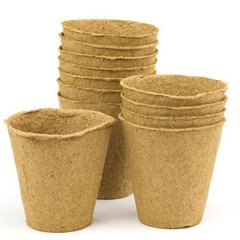
    I've always just used these bio cups. They are made of compressed peat moss. Some are made of paper. If you are trying to get rid of the plastic.

  • 7 years ago
    last modified: 7 years ago

    I purchased a soil block maker a year or two ago and just love it. I use my own mix and don't follow any sort of expensive recipe - just make something that holds together with peat, compost, planter mix etc. The secret is getting the water content right. Making the blocks themselves takes some practice, but don't most new techniques? Making them can be a lot of fun.

    I put my soil blocks in various water-holding containers/pans/trays and try to leave one corner without a block for more safely adding water. If you water from above, the blocks will disintegrate, so it's better to allow a slow stream of water to partially fill the side or corner of the container your blocks are in, and they saturate from the bottom.

    Air pruning allows the roots in your blocks to not get root bound as they often do in containers, but the roots grow very well. And the blocks separate and plant out very easily. Mine have worked very well. I currently have turnips and beets ready to go out. ...and some flower seedlings.

    I do not move my starts up into 'the next size' block - a waste of money IMO. You don't have to. Just choose a blocker of 'medium' size, and it's good for most medium seeded plants. Large seeds/seedlings such as zucchini, I still use cells, and small seeds/seedlings such as lettuce and spinach seem more efficient started in plug flats. (200s)

  • 7 years ago

    With all due respect for soil blockers, I'm still just trying to understand the benefit of soil blocks. What does it actually DO that makes life easier or plants do better? Is this about conservation of paper cups, tissue rolls, or maybe plug flats? As Randy noted above, I guess it might make sense if you're doing large scale gardening, but ...?

Sponsored
Innovative & Creative Custom Closet Designer Servicing Franklin County