Software
Houzz Logo Print
hairmetal4ever

Eucalyptus neglecta

7 years ago

Would this euc possibility be worth a try in a mid-Atlantic sone 7 location?

Comments (10)

  • 7 years ago
    last modified: 7 years ago

    While there are currently some towering examples of other species present in Seattle the one that appears to have the longest history of success in my part of USDA 8 is E. perriniana. Prior to the coldest-in-30-years 1990 winter, when this particular planting was apparently ruined one Seattle site even had this species reseeding. (Some other locations in the area still have E. perriniana that instead came through 1990).

  • 7 years ago
    last modified: 7 years ago

    Yeah there are a lot of options once you get into zone 8, especially the parts of greater Seattle that are 8b with very infrequent single digit readings.

    Or I should say a lot MORE options. It's a huge genus (and family) of course, most of which are only zn 9 hardy or less. The Angophoras are especially striking and it's too bad they aren't hardy enough for the PNW.

  • 7 years ago

    I realize that just about any southern hemisphere plant is a bit of a fool‘s errand on the East Coast, combo of winter being a bit too cold, and summer too wet.

  • 7 years ago

    This article, written by Ian Barclay (owner of Desert Northwest Nursery), may be helpful as it describes the viability of eucs grown here.....which is arguably a much easier undertaking than along the east coast. Hardy Eucalypts in the Pacific Northwest.

    One thing that should be pointed out is the propensity of many species to regrow from the root system when/if the top is damaged or killed from winter cold. And pretty darn rapidly as well!!! There is a rural property in my area that had eucs (species unknown - I have never stopped to examine) planted along the roadway as a wind break. However the wind was strong enough across the field that the trees developed a distinct lean across the road and were cut down after attaining an average height of 40-50'. Five years or so later, they have regrown to about 15', last time I saw them.

    Here on my island, it is not unsual to see large eucs. But then the climate tends to be milder here than just about anywhere else in the Puget Sound region. I still have zonal geraniums and cuphea in bloom!

  • 7 years ago
    last modified: 7 years ago

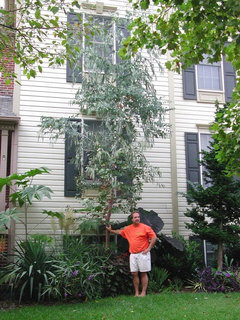
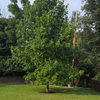
    Eucalyptus pauciflora sbsp. debeuzevillei , neglecta and perriniana would be among ones to consider. Here's a shot of E. perriniana (spinning gum) that was growing at a friend's home in Germantown, Maryland, until a windy tropical storm brought it down. It was getting mature foliage! If they do freeze down, they usually come roaring back from the lower trunk or the lignotuber. There's no sure thing with Eucs in the Mid-Atlantic though. Maybe someone will prove me wrong. Best to heavily mulch the base during cold winters. There was a nice E. parvifolia (parvula) growing in Alexandria, VA (borderline zone 7B) for many years. Not sure if it's still there.

    Photo by Boca Joe

  • 7 years ago

    I would add Eucalyptus gunnii to that list as well. And I do think it possible to grow eucs in less favorable climates, provided they be considered as dieback shrubs (almost perennials) rather than actual trees......in much the same way crape myrtles are. Root hardiness tends to be more elevated compared to any top growth.

  • 7 years ago
    last modified: 7 years ago

    The article linked to above about covers it. Note that the oldest example mentioned was one of E. perriniana. Results being gotten in this part of USDA 8 relate to the topic by showing which kinds appear to be most hardy, in a climate on the damp side most of the time. We do, of course have the opposite annual precipitation spread from the eastern States. And it's true the hot eastern summers might be more effective for maturing growth. But all species tried will still otherwise have a built in minimum temperature, below which they will fail.

  • 7 years ago
    last modified: 7 years ago

    "I realize that just about any southern hemisphere plant is a bit of a
    fool‘s errand on the East Coast, combo of winter being a bit too cold,
    and summer too wet."

    Not necessarily but one has to have realistic expectations for the very few that can do well enough to bother with. (though not as well as they would do in a place like Seattle!)

    For example, Grevillea sulphurea became a large, showy shrub in my garden from 2007-2013, when PV-I knocked it out. It is easy to layer and I should have created a 'backup' plant; that will be my future plan going forward for all plants of dubious hardiness, whether southern hemisphere origin or not. My 'Lake Te Anau' hardy Phormium amazed me by surviving the utterly hideous 'Everglades swamp summer' we had (I believe both DC and Baltimore have now hit all time yearly rainfall records!) and I believe it will be hardy enough here to eventually bloom after a string of mild winters. But, it is about ready to be divided, and again, I will keep a backup plant in my garage over winter, just in case!

    (the seed I collected in the coldest part of New Zealand has produced a red plant, which is exciting because I will now have a green and red phormium. The horticulturalist at Christchurch BG laughed when I told him Sean Hogan was saying a Lake Te Anau collection would be very hardy - saying it wasn't a very cold area. He suggested I instead look for ones near the Otago region. But the Lake Te Anau collection has been pretty tough.)

    Eucalyptus pauciflora sbsp. debeuzevillei, is probably one of the hardiest,but as with E. lacrimans, watch out for root rot. OTOH, E. parvula and E. neglecta are more disease resistant, which is why they can grow in the south. In the parts of the Snowy Mountains where the valleys are so cold no trees can grow, E. lacrimans were the ones growing right at the edge of the inverted tree line.

  • 7 years ago
    last modified: 7 years ago

    >Eucalyptus pauciflora sbsp. debeuzevillei, is probably one of the hardiest, but as with E. lacrimans, watch out for root rot<

    I have one about 30 ft. tall but the crown isn't much to look at, despite the trunk having some presence. And, yes, any of the snow gum types I wouldn't expect to be that happy in the eastern heat. Whereas spinning gum has a somewhat similar general aspect but produces juvenile leaves, the adult foliage is more abundant and substantial. As though it might have a different ecology.


0