

Help me make some hardscaping decisions!
We have had a few meetings with landscape designers and contractors over the past couple of weeks to try to develop a sensible plan for dealing with our lot and figure out how far our budget (this year) will take us. Because our backyard is currently more or less unusable, that is where we have decided to concentrate our efforts this year.
Our lot is narrow (50') and steeply sloped. The back slope was a mountain of weeds when we bought the place, and we have been working the past two years to eliminate the weeds and replace with groundcover in the areas where it is too steep to walk or mow. However, the area could really use some structural features to help give it some shape and defined planting areas. Here are overlapping photos of the whole thing, taken from the first floor window (from north to south):
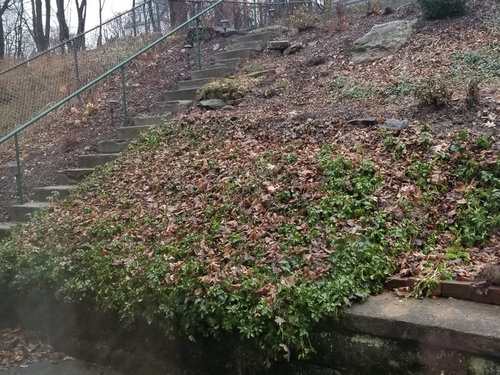
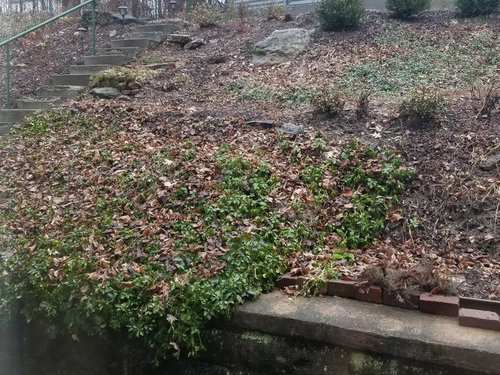
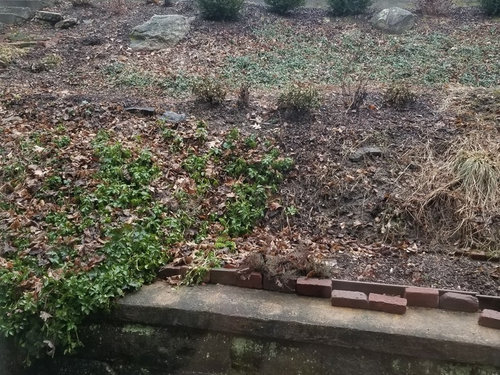
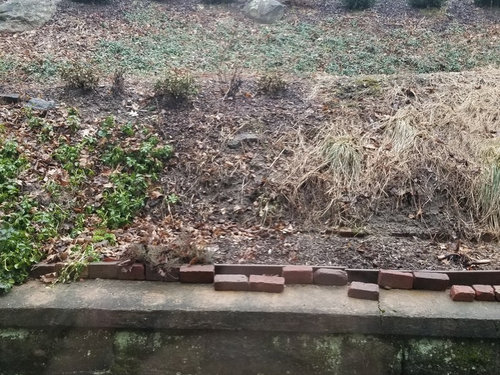
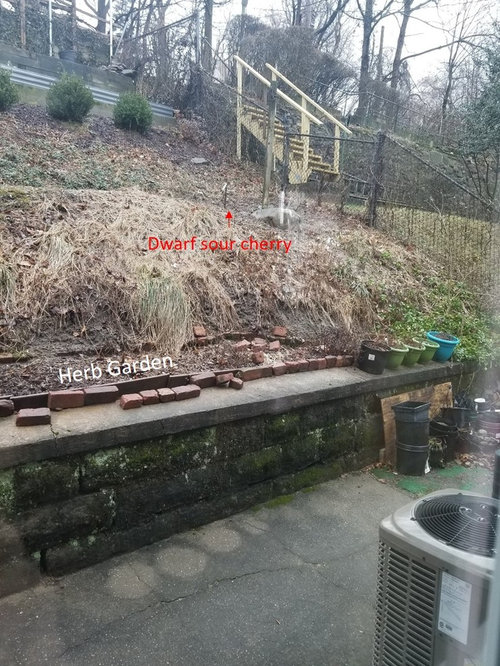
What may not be clear from these photos is that the main slope, to the right of the stairs, is actually two slopes separated by a flat area (extending from just above the pachysandra patch in the first photo, all the way to the old post and boulder in the last photo). This flat area varies in width from just about a foot behind the pachysandra to 8-9' in the middle of the yard. If I didn't need to walk on it, I would just add shrubs and vinca (or pachysandra) there as well, but I use it as a way to access the plants on the two sloped sections that I would not otherwise be able to reach.
We know for certain that we want to add a small (stone?) retaining wall to surround my herb garden (which would also provide support for that nearly-vertical section of the slope), but beyond that we aren't sure what might enhance the area. One designer suggested an additional wall as shown below, another suggested strategically placed boulders in the same area, but otherwise didn't have a lot of ideas:
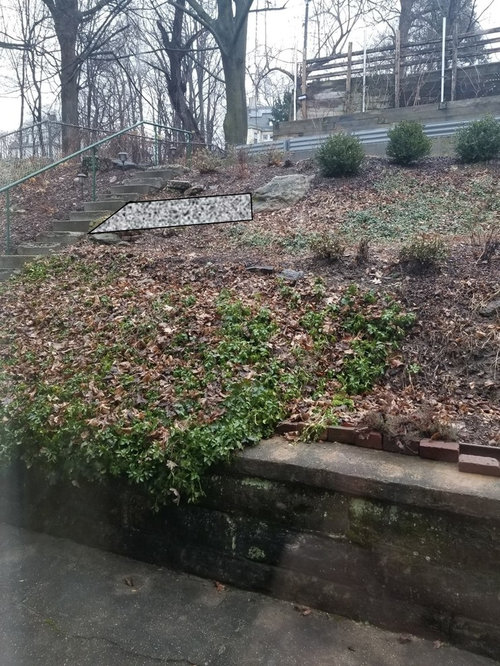
I do like the idea of a wall or boulders where suggested to define that area as a "bed," but I think I would also like to see the flat area defined somehow to make it look more purposeful. I am trying to grow a dwarf sour cherry tree near the old post (which I plan to remove, btw), but it is very slow going! Would placing a border of some type (stones, etc.) near the top of the first slope and bottom of the second slope to define the flat area and delineate a walking path look strange? Any other ideas? I am sure that the contractors can find ways to do anything I can dream up (within reason), but I am having a really tough time visualizing things that will look good and purposeful. DH is tired of looking at mulch, mud and weeds, so I would really appreciate your creativity! Thanks in advance!
Comments (14)
 7 years agolast modified: 7 years ago
Here are some Houzz photos and the last from the NY Botanical Garden:

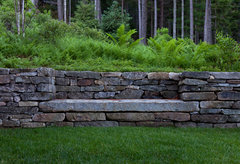
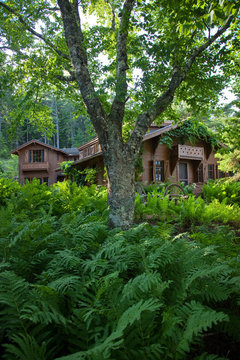
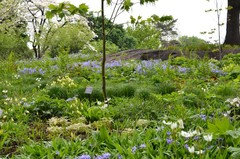
I'm not a designer and maybe I'm crazy, but I personally would start planting things that I want to look at, until the ground is covered. I am not familiar with the landscape designer who created the photos but that is the general idea. Maybe add some boulders in the area you were thinking about as a place to sit and look over the property. Leave a mown path accross the ridge/plateau you described to keep access to where you want to walk.
Notice the variety of plants and lack of clear order and lines in the first picture. It can also be simplified as shown in the second two pictures. You could pick a variety of things that flower each season and are suited to your light, soil, and climate. I would plant taller things along the perimeter and taper the height near the path and low area. Plant some mid-height plants in straight lines along areas where you want like a hedge for defined space look. Choose a plant or a few plants for every bloom season, typically spring, early summer, and late summer through fall. I would plant evergreen Rhododendrons, Calycanthus floridus "Michael Lindsey", and Comptonia peregrina along the right and left perimeters. Plant plugs of Pennsylvania sedge and violets to cover the ground, then plant taller flower perennials here and there as accents. Consult a designer for plant suggestions if you want. Avoid invasive plants. Try to find a few plants for winter interest (evergreen ferns?). You will have to maintain it, but that can be achieved by periodically weeding it and annually or bi-annually mowing. If you or your contractors do a really good job prepping the land before installing the plants, the weeding will be less. If you can get a maintenance plan from the designer, you could follow it yourself or hire the work out. I mow the lawn and/or weed mulched beds every weekend, I feel like the kind of landscape pictured above wouldn't take a lot more time to maintain. I could spend some time spot removing weeds instead of pushing a noisy lawn mower around.
Planting and prepping is going to cost a lot of money to do all at once but I would rather spend my money on plants, design and installation than hardscaping. I know many would think otherwise and go for the hardscape, but I wanted to present what else is in the realm of possibility.
biondanonima (Zone 7a Hudson Valley) thanked Skip1909biondanonima (Zone 7a Hudson Valley)
Original Author7 years agoThanks Skip. I love the inspiration photos you posted. I have actually been adding plants for the past couple of seasons, but there is a lot of space to fill, and anything that isn't covered with cardboard and mulch sprouts weeds instantly. The designers I have spoken with have all advised that we get hardscaping in place before planting, and to be honest (since I am not a pro!) I am having a hard time visualizing how to arrange even plants I know I love without any defined areas. I'm also worried about erosion in some places, although I think the wall behind the herb garden will take care of the most problematic spot. I just don't want to spend a fortune on plants without a clear plan as to where they should go and how to create focal points within the currently amorphous slope masses.
Related Professionals
Hagerstown Landscape Architects & Landscape Designers · Murfreesboro Landscape Architects & Landscape Designers · Newark Landscape Architects & Landscape Designers · Lubbock Landscape Architects & Landscape Designers · Mount Vernon Landscape Contractors · Fort Worth Landscape Contractors · Victoria Landscape Contractors · Kankakee Landscape Contractors · Fergus Falls Landscape Contractors · Tucson Landscape Contractors · Aberdeen Decks, Patios & Outdoor Enclosures · Frederick Decks, Patios & Outdoor Enclosures · Manhattan Decks, Patios & Outdoor Enclosures · Newport Decks, Patios & Outdoor Enclosures · Reno Decks, Patios & Outdoor Enclosures PRO7 years ago
Generally with big slopes like that I recommend a looping path and if there's a feature area, to be as cost efficient as possible. That way you have a safe way to get around on the slope and can have fun with interesting plants, and it creates a focal point and some purpose to the area. The reason I usually advise against investing a lot in a "destination" area is that most people will never use it. It's 7 pm on a Saturday, are you going to sit outside the back door or will you walk your wineglass up 16 steps so you can look down on your neighbor as he burns his bratwurst?
biondanonima (Zone 7a Hudson Valley) thanked Revolutionary Gardensbiondanonima (Zone 7a Hudson Valley)
Original Author7 years agoLol, I said the same thing to my husband! He was talking about putting a little seating area halfway up the stairs on the left, where there is a natural plateau, and I said dude, are you really going to walk up a flight of stairs just sit up there where all the neighbors can see you? Nope.
Unfortunately our slopes are too steep to put in a looping path without significant regrading and probably retaining walls. Here is a photo of the flat area that divides them - it's a bit hard to tell because of the camera angle, but the spot where you step off the stairs is less than 2' wide, then widens to a max of maybe 8' before you get to the pole and boulder: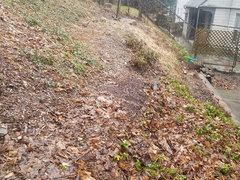
DH especially hates this area because it is so brown and there is no clear visual border delineating the change of plane from flat to hill. I have considered a stone border along the base of the hill on the left (which might also help keep the vinca from creeping down too far), but I think a similar border on the right might just look weird. Maybe I should just go try it out with some of the rocks we have lying around and see? Eventually I plan to plant it with creeping thyme or another walkable ground cover but I am trying to work out a path or other idea first.
To further complicate this area, there is a steep drop into the pachysandra patch on the right just as you step off the stairs onto the flat. I feel like that area could stand to be widened (which would happen if we put in the proposed decorative wall), but also maybe supported on the right side - perhaps boulders would work well there to provide support? Just having a hard time visualizing the possibilities. PRO7 years ago
Other than maintaining the existence of a flat path halfway up the hill, having an herb garden and dwarf cherry tree, what are the goals & objectives? I'm not asking in terms of how they would be solved, but what is the raw list? Also, why is the herb garden where it is?
biondanonima (Zone 7a Hudson Valley) thanked Yardvaarkbiondanonima (Zone 7a Hudson Valley)
Original Author7 years agoThe goals for this space are for it not to be a shitshow, LOL. Seriously, though - the backyard is our view from our kitchen and dining room windows (plus a clear view from the living room), so I want it to look reasonably nice year round. I also want it to look nice from the back patio, where I barbecue and where we plan to add a seating area/firepit this year. The herb garden is where it is because it is just a few feet away from the kitchen door. I could use the beds at the top of the hill for herbs instead, but to be honest, I am too lazy to climb the stairs every time I want to run out and grab a few sprigs of rosemary. I have the beds at the top planted with things like garlic, blueberries, tomatoes, peppers, etc., that aren't going to be needed at a moment's notice (or after dark, which herbs often are - we eat dinner late).
As for the flat path, I want to maintain it because without it I would have no way of reaching any of the plants on the upper slope. It is part of a naturally-occurring ridge (if you could see the neighboring properties to the south you'd see that it runs down the entire block) and we feel like messing with it is probably just asking for trouble. I planted the cherry tree at the far end because 1) I am a Michigan girl and I love sour cherries!; and 2) I felt like it would be nice to have a "destination" on that flat area to make it feel more purposeful.
Otherwise, my goals are to prevent or remedy any erosion issues and stabilize the slopes/flat area as necessary, eliminate weeds, get the steepest areas planted with a ground cover that will not require mowing, and use the most visible and accessible areas to grow ornamental and/or edible plants that I enjoy. 7 years ago
I lived in a similar home with a steep slope that ran up off the back patio. The slope was planted with a flowering ground cover and a few small trees plus a dense hedge at the top of the slope. I added plants that spilled over the wall and kept pots of flowers on the retaining wall ledge. I didn't own the house long enough to make major changes but I really liked the set-up because it provided great privacy, looked attractive from the house and was low-maintenance.
If I had stayed I would have added more shrubs and bulbs for texture, although it was the the ground cover that made the slope work. A yard that rises up and away from the house really can be fabulous with the right planting scheme. Good luck with your project.biondanonima (Zone 7a Hudson Valley) thanked einportlandorbiondanonima (Zone 7a Hudson Valley)
Original Author7 years agoThank you Yardvaark - that is very helpful! Our goals as you stated them are correct, although I am not opposed to certain kinds of maintenance (deadheading, etc.). What I don't want is anything that will need to be mowed or cut back regularly, especially on the slopes. They are simply too steep.
Anyway, to elaborate on your (very astute) observations, I agree that the hedge and two groundcover patches are the best looking parts of the yard right now. We installed the hedge to hide the ugly wall and beds behind it and define the top of the yard and as you said, as it grows it will do a great job of that (I do plan to replace the two non-matching shrubs in the hedge this summer - DH thought we needed variety but IMO it will look better to have all boxwoods up there). The pachysandra patch (circled in green) was there when we bought the house, and except for the fact that it is getting overrun with Bishop's weed (a situation I hope to correct this year) I like the way it looks. The vinca on the top slope (circled in blue) is something I installed after killing off the mixture of weeds that used to cover that area. It is still developing and requires weeding but I think it will eventually fill in, although for some reason it doesn't seem to like that far left side of the yard circled in white. I was considering adding some shrubs there along the fence to see if they would do better than the vinca.
As for the rest of the white areas, the small one near the stairs (not so small in reality, it's probably 10'x12') is actually one of the nicer "gardening" areas of the yard because it is naturally a little less sloped than the rest of the yard, and easily accessed by the stairs. I have been trying to create a nice bed with azaleas, salvia, some bulbs, etc. up there, and it does look decent in the summer. I would definitely like to continue to improve this area, and I think the small wall suggested by the pros would define it nicely and make it even a bit more level (and easier to work on).
The small white square at the bottom right is a hot mess right now because that section of the patio is unpaved dirt. The previous owners had rocks piled up haphazardly and a hydrangea weirdly planted in a corner, etc. - we dug all of that out this fall and are planning to finish that section of the patio with some sort of impermeable surface, either pavers or decomposed granite (I have another thread going on this topic right now; suggestions are welcome!).
As for your large white circle, it encompasses three very distinct areas - the flat area separating the slopes, the very steep lower slope behind the herb garden, and the herb garden itself. The herb garden will remain where it is, but I agree with you that the bricks lining it look terrible and something nicer-looking needs to be done to define it. Given that the slope behind it is SUPER steep and a lot of dirt erodes from it into the garden, I am hoping that a short wall behind it (made of material that complements the existing wall) will solve the erosion issue and make it easier to plant whatever remains of the slope with groundcover. Here's an update to your drawing, with the herb garden outlined in pink, a rough sketch of a potential new wall in brown, and the flat area blacked out. The remaining areas outlined in white are all that would be left of the steep slopes.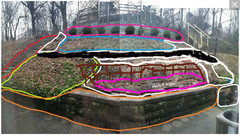
Anyway, perhaps I am trying too hard to create "structure" where none really needs to exist in this yard. The two proposed walls would solve the most worrisome areas of erosion and define two gardening areas - maybe I don't need more. I do think defining the change of plane between slope and flat would look nice, but perhaps I'm overthinking it - presumably a stone border or something along those lines could be installed after we get other solutions in place anyway. I think my fear here is doing something permanent (or at least expensive enough that I don't want to undo it!) that would preclude me from doing something better/more necessary in the future.- PRO7 years agolast modified: 7 years ago
In my view, building a retaining wall in order to sequester the herb garden from the overall slopes running through the yard, is visually disruptive and immediately works against your goal of improved appearance. It looks to me to be along the lines of "taking a bite" out of the yard. I think it would be better to maintain the flow of grade that was originally established, and perfect it at places.
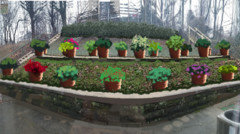
It's not a pat plan/solution that I'm offering, but rather a scheme. Usually, in order to garden on a slope, one makes terraces so as to minimize erosion, and for practical reasons, to have a level space on which to walk. A compromise to that would be to incorporate raised "containers" that are level/plumb that can be reached from the two level places that are already established: patio & upper terrace. Raised containers would need to be embedded securely enough so as not to tilt throughout their life span. In order to make growing easier, they would be open to the soil below and anchored such that their lower portion prevents or strongly discourages invasion by the roots of surrounding groundcover.
Such a scheme could be incorporated in any number of ways insofar as decor, size, placement and arrangement is concerned. In my sketch I'm suggesting a scheme that uses ready-made large clay pots. (They would probably need to sit on a special made, tubular base that is embedded in the ground.) They are arranged to edge the patio, widely spaced. They would also edge the the fore and aft edges of the upper terrace in the same wide spacing. In spite of that suggestion, planters could be devised of many different materials or containers. They could be matched or they could be all different (but of a flavor), depending on the desires of designer.
Such a scheme would allow the growth of many different gardening plants -- herbs, flowers, perennials, etc. -- yet provide an easy way to keep them separated from groundcovers. Too, it would be versatile, allowing for the square footage of growing space that suits the owners needs and for tending without disruption of the surroundings.
The outer edge of the upper terrace could be refined with a solid curb, spanning the width of the yard, extending from the steps.
The steps could be flanked with low cheekwalls in order to refine them to be closer in character to the retaining wall that borders the patio.
Another advantage is that this raised planter scheme would allow for beginning slowly, testing the waters to make sure that the chosen solution is solid, prior to expanding it. And then it could expand as quickly or slowly as was desired, with few or many.
Again, the picture is just one version of this idea. open to innumerable variations.
 biondanonima (Zone 7a Hudson Valley) thanked Yardvaark
biondanonima (Zone 7a Hudson Valley)
Original Author7 years agoYardvaark, thank you so much for these ideas. I agree with you the herb garden sort of "takes a bite" out of the yard, but to be honest, I rather like having something that breaks up the monotony of the slopes. That area was also chosen for herbs because of the sun patterns in the yard - shadows from the neighboring houses and trees, etc. creep in from the corners to the center, so the outermost edges of the yard really don't get enough sun for things like basil. If we do put a low wall there, we would probably center it between the stairs and fence and flank it with symmetrical beds of pachysandra on both sides to make it look cohesive.
I do love the idea of planters on the flat portion, though, as a way to define that area better. I have played around with various plants on the downhill edge, but they always just look as though they were stuck on the edge of a precipice randomly. Using planters that are actually anchored somehow could be a very elegant solution! I will have to experiment with that when the ground softens up and talk to whichever pro we decide to work with about the possibility/cost of a curb along the ridge.
As for the stairs, I agree a cheekwall would look nice. I actually meant to ask one of the designers if there was an affordable way to widen those stairs a bit and/or cap them to protect them from further water damage, because they are in pretty rough shape and very narrow (maybe 2.5' wide). Any advice you might have for an affordable solution would be quite welcome - there are a LOT of stairs there! Thank you again!- PRO7 years ago
I think the easiest way to go wrong with planters incorporated into the yard is to make them too small. I'm thinking the smallest should be 30" or 3'. No harm in going larger. other than they're harder to handle. I did something similar in my own yard once, as I had a fairly steep bank that flanked the street. It was a single large planter ... a "bottomless" 5' diameter bowl made (by me) of reinforced concrete. It was set on a separate, hidden "foundation." (It looked great filled to the brim with tulips.)
biondanonima (Zone 7a Hudson Valley)
Original Author7 years agoI will keep that in mind. The flat area is quite shallow in places so I will likely have to look for longer but narrow vessels to get a size that looks good in proportion to the overall yard, but that should be doable. Now to decide what to do about the patio... :)
- PRO7 years ago
We are describing the herb garden area very differently. Me: "a disruption to the established flow." You: "breaks up the monotony of the slope." I think the more it is developed, especially by being surrounded or backed up with a wall, the more it will look like an artificial contrivance imposed on an area. Consider that more embedded "planters" could be incorporated into an area if it's necessary for practical reasons. It would just be made part of the design. Since we're at odds here, logic has it that only one -- or none -- of us will be right about how this goes.



Yardvaark