Software
Houzz Logo Print
mc510

Plants to grow up in a (dead) tree?

7 years ago
last modified: 7 years ago

I've got an 8 foot, totally dead weeping cherry tree that has a bushy tangle of dead branches at the top. It's crossed my mind to try to get some plants growing in the tangle, by tying up some big wads of dried moss to root plants in. I've seen this in Hawaii and South Florida with orchids, but my climate is not consistently damp enough and I don't want to have to water twice a day, every day. Any thoughts about plants that would work for this, that would be a bit tougher than an orchid, could survive an occasional week without being watered? Spider plant comes to mind and I'll try some, but something a bit more colorful would be nice. Tree-top is pretty much in full sun; weather here (on SF Bay) is mild, no freezing temps in winter, nothing above 75-80F in the summer. Thanks for ideas!

Comments (7)

  • 7 years ago

    I had a similar situation with a dead Cercis canadensis. I planted a Clematis montana at the base and it grew up the trunk and through the crown and finally filled up the crown. When it bloomed it was amazing - as if the tree was alive and was covered with white blossoms. One day the tree finally decayed enough and fell over. That was that!


    You could try tillandsias - I am 9b in Petaluma and I really can only grow them in my greenhouse, so it depends where you are. It sounds like you'd be ok.

  • 7 years ago

    There's a tree in West LA where a Lantana has done this. It's beautiful. Any twining vine ought to work, I would think?

  • 7 years ago

    Ok now I’m hooked on the idea. But the two dead weeping hemlocks I have in mind are not in an area that I water. Could clematis survive on their own? If not, what would?

  • 7 years ago
    last modified: 7 years ago

    Ah, clematis; I neglected to mention that I'm (vaguely) intending to approach this from the top and the bottom ... it did occur to me that a clematis might be a good approach from the bottom, especially since the soil is totally shaded ... buuuut, I've no experience with clematis and have a vague impression that they get big, and this is a small tree and I don't want to have to constantly hack back at a vine (my kids will quote me as saying that vines are evil). Any advice on selecting a small clematis?

    From the top, I want to get something growing in the branches as described in my original post, to improve the look while awaiting growth from below, and in case growth from below doesn't take off. Hoping to get some thoughts about plants and techniques.

  • 7 years ago

    You could easily find a Clematis that would grow neatly on an 8 foot tree. Most don't need 'hacking back'. What they need is routine pruning which is easy and only needed once a year. If you find vines 'evil' there's been a misunderstanding somewhere in your gardening past. Many vines are garden classics which I, for one, wouldn't be without. Btw if the cherry really is a tangle, you might want to thin it out to leave a less congested framework for your climber.

  • 7 years ago

    Hi everyone.


    mc510 - As you've posted on a bromeliad site, I imagine you are after suitable bromeliads that would grow on your tree and yet in the responses so far many other plants are mentioned except bromeliads.


    My answer is based on bromeliads, and as you may or may not know most of these plants are epiphytes (They grow naturally on trees in nature) so they would be ideal for the situation you describe.


    I have several friends who grow bromeliads mounted on both living and dead trees and they seem to do equally well on both. The best way to mount them is to get a new offset (Pup) that is just starting to grow roots and tie this directly to the bark of the tree in such a way that it can't move.


    If you mount it with moss or some other type of mix behind it the roots, it will in preference grow into this instead of growing onto the tree so you're better off tying it directly to the tree. It must be tied directly and very firmly so there is no movement whatsoever because if it can move the new roots won't attach to the tree and will constantly be broken off, so it MUST BE TIED FIRMLY.


    It will also need to be regularly watered initially until the roots are attached to the tree, and always make sue that the centre vase of the bromeliad has water in it also. Remember that any plants mounted on a tree or any other object will dry out much quicker than plants growing in pots and will need to be watered more often.


    Once the roots are attached to the tree and the plant is well established, it can go without water more often and can survive on just the water it gets coming from the rain or dew, but you must keep water in the central vase. The reason for this is that this vase also traps bits of debris, broken leaves, small animal droppings and dead insects which all rot own in the water to create a weak liquid fertiliser which the plant can absorb continually.


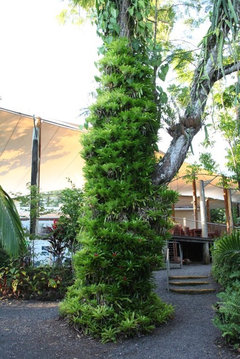
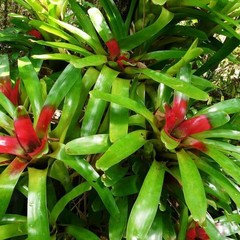
    Many bromeliads are suitable candidates for mounting, but three that do exceptionally well are Neoregelia compacta, Aechmea fasciata and Aechmea nudicaulis. Neoregelia compacta has been know to grow rampant up a tree to a height of thirty feet (see Pic.1), but it's easily controlled.


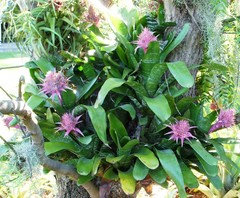
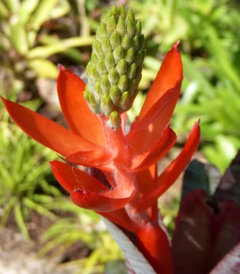
    I have Ae fasciata growing in an old half dead Peppercorn Tree and it flowers regularly every year (See pic.3.) I also have an Aechmea nudicaulis growing well on a Golden Robinia tree. (Pic 4) Also shown below is a picture of Neo. compacta when in full colour (Pic.2)


    Neoregelia compacta growing up a large tree, unfortunately it isn't in full colour


    Neoregelia compacta


    Aechmea fasciata growing in my Peppercorn Tree


    Aechmea nudicaulis 'Costa Rica' showing the brilliantly coloured flowers and bracts.


    I hope this helps you to decide what to do.


    All the best, Nev.