Software
Houzz Logo Print
julie_sanfilippo25

Looking for advice with repotting into gritty mix

7 years ago

HI everyone,

I have read and stalked the threads about Al's gritty mix, and have started switching my plants over to this. So far I have had great success! I actually like watering more, because it takes less time surprisingly, and I'm not panicking over if I am over watering my plants! I used some of my smaller plants as guinea pigs, and now am looking at moving onto some of my more "picky" plants. I'm looking for people's experiences with a few things. I'm using the 1:1:1 mix.

1. Did you find that you potted down when you moved to gritty mix? I most likely potted up too fast in my ignorance, and am finding I am putting plants into 1-2 inch smaller pots now. Is there some sort of guideline I could implement for gauging pot size needs?

2. Any tips on Ficus elastica, or Calathea? I know these can be more sensitive plants, and I'm hesitating on just bare rooting them, and going right into the gritty mix.

3. For plants like Calathea that tend to like to be "moister", should I consider adding more turface or pine bark fines?

Thanks in advance for your feedback!

Comments (9)

  • 7 years ago

    Thank you for the info! I am trying to avoid the weight issues with the mix and bigger pots. But that gives me reassurance! My ficus must be the anti-ficus, I find it to be so temperamental! I think the light conditions in my house are not quite as bright as I thought, so I now have it under lights and it seems to be happier. I may try to add a little more turface into the 1:1:1 for the calathea, and see how it goes! It's not a pretty plant right now because I don't even have it in the "right" potting soil- not enough drainage- but I chalk that up to my inexperience.

  • 7 years ago
    last modified: 7 years ago

    You're very welcome.

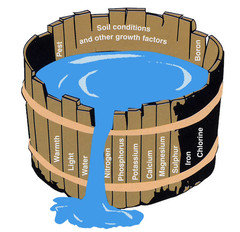
    Why a plant might seem temperamental: Liebig's law of the minimum is an agricultural principle that came into being as a way to quantify how deficiencies of individual nutrients affects plant growth/ health/ yields. In essence, it's a way of restating that the strength of a chain is determined by its weakest link. As it relates to plants, it shows that growth/ health/ yields are not determined by the sum of the resources available, but by the resource that is most deficient. The principle is most often illustrated as an upright barrel with staves of varying hts representing individual nutrients. The principle states that the nutrient that is most deficient is the one limiting the plant. It has since been expanded to include cultural influences, like light levels, temperature, soil conditions, .....


    Using the image, you can see that making perfect every factor other than the nitrogen deficiency causing the limitation cannot fix the problem. The N deficiency still remains as the limiting factor. If you fix the N deficiency w/o fixing the other issues, you can see that either warmth or a scarcity of boron will next become the limiting factor. Every factor that affects growth/ health/ yields must be such that it does not stress the plant to the point it's growing at or near the limits it's genetically programmed to tolerate. Mother Nature always sides with the hidden flaw, so if there's something you're not watching over, you can bet she knows about it and it will affect your plant.

    The good news is, if we exclude cacti and the carnivores, terrestrial plants like pretty much the same conditions when they are growing. Temps in the 70-85* range, roughly the same fertility ratio with a few exceptions, a medium that is never wet/soggy and provides a moist/damp home for roots, and favorable light. The thing that makes it most difficult to keep things in the plants' sweet spot is an uncooperative soil that works at cross purposes to your goals. Once you get the medium right, the rest quickly falls into place and becomes remarkably easy.

    It's unfortunate that 9 of 10 of us had to learn that the hard way - from our failures and mistakes. Now though, the information is so readily available that a grower exposed to the idea that how a medium is structured can hold the key to maximizing the personal satisfaction we all get from nurturing our plants .... or eating them, can be learned very quickly.

    Al

  • 7 years ago
    I consider myself lucky that I came across these discussions early on in my plant growing foray. It makes so much sense to me, but I also don't have such a large collection that the time commitment is daunting. I love soaking in all the info!
  • 7 years ago

    i would add more bark or turface for plants that like it moister, especially if you are a lazy waterer :). I have had to do this for my gritty mix. I am in hot hot texas though and very lazy.

  • 7 years ago
    last modified: 7 years ago

    The closer you look at the gritty mix, the more you understand that everything that goes into it, or doesn't, is done/not done for specific reasons. The bark fraction is screened and limited to 1/3 or less of the medium's o/a volume to prevent collapse of the soil structure. The primary reasons one would to make/use gritty mix is because it's extremely stable and lacks ability to support a perched water column. Bark breaks down over time, albeit slowly. Limiting the bark fraction to 1/3 or less of the o/a volume ensures that as it breaks down, there will never be enough small particles to fill/clog the large pores between the screened soil particles to the degree it supports a perched water table.

    It would be better to add a measure of screened internally porous material that is stable. Turface (as you mentioned), pumice, calcined DE, are examples. I should also mention that adding fine ingredients (peat, coir, sand, compost, ....) to increase water retention would also entirely defeat the purpose of making/using the gritty mix or any medium that doesn't support perched water.

    Al

  • 7 years ago
    Would pumice hold water similar to turface?
  • 7 years ago

    not really pumice and turface are different in that aspect. pumice is more equatable to perlite, and turface is a clay substitute so think of it more like kitty litter.

  • 7 years ago

    Pumice holds varying amounts of water because the conditions under which pumice comes into existence (shot out of a volcano) are highly variable, and there are variances in the chemical composition as well. Pumice holds somewhere around 3-4 times its weight in water. Turface holds about it's weight in water, but Turface has a much greater bulk density than pumice. In short, you'd need to do some simple experiments to determine how much difference there is between the Turface and pumice you might be using.

    Al