

Geothermal heating and cooling
I know this is for design advice, but I was wondering what people's thoughts were on geothermal heating and cooling? I will be building a house in Missouri and was wondering if anyone has geothermal heating and cooling and would recommend it? Is it worth putting in since I am starting from scratch? I'm struggling with what my best most energy efficient choice.
Comments (73)
 7 years ago
Springtime,
I am in central NJ. My winter design temperature is about 10F degrees. Tell me what COP I should use and I will redo the calculation again. I understand some ductless heat pumps (mini splits) have high COP values. But we are debating geothermal (ground sourced) heat pumps.
My electric rates are not bad compared what people are paying in New York City and Long Island. Electric rates are high and gas rates are low in the North East and Mid-Atlantic region. This is why home builds in these regions continue to install gas furnaces for heating.
- 7 years ago
“brad smith, I believe fsq is/was a salesman for or employed by a company that sold ground source heat pump systems and his comments at times were something less than objective. Check out any potential biases before pursuing his advice. If I'm mistaken, please speak up and I will apologize.”
Elmer J Fudd
Not that I have to answer to anyone on this forum… (Perhaps only a moderator)
Yes I do work in the HVAC field as a geothermal consultant, at times representing individuals, HVAC companies and drillers. I have consulted on geothermal projects that have included schools, hospitals, municipal skating arenas, municipal garages and municipal swimming pools. I have been trained in this field (figuratively & literally).
Does this make me a heretic?
I am but one more, just another voice on this forum – that’s it, “another country heard from”!
Please re-read above posts where I wrote:
“However, you have to do your own research and independently come to your own conclusions on what’s right for you and your situation.”
“I could e-mail you the contact info for an excellent geothermal installer in your area. There’s nothing in this for me.”
I usually end my posts with, “IMPO”, that in my case means, “In My Professional Opinion”.
Take it with a grain of salt, do your own investigation and research. Speak to many people; learn as much as you can. “Come to your own conclusions on what’s right for you and your situation.”
I’ve helped many people switch off of fossil fuels – including myself. My (environmental) conscience is quite clear.
I DO NOT SEEK ANY BUSINESS FROM THIS FORUM.
(That is why I have not registered as a ‘Pro’)
IMPO
SR
Related Professionals
Richmond General Contractors · Ottumwa General Contractors · Sheboygan General Contractors · Lexington Home Remodeling · Binghamton Home Remodeling · San Francisco Bathroom Remodelers · Worthington Architects & Building Designers · Show Low Architects & Building Designers · Bismarck Architects & Building Designers · Tacoma Architects & Building Designers · Evanston Architects & Building Designers · Buffalo Design-Build Firms · Pierre Design-Build Firms · Shreveport Home Builders · Syracuse Home Builders PRO7 years agolast modified: 7 years ago
Woops, my bad. The calculator assumes COP 2.93 (293% efficiency) for Maine. I wouldn't bump that too much higher for NJ without equipment options in hand. I think with some of the newest Mitsubishi or Fujitsu equipment you would experience moderately higher COP for most of the year but it's the design temperature that could cause problems. NJ is one of those eleven states I mentioned where gas still beats ductless heat pumps for heating but when you consider the year-round benefits of high efficiency heat pumps, the choice is not so obvious.
If you are planning an efficient envelope and still have the budget for GSHP, a PV system is generally the better investment.
 PRO7 years ago
Since this is such a complex question, hire an energy consultant familiar with your local rates and tax incentives to help you spend your money wisely to get the most energy efficient home for your dollar. You may find there are much less expensive ways to build green.
- 7 years ago
Summit, This sounds like a good idea. Where would one find such an individual or service?
- 7 years ago
I spray foamed the hell out of the house, even under the basement slab. Total envelope I believe they call it. Got good quality Anderson 400 windows throughout. Got an amazing score on blower door test, but somehow the geothermal system is an energy hog. It never uses the plenum/auxiliary backup, run times appear normal, and the house is as solidly well built as they come. I have purchased a fancy gizmo from Amazon that attaches to the breaker panel to measure exactly what each circuit uses. Can't wait to nail this down definitively.
 7 years agolast modified: 7 years ago
"Does this make me a heretic?"
No, it makes you a person with an obvious bias that you don't mention in your comments. Compare these two statements, first how you said it, second, how it might be.
"We have geothermal in our home for 15+ years and like it; would recommend it",
versus
"I am employed as a geothermal consultant. We have geothermal in our home for 15+ - years and like it; would recommend it. "
I promise you, the message received and most readers' reactions to these two alternatives are very different.
Another question I have about your comments. When you said
"I’ve helped many people switch off of fossil fuels"
Besides the obvious emotional appeal of this comment to some readers, other than homes with a large and expensive solar panel installation, where in the US is electricity available with no fossil fuel generation component?
- PRO7 years ago
Homechef59 I live and work near Boulder Co where energy requirements are extremely restrictive. Fortunately, we have a plethora of excellent energy consultants. Look for HERs raters or residential energy consultants. The department of energy may have resources as well. It's important to use someone who is familiar with the local climate, resources, rates etc.
Taconichills... something sounds wrong with your system. I hope you figure it out. - 7 years ago
I may be wrong, but I think it will be difficult to find a residential energy consultant to advise you what HVAC system you should install in your new home. The residential consultants are typically energy auditors whose goal is to find energy loss and sell you either insulation or a more efficient system. It is hard to make a living just selling consultant services to homeowners without selling something else. If they will be biased to sell what they have to offer.
I do think there are commercial energy consultants. You would be better off finding one of those who can also consultant on residential equipment.
- 7 years agoWhen you consider your electric rates, ask your utility if they offer a heat rate. We have a separate meter for the geothermal system that is charged at a much lower rate than the rest of our electric usage. Between low electric cost and no natural gas ( only higher cost propane), geothermal is almost a no-brainer for us. We retrofitted it into a six year old house in Iowa with forced air so I can compare two systems. Besides cost savings, our house is more comfortable, especially in the summer. The geo system has longer run times at a more moderate temperature so we don’t experience noticeable fluctuations in room temperature.
- 7 years ago
"We have geothermal in our home for 15+ years and like it; would recommend it",
versus
"I am employed as a geothermal consultant. We have geothermal in our home for 15+ - years and like it; would recommend it. "
I see little difference. For the sake of this forum, I am like any other homeowner/consumer. It should be assumed we might all have a bias; it is an opinion forum.
I do have a bias but that doesn’t mean that my preferred technology is right for every situation. I prefer when people at least give it a thought but it can be rejected for any reason.
I don’t understand this hand wringing over how electricity is generated. Build your envelope as energy efficient as possible so that the smallest capacity system can be installed, hopefully something energy efficient. Most of us will not forgo the comfort of air-conditioning, refrigeration or hot water to use even less energy.
I wouldn’t care beyond that – just my personal biased opinion.
SR
- 7 years ago
tacoichills:
“ It never uses the plenum/auxiliary backup, run times appear normal”
Of course compressors use a lot of energy. So how do you know it’s an energy hog?
Has it always been like this or has your consumption changed?
Have you had your installer verify the efficiency of the system?
As you know it, what are the details of your system and house, particularly your ground heat exchanger (ground loops)?
SR
- 7 years agolast modified: 7 years ago
" I see little difference. "
That's surprising but I'll believe you. In return, you can believe me, many other people DO see a difference.
" I don’t understand this hand wringing over how electricity is generated. "
It was YOU who said:
" "I’ve helped many people switch off of fossil fuels" "
I commented to point out that absent a large home solar cell system, this is untrue puffery. Call it "salesman's hype" if you like that better, saying what is not strictly true in an effort to convince someone of a product's virtues.
- PRO7 years agolast modified: 7 years ago
A home doesn't need a PV system to participate in the increasingly renewable electric grid. Using electric grid which currently has ~20% renewable input, is better than the gas grid which is 0% renewable.
- 7 years agolast modified: 7 years ago
I did the crunched numbers for our house 90,000BTU heating [zone 5A 4T 3,800 sq ft], the only way it will make sense if we install it our-self and pay for the horizontal loop installation. Because tranquility + pressure center + 4x600ft of pipe = 10k + loops 4k +1k misc = 15k - ~30% = 11k. I don't see how math works-out $29,000 - $35,000. GHP - will fail in about 14 or 15 year anyway, and we know it is going to have problems after about 11 years. No equipment last forever.
 7 years ago
Unless you are really committed to reducing your personal carbon footprint, Geothermal is rarely a good investment. It is very expensive and complex to install (properly); It may or may not be less espensive to run that natural gas; And it can be horrendously expensive to repair (and it will fail eventually).
- PRO7 years agolast modified: 7 years ago
I agree the investment is questionable but think GSHP components will last longer than conventional heat pumps. 20-30 years with minor maintenance is possible with some systems. When there is a failure, it's usually replaceable parts. Ground loops, the most expensive add-on for GSHP, could last hundreds of years.
Commercial projects caring little about their carbon footprint sometimes choose GSHP when the developer assumes operational costs and long term ownership. It's generally a tougher case for residential, especially with dropping costs of PV and increasing performance of air source heat pumps.
- 7 years agolast modified: 7 years ago
Ground loops often fail.
Installing a ground source heat pump to save money isn't very different from, is aimed at the same market as and often offers the same uneconomical proposition as buying a $90k+ Tesla. .
The salesmen and contractors of less than expected ethics are the ones touting "a possible" return on investment when they know darn well there's more likely to be a net cost. And a large one. In my experience, people spend money on both so that they can talk about them. And they often do. In constrast, when was the last time someone started talking about their new water heater or an air source heat pump?
Speaking of air source heat pumps, as is well known, they're in wide use because their relatively affordable acquisition costs and reasonable performance makes them attractive in many areas where gas isn't available.
- 7 years ago
Re BT:
“I did the crunched numbers for our house 90,000BTU heating [zone 5A 4T 3,800 sq ft], the only way it will make sense if we install it our-self and pay for the horizontal loop installation. Because tranquility + pressure center + 4x600ft of pipe = 10k + loops 4k +1k misc = 15k - ~30% = 11k. I don't see how math works-out $29,000 - $35,000.”
The difference in price is what you pay for the labour, machinery and most of all the expertise and experience of a well-trained professional to design, install, commission (startup) and guarantee the installation.
I won’t talk about the economics for you to install a geothermal system, that’s for you to decide but I will tell you something about installing ground loops. The cost is enormous for the contractor/driller to pull up to your house with in some cases what is a Million Dollars or more worth of drilling and other equipment, such as semi tractor-trailer trucks for transport of drill rigs and excavation equipment as well as pumps, grouting equipment and massive compressors. The cost of purchase, finance, maintenance, fuel, insurance and trained personnel is sky- high. In addition to that, being pulled over, detained and heavily fined for every nonfunctioning signal or broken taillight.
Then there is the risk every time you put a drill bit into the ground. Imagine the sheer force and strain required to extract and recover a drill bit that is down-hole 450ft in the rock with the suction of the mud that has closed in on it. Loose that bit and the driller is out $5k and more – minimum! I’ll leave it at that.
“GHP - will fail in about 14 or 15 year anyway, and we know it is going to have problems after about 11 years. No equipment last forever.”
As mentioned by ‘Springtime Builders’, properly designed and installed ground loops should and will probably out live us. “20-30 years with minor maintenance is possible with some systems.” This is also correct regarding the HP. The most likely failures are the compressor, ECM blower motor and control board. That is just like any other HP except that these heat pumps are more like commercial equipment that is designed for extremely long run times. Even in the event of a flood, fire, tornado or hurricane, the heat pump can be swapped out and the ground loop flushed and reused. A new system would likely only be marginally more expensive than a high-end new system such as a Greenspeed except it would be more efficient and have a longer life cycle with lower maintenance.
IMPO
SR
- 7 years agolast modified: 7 years ago
Just so we aren't exaggerating or anything, a base Tesla costs $35k +$1200 destination. Finding a sports sedan with comparable acceleration and handling will cost more. But yes, a 10 year old Civic is always cheaper.
I have had no issues finding an energy consultant that doesn't try to sell me anything. They charge about $1000 for a new home audit including inspections and blower door testing. That $1000 is fully recoverable with utility rebates (in my area - Duke energy). Mine will be about $3000. In the past, Energy Star certification saved me 5% for life from my electric and gas providers. That isn't much but in the last house helped. There was no upfront utility rebate then.
This company does PV installs also. But I had to inquire about it and so I would certainly say they aren't pushing it. Given the economy and my local environment, they are fully busy.
My super expensive Solar system (13kw) cost $35k. Net cost after utility rebate was $18k. Should save about $1500 per year. Not a financial no brainer at all. But at 4% mortgage, it cash flows fine. If the house were to need to be sold, it may be a loser. But may not.
Very few people on this forum could not afford a Tesla or a PV system. Poor people (and most middle income) don't build new houses.....
 7 years ago
We are in the midst of building a new home and we considered geothermal until we saw the upfront costs, around 50k. We are considering propane with a heat pump but not set on it yet. We have been talking to many in different businesses and they all have a different opinion. A guy we know who has a fuel business is putting in propane in his new build. An HVAC guy said oil and baseboard. Lots to look at and consider. We do not have NG available. I don't think I have to tell you where I am located. :)
- 7 years ago
I'd be curious to know what your quoted cost is for propane & air heat pump, compared to the $50k. Unfortunately estimates, averages or costs from other locales won't help until you have your own specific quotes where all else is the same.
 7 years agolast modified: 7 years ago
"But yes, a 10 year old Civic is always cheaper."
Perhaps.... Or not. When you consider the higher costs of fuel and maintenance and likely much lower resale value (trying to sell a gas car when everyone wants electric will be tough). For a 10 year old probably yes but I know a few folks who've run numbers on 3 year old used Toyota's and the Tesla wins.
Norway, Netherlands and California are starting to see gas station closures due to less demand driven by electric cars (and people walking/biking more and driving less). At some point the remaining gasoline suppliers will begin to milk their remaining customers. That will be expensive. And then there will be the issue of having to drive a longer distance to find a gas station which is starting to happen in Norway.
Insurance companies are discussing how they will differentiate rates among cars with varying levels of autonomous safety & driving features. Cars without these systems will start to become more and more expensive to insure.- 7 years ago
Brad I'll let you know when we get an estimate. Probably within the next month Id say.
 PRO7 years ago
For a 10 year old probably yes but I know a few folks who've run numbers on 3 year old used Toyota's and the Tesla wins.
Did they consider the battery replacement cost of the Tesla?
While the battery is said to be covered for 8 years, there are limitations as to what is actually covered. Reduced capacity of the battery isn't something that's covered. Inconvenience is a sellable attribute?
Actually only total failure of the battery is as far as I can see what determines whether Tesla will fork over a replacement battery.
What does the larger 85-kWh new battery cost? $12,000.
Let's say you get 30 mpg in gas car. You drive 15,000 miles.
math equation: 15000/ 30 = 500 gal of gas needed.
Current price of gas where I live: $2.19 a gal. But we'll use $2.50 a gallon.
500 gal X 2.50 = $1250 per year.
8 years X 1250.00 = $10,000
Sorry gasoline engine isn't going anywhere, yet.
- PRO7 years agolast modified: 7 years ago
That math should probably include value for the used batteries on secondary markets. Used electric vehicle batteries have potential to increase amount of clean renewable energy available to the electric grid.
Bloomberg is predicting EVs to achieve cost parity with petro-based cars by 2024. That's without including fuel cost comparisons. Mass adoption appears to be surprisingly close for EVs.
Lots of competing analysis, but energy experts not in bed with fossil fuel industry suggest that EVs and secondary used battery market will further increase the renewable portfolio of electric grid.
- 7 years ago
"Did they consider the battery replacement cost of the Tesla?"
This is largely a non-issue, a red herring.
People that operate commercial vehicle fleets are pushing towards electric because the total cost of ownership (TCO) is so much better than gas or diesel vehicles. If the batteries hadn't already proven to hold up we'd not see this.
There are hundreds (and possibly thousands by now) of Tesla's used as taxi's that have over 200,000 miles on the original batteries and are still going strong. Taxi fleet operators are moving to Tesla's and other electrics because even though they cost more up front the TCO over time is much better.
A friend who's CEO of a construction company is planning for all of their pickup trucks, I believe around 120, to be electric by 2022. This is partly due to TCO being so much better but also because they have more torque and do much better pulling heavy loads and trailers out of muddy job sites. He says all of the extra storage is icing. Just this past week he issued an order to cease purchases of any new vehicles unless they are fully electric. Exceptions must be signed off by him personally.
I've got over 50k on my Tesla S with only about 3% degradation (and since degradation decreases over time I can expect no more than 5% at 100k miles).
Some batteries will be defective and need to be replaced. This was an issue with early batteries from Tesla, Nissan and others but these cases have largely disappeared. On forums you never hear about anyone needing a battery replacement except very rarely and all that I've heard have been under warranty.
- 7 years agolast modified: 7 years ago
"The cost of purchase, finance, maintenance, fuel, insurance and trained personnel is sky- high. In addition to that, being pulled over, detained and heavily fined for every nonfunctioning signal or broken taillight."
Sorry fsq, this is more hyperbole and nonsense from you. You're suggesting that these contractors need to add itemized lines for traffic tickets? How about oil for the trucks?
For any business, the economic opportunity is to sell a product or service (at a price customers will pay) for more than it costs to provide. If revenue levels don't allow drillers and trenchers a profit, they'd leave the business. As happens in any other. No Kleenex is needed to read about them.
When the ground source heat pump industry was new, it was thought to have a limitless opportunity to gain market share. That's turned out to not be the case and for now, it's a niche market. Maybe things will change if power prices rise substantially but I'm going to guess not.
- 7 years agolast modified: 7 years ago
"For a 10 year old probably yes but I know a few folks who've run numbers on 3 year old used Toyota's and the Tesla wins."
I've seen such analyses differently. It makes no sense at all to spend big bucks to save small bucks. The people I know who have Teslas bought them to have one, to be cool. Not for economic reasons. The cheaper, more pedestrian electric cars start to make sense for some people. But at best a bunt single, not even a double or triple, and no RBI.
"Norway, Netherlands and California are starting to see gas station closures "
I'm in California and not far from Tesla's HQ and factory in Fremont. Teslas have a special appeal here in Silicon Valley. Here as in other parts of California where I frequently travel, this speculation from an unknown source about diminishing gas station locations is untrue.
- PRO7 years agolast modified: 7 years ago
The "only doing it to be cool" argument is a favorite of clean energy opponents. Fact is that renewable energy and clean power are becoming more cost-effective than fossil fuels. T. Boone Pickens didn't invest in wind power nor TVA recently decide to shutter two coal plants to be cool. These are directions based in sound economics. PV, GSHP, and EVs are all capable of being very good investments.
- 7 years ago
@fsq4cw:
The cost is enormous for the contractor/driller to pull up to your house with in some cases what is a Million Dollars or more worth of drilling and other equipment, such as semi tractor-trailer trucks for transport of drill rigs and excavation equipment as well as pumps, grouting equipment and massive compressors. The cost of purchase, finance, maintenance, fuel, insurance and trained personnel is sky- high.
I have 608 cert, small appl. The Distributor here is also in the business of providing ground horizontal loops... Most GSHP HVAC dealers/contractors do not install loops rather pay a 3rd party. So I talk to the distributor about doing the new house we are trying to build... Got 4k estimate [loops only], if I do slinkies 2k [excavator] (1.2k excavate 6', .8k backfill). The distributor will help with the design and do the loops, however not interested in anything inside. Still a bit more expensive than airsource and gas. - PRO7 years agolast modified: 7 years ago
If someone could figure out a way to create ground loops costing little more than the plastic tubing component, it would make GSHP much more viable. Hoping to experiment with my compost water heaters someday.
One of our GSHP systems utilized an already sunken well that came up too dry for domestic water supply.
- 7 years ago
Two thoughts:
1) Most people I know don't have vehicles just for transportation - there's almost always some kind of cool factor, otherwise everyone would be driving tiny cheap cars. Okay, not everyone. But still, so many cars are sold for 'cool' factor of one kind or another. If someone think it's cool to pollute the air less - and I do - that's great. (Even if it's from a thermal plant, at least that pollution is (typically) further away.
2) I'd be interested to know how much of the installation cost of geothermal is getting the excavator out. And I'm a little surprised that for new build houses, more people don't get the trenches for the geothermal done at the same time.
- 7 years ago
Can anyone comment on the newer air source heat pumps? After watching This Old House, the Jamestown net zero house, I was really intrigued. Of course, much of what is done on that show is financially unattainable for most folks, and over the top cutting edge technology. The LG system they used had features that many could do without (e.g. simultaneous heat and cooling different parts of the house, multiple air handlers). It just seems like the air source heat pumps have come a long way and definitely work in cold climates. I have an older Mitsubishi Mr. Slim (cooling only) and dislike the large indoor wall mount and sound. I think there are now other options including smaller and quieter indoor units. Some of the exterior units can be ducted for zoning instead of the simple through the wall for one or two areas. I would like to learn more, including operating efficiency, price range averages, etc. Any direction would be appreciated.
- 7 years agolast modified: 7 years ago
"The people I know who have Teslas bought them to have one, to be cool. Not for economic reasons."
For individuals that is mostly the case though a sub-$40k model 3 can be quite easily justified based on TCO.
Fleet operators though care little for that and make purchases based almost entirely on TCO and ROI.
- 7 years ago
Re BT:
In your case you might be onto something with the way you’re looking at doing it. Slinkies are one of the most cost effective ways to install a groundloop. I personally prefer horizontal slinkies, as they’re easier to flush and less susceptible to air lock as compared to vertical slinkies. The HP is different than an air-source HP so commissioning is somewhat different but perhaps nothing that you can’t handle once the loop and flow center is taken care of. The rest of the system is basically the same as air source.
Are you planning on a pressurized or non-pressurized flow center?
“Still a bit more expensive than air-source and gas.”
If that were the case - I’d do it!
IMPO
SR
- 7 years agolast modified: 7 years ago
RE Armoured:
“I'd be interested to know how much of the installation cost of geothermal is getting the excavator out. And I'm a little surprised that for new build houses, more people don't get the trenches for the geothermal done at the same time.”
Considerable land is still required for horizontal trenching so that would have to be available for each new house involved. Cost might be further reduced on multiple new housing projects by installing vertical slinkies that are dug using a ‘Chain Trencher’, that’s much like a chain saw on the back of a back hoe. There is a transportation cost saving by having machinery on-site that can easily move from one house to an other but it wouldn’t be that great.
However, keep in mind that installing a slinky ground loop, vertical or horizontal, in the back yard precludes installing an in-ground swimming pool – unless you have a lot of land!
Still, it might be a good idea in some cases.
IMPO
SR
- 7 years ago
Haha thank you. Project been 7 years in planning but we are ready to start [now we have the funds]. Never pressurized, viva non-pressurized flow centers. We have few dealers that can service, but getting them to take the cart out.... I felt like I am asking them to build the toaster from the row materials. The way I see it $550 - 30% not a big money.
Talking to other dealers - IMHO no one should be installing pressurized GSHP.
=
I am working on a source for 2" exterior rigid (like polyiso) hopefully reclaimed... ABC supply used to be cheap now I went he told me $20/sheet. I figured I need either 3.5T - 4.5T, 90kBTU 3800sq ft tight construction good windows air sealed but 52windows; and unfortunately some big windows on the South side could create decent summer load. Worst case scenario ask the foundation contractor to 2" sleeves 5 sets of holes 8" apart ~4ft. I am going to re-run ManJ to see what I may need more precisely.
- 7 years ago
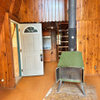
My neighbor had a GSHP installed March 2009. Two or three (I forget how many) vertical boreholes were drilled in his front yard in the indicated area.
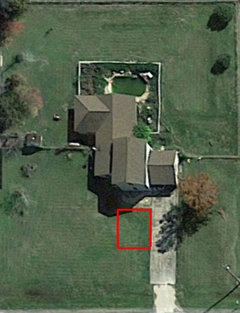
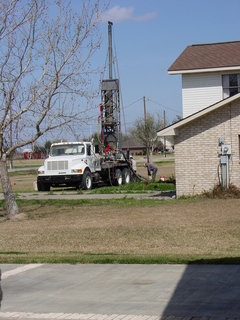
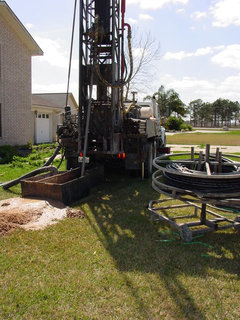
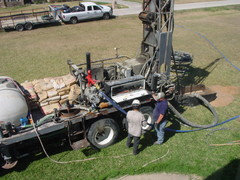
- 7 years agolast modified: 7 years ago
Re BT:
“Never pressurized, viva non-pressurized flow centers… Talking to other dealers - IMHO no one should be installing pressurized GSHP.”
Well, I don’t agree with that but I do understand why you would. Unpressurized is fine for your install.
I would suggest that it is very important to fully test your ground loops before they’re back filled and to have the loops pressurized during the back fill process to help insure that nothing in the back fill process crushes any part of the loop. Even if you’re installing an unpressurized flow center, back filling without pressurized loops is risky business!
“Worst case scenario ask the foundation contractor to 2" sleeves 5 sets of holes 8" apart ~4ft. I am going to re-run ManJ to see what I may need more precisely.”
So that sounds like you’re planning on up to a 5-ton HP, headers inside the envelope and 600ft of 1-1/2in HDPE per ton connected in parallel.
BTW: Slinkies ‘should be’ 10ft apart – min!
Don’t forget to include any skylights in your load calcs. They can add about ½-ton ea. to your AC.
IMPO
SR
- 7 years ago
"Don’t forget to include any skylights in your load calcs. They can add about ½-ton ea. to your AC."
I have 5 skylights in my house. Your professional advice is that the 5.5 tons I have for 4500 sq feet should be 8 tons? Or that without the skylights, it would have been 3 tons? Either possibility is most unlikely. Do you use Kentucky windage and not Manual J?
- 7 years agolast modified: 7 years ago
Those statements are just wrong. (This was a reply to a post that got deleted - that is kind of infuriating. It looked like I was reply to Fudd and I was not)
- 7 years ago
We were dead set on geothermal (no NG here), but if I can get a good ASHP installed for under $20K, I'm doing it. I was quoted $36K for a 4 ton WF 5 series with 3 zones. Even with the tax credits, it still doesn't make sense (especially if you factor in the increased amount you're financing).
- 7 years ago
I'm pretty sure everybody now knows that geothermal won't save you anywhere near "30 to 60 percent on heating, and 20 to 50 percent on cooling". While I'm a geothermal fan, I have yet to see any peer-reviewed solid data that backs up wild numbers like that, all else being the same.
General consensus, from talking with actual users, ranges from "slight savings" to "no savings", depending on what alternatives are available. Assuming the extra install cost is viable for an individual, your decision to go geothermal needs to be based on factors other than just any perceived savings on monthly costs. At least in my opinion.
For us, because we've had geothermal before and know what to expect, the extra up-front cost may be viable, but we're under no illusion that it'd pay for itself in anything less than 20 years. Luckily, we're designing our new house specifically so we can live there 20+ years, so we may actually see that payback. - 7 years agolast modified: 7 years ago
Re Fudd:
“I have 5 skylights in my house. Your professional advice is that the 5.5 tons I have for 4500 sq feet should be 8 tons?"
I said: “Don’t forget to include any skylights in your load calcs. They can add ‘about’ ½-ton ea. to your AC.” (My emphasis)
My professional advice is to always ‘Run all the Numbers’, with a professional, using the latest version of an approved software.
I’m not there, I was just reminding the OP not neglect the effects of skylights – they do affect loads and yes, in ‘some’ cases it might be that much – so ‘Run Your Own Numbers’ to be sure!
IMPO
SR
- 7 years ago
Re David Cary
“Those statements are just wrong.”
Why bother commenting when ‘Elmer J Fudd’ can be unleashed!
SR
- 7 years agolast modified: 7 years ago
Why bother continuing with the BS and double-talk when people pay attention to what you say and may question you about it? Your response is often to the effect "that isn't what i said", or "that isn't what I was referring to". Why not consider the veracity of your comments before making them, that way you'll have nothing to try to walk back from or try to defend by "clarifying".
There are a lot of dishonest people in the HVAC business. They find homeowners with little knowledge of their industry and often high anxiety about their needs to be easy pickings. As the owner of two homes where I've had major work done in the past few years, these types are very easy to spot. BS and double talk starts to fly. and fear-mongering is used too. At the same time, the honest and sincere ones are also around to be found and are easy to identify too.
I'm not saying any of the people who comment here are either saints or scoundrels. But in my experience, anytime extreme and or unsupported claims and fear are used to be convincing, the red flags go up.
- 7 years agolast modified: 7 years ago
Most of the above statements are wrong. Geothermal can save you money, but in the predominantly heating climate where NG is available, probably not that much. It is also depends on the ground conditions and the amount of moisture in the soil at pipe depth.
=
> There are a lot of dishonest people in the HVAC business.
Ok. But HVAC dealers are facing some severe risks. It is soil conditions, loop failure, error in the design, flat looping. I dont know anything about vertical drilling. Pressure vs Non-pressure flow centers - GSHP equipment does not care [at least resi < 6T], but non-pressurized is more forgiving esp with a little air in the lines, you can add a little liquid, you can replace the failed pump.
=
Where GSHP equipment could really shine - is the ability for multiple units to share the loop [but you can not use non-pressurized design]. Like having multiple zones. I think if you are building a house and need two ASHP units, GSHP could be a viable option.
=
My main concern is with the ground separation over time due to vibrations and expansion & contractions of a pipe (like seasonal) .
- 7 years ago
So this thread has become very confusing. A post that was cut and paste from somewhere claiming huge savings for anyone that installed Geothermal was deleted and there are several posts that replied to that post. Makes the thread look like it went off the rails.....
Would be nice if Houzz put a marker that a post was deleted (and why).
- 7 years agolast modified: 7 years ago
Nice ad with imaginary up to 70% savings... Just like staples up to 70% off... The up to 70% off is an eraser $1.39 eraser .. now $.50. Only one eraser per customer.









just_janni