Software
Houzz Logo Print
ntrainer

Best Garage Floor Epoxy?

7 years ago
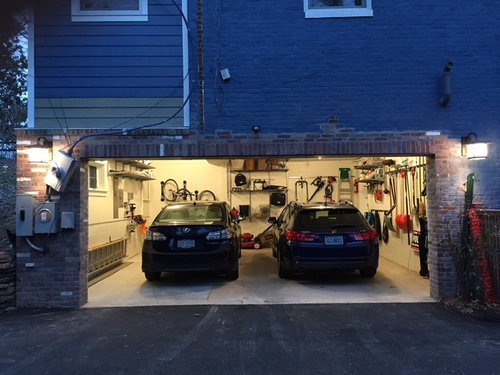
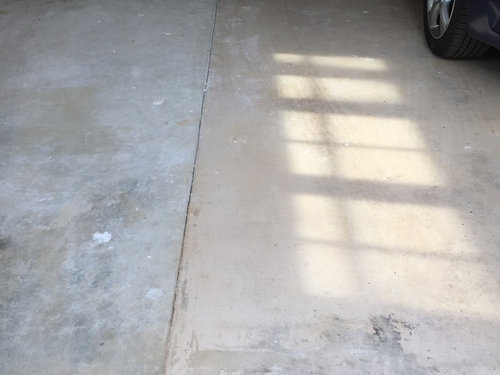
We have recently (almost) completed a garage renovation, taking what used to be a 1-car garage and making it a 2-car garage. Here's a photo taken a couple of nights ago:


Yes, we still have some work to go, including clean-up and painting, but please focus on the concrete floor in that photo. You can see where the old floor (at right) meets the new (at left). Our local painting professionals tell us the best way to marry the two is to use an epoxy. They will "prep" the space by grinding down the old floor, which was stained around 17 years ago. Then they may need to use a filler on the joint left between old and new. Here's a photo of that joint, closer up:


Their recommendation is to use Armorseal 8100 as the epoxy. I'm concerned, though, that the low % of solids in this epoxy might mean it's not as durable, and in particular that we could experience "hot tire pickup". This is a commercial/industrial product, but not necessarily designed specifically for garages. Also, the low % of solids might mean that the epoxy wouldn't fill in that joint as well.


Anyone out there who has used Armorseal 8100 in a garage? Some other epoxy product? All thoughts and suggestions are welcome!

Comments (15)

  • 7 years ago


    Several I know have tried Epoxy and experienced bonding issues - that included both Homeowner and Professionally applied.


    i went the route of Racedeck. Been very satisfied.

  • 7 years ago

    Swisstrax!!! You can't go wrong!

  • 7 years ago

  • 7 years ago

  • 7 years ago

    What is swisstraks and how much is it?

  • 7 years ago

    Great floor coverings, folks, but I'd rather have somebody reply with information about epoxy... as that's my preference.

  • 7 years ago

    OK...here we go. Garage floors are NOT sealed the way "house slabs" are sealed. They rarely have (if ever) a vapor/moisture barrier underneath them. The moisture barrier is what PREVENTS adhesion/bonding issues. So...that means the EXTRA EFFORT needed to ensure bonding will be required if you don't like the idea of your epoxy lifting or blistering.


    To get this to work, your epoxy flooring specialists (not just "painting professionals") will have to do the following:

    • Shot blast the surface of the garage floor (to rough up the surface and remove an deposits sitting on the top...like the stuff they add to create a fast cure)
    • Apply 1-2 coats (spray on is most common) of moisture barrier and allow to cure
    • Apply a primer (1-2 coats depending on the system used) and allow to cure
    • Apply a micro topping of concrete to give a finish
    • Apply the epoxy of your choice

    Whew. Lots of work. I've heard the "prep" (the first 4 points listed above) can reach $5/sf. The epoxy is then added to the cost.


    This is not a job for painters. Regardless of the system used (commercial/industrial vs. residential) this is not a job for painters. I've seen SOOOOO many painters ruin home improvement projects I could just spit! As a former flooring professional, I can tell you that painters love to make suggestions - especially if it means more work for them.


    I'm sorry, but PLEASE contact several epoxy professionals to get some quotes. This is your best way forward. And those joints are supposed to be there. Your epoxy experts will know that.

    Nancy Trainer thanked SJ McCarthy
  • 7 years ago

    @SJMcCarthy, do you mind explaining how the garage floor would be sealed if it did have moisture barrier underneath it?

    @Nancy, I hope you don't mind me posting here. I was going to create a new posts, but I had the same question except my garage slab does have a moisture barrier underneath it.

  • 7 years ago

    The slab will not need sealing if it has a moisture barrier underneath it. You will still need moisture or RH testing - just to be sure the barrier remains intact. Once that is done, then the cleaning of the slab (removing all the residual chemicals used to help quicken the cure rate) and roughing it up (so that the epoxy has something to grab) will be all that is needed before a professional grade epoxy is applied.

  • 7 years ago

    We can definitely do moisture testing... honestly, given the fact that I stained the original slab and never had difficulties with it (like "hot tire pickup"), I'm guessing our moisture levels are OK. But what are your thoughts about Armorseal 8100 in particular?

  • 7 years ago

    Looks like any off-the-shelf product....

    armorseal® 8100 - VA Vendor Portal


    It still requires all the effort of a professional grade epoxy. The "hot tire pick-up" test went to 60 Celsius (140 F). The preparation strictly forbids acid washing the concrete to get it clean. Abrasion must be done. And a test patch must be done if an old coating/paint/stain had been applied. The test patch must sit for one week.


    As a Sherwin-Williams product, the painter would have seen this and thought it was a good idea. Your location and the average temperature of your tires after a drive will be the final test. Find out the absolute LIMITS of this product (hot, cold, salt, water, staining, etc) and then find out if your situation fits into any of the extremes.

  • 7 years ago

    I have Rustoleum 9100 two-part epoxy, mixed with pumice. I put it on my garage floor when it was new - 19 years ago. Has held up great. Used to coats.

  • 4 years ago

    Well.... I wouldn't say epoxy floors are hard to clean. I had an oil spill, used simple green, and we're good to go. On the other hand, that's the only time in the past two years that I've cleaned my garage floor. I blow out the leaves and other detritus, but, hey, who's got the time to worry about the glow on their garage floors?


    Or maybe I'm just lazy like your neighbor, William.

  • 4 years ago

    @Nancy Trainer, so are we to assume you went with the Armorseal 8100 and it was successful? If so, congrats!