Software
Houzz Logo Print
kandice_breinholt

Fiddle Leaf Fig Advice? (Light)

7 years ago
last modified: 7 years ago

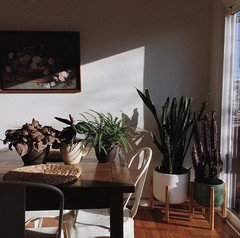
Hey all! I don’t have south (or north) facing windows in my home so I’ve tried my FLF in three different spots between east and west windows. You’ll see in the photo that at the moment, it’s in the very center between my east-facing sliding glass doors and my west-facing floor-to-ceiling windows. This is the kind of light it receives most of the day until the sun starts beating in around 5 to the west (left of pic). The leaves are very small so I know it needs more light *BUT* this seems to be the spot it has done the best in, although it’s approximately 12ft from both east and west windows. (A humidity bonus would be that it’s closer to our swamp cooler in this spot while it’s on during the summer.)


The east-facing sliding glass doors (to the right in the photo) provide just a few hours of great light but by 3pm, that area gets pretty dark. So I’m certain that isn‘t a great option.


The west windows (to the left in the photo) provide as much indirect light as you see here until about 2:30 or 3 and then more intense afternoon sun for a few hours. I would feel inclined to place it there so it can at least touch some sun but I would have to place it right next to a floor vent which isn’t great during the winter. Furthermore, the floor-to-ceiling windows make it very cold in that spot during winter as well. I’m also concerned about burning the leaves in the more intense late-afternoon sunlight.


Given these details/conditions, what might you recommend? That I leave it in the center where it can sort of benefit from both light sources (it’s growing more leaves now than ever before but they’re puny) or move to a window despite the supper cold winter temps/heating vent?

Thanks in advance for your time!


Comments (11)

  • 7 years ago

    Sometimes the photo doesn’t show up when I post so here it is again. Along with what the windows look like on either side.


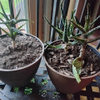
    East-facing. Apparently enough light for a snake plant and an African Milk Tree.


    The large windows on the west side.

  • 7 years ago

    Thanks Al! I was hoping you’d respond. I really value your advice.


    Along with moving it to our east window per your suggestion, I’m changing out the pot (something I’ve been meaning to do for a few growing seasons and finally feel it’s healthy enough to tolerate) and will instead use a terra cotta pot with better drainage/breathability than what I’m currently using. Is that the right choice of pot?


    Also, I was searching to see if you had a specific soil recommendation (a brand you prefer) but couldn’t find anything specific. I went with generic potting soil and mixed in cactus potting soil to allow for saturation when watering but faster drainage and quicker drying. I saw that suggested and it seemed to make at least some sense based on what I have read from your comments remarking that figs need to be saturated and have effective soil to accommodate that. I had it in generic potting soil before so it’s at least a step up (including the terra cotta pot). Or at least I’m hoping it is?


    I should also mention that i did my best to work all the old soil out from the roots but wondered if I have harmed the roots in any way by doing so?


    Do you have a fertilizer recommendation? How soon after repotting should I fertilize?


    Lastly, in June (given it survives the moving to a new spot AND the repotting), I would like to prune that bottom branch so it becomes a tree and then pinch the top to encourage new branch growth at the top as well as notch in a few places as well. Is this ALL too much to do to a fig in one growing season? If not, can I prune/notch/pinch now at time of repotting?


    Thank you so much!!

  • 7 years ago
    last modified: 7 years ago

    I just found and read your informative post about good growing practices for beginners.

    I understand now that the ”mix” (haha if you can even call it that) of soil I used isn’t nearly porous enough to allow proper airflow to the roots. What do I need to mix it with or replace it with? I would greatly appreciate some help with this. I’m so excited to have read this information because roots were never at the forefront of my mind (stupidly). As you described, of course that’s the main consideration with any plant. Why have I had plants for years and avoided the roots as much as possible?! I essentially thought it was like a pretend-they-don’t-exist-so-as-not-to-ruin-them-and-hope-they’re-doing-their-job kind of thing but now after reading your take, I feel confident about caring for roots from here.

    I’m happy to know now that my removal of the old soil from the roots was indeed good for my flf! Yay! I’ll continue to repot my beloved plants properly every 3 years (as oposed to potting up).

    My final questions are these:

    1. Fertilizer? I will heed your advice on how often and when (found in that helpful thread you started). And, if I understand you correctly, Miracle Gro should do the job in the proper ratio, correct? Nothing special needed.

    2. When should I prune/pinch/notch?

    3. Should I drill more holes in my pot to allow for better drainage?

    4. Should I use a humidity tray underneath? I read in a few different places that rocks and water create humidity but I also used to mist my flf and now know that’s a futile practice (thanks again for enlightening me).

    Thanks for the time you’ve devoted to helping people like me!

  • 7 years ago

    Thanks for the kind words - glad to learn you found some value in what I share.

    I try to always look at things from the plant's POV, so from that perspective, it's hard to beat terra cotta. When you do make the switch, buy a bigger pot than you think you'll need. I'm sort of following along in order of what you wrote, and at the spot where you ask what to do about the soil situation, you'll see why I suggested a bigger pot.

    I should also mention that i did my best to work all the old soil out from the roots but wondered if I have harmed the roots in any way by doing so? Yes, you did harm the roots, but the upside of that is - it's no big deal. Any time you're removing soil and whacking away at roots, you harm them, but it's nothing a healthy plant can't tolerate with relative ease. Where temperate trees naturally occur, it's not unusual for more than 90% of the trees fine roots to be in the top 18" of soil during wet/cool months where aeration is adequate. In summer, almost all of those roots die, and new roots are generated deeper in the soil where moisture availability and temps are more favorable. I often remove more than 90% of healthy tree's roots when repotting, and can't remember the last time I've lost a recently repotted tree. I sometimes sever roots as thick as my wrist, near where the roots transition into trunk, with no problem.

    Do you have a fertilizer recommendation? Yes. Foliage-Pro 9-3-6 has all the nutrients essential to normal growth in a favorable ratio. Very few fertilizers can make that claim. It has several other attributes as well, which I won't mention due to how long this post will be w/o me getting too far off course. How soon after repotting should I fertilize? As soon as you can see the plant is pushing new growth.

    Lastly, in June (given it survives the moving to a new spot AND the repotting), I would like to prune that bottom branch so it becomes a tree and then pinch the top to encourage new branch growth at the top as well as notch in a few places as well. Is this ALL too much to do to a fig in one growing season? No - not too much for a healthy tree. Young trees (trees younger than 25 years old are all or almost all dynamic (living) mass, and as such, have a very strong constitution. As long as the tree hasn't been super stressed to the point it's barely able to make enough energy (from the sun's light) to grow, pruning is no problem, and pinching causes very little stress, no matter what time of year it's done; but, pruning and pinching produce something more like the kind of results you would hope to see if you do it when the plant is healthy and at/near the peak of its energy/food-making ability. If you're going to work WITH your tree's natural rhythms, you should plan all hard work (repotting and hard pruning) for sometime near the summer solstice. The tree will recover faster and offer a more enthusiastic response to your ministrations.

    If not, can I prune/notch/pinch now at time of repotting? Again - I'd wait until June. BTW - notching works, but not reliably unless you're very familiar with how it's done. If you prune in June and start pinching conscientiously, notching will be completely unnecessary.

    I understand now that the ..... soil I used isn’t nearly porous enough to allow proper airflow to the roots. What do I need to mix it with or replace it with? I would greatly appreciate some help with this. I’m so excited to have read this information because roots were never at the forefront of my mind (stupidly). As you described, of course that’s the main consideration with any plant. Why have I had plants for years and avoided the roots as much as possible?! I essentially thought it was like a pretend-they-don’t-exist-so-as-not-to-ruin-them-and-hope-they’re-doing-their-job kind of thing but now after reading your take, I feel confident about caring for roots from here. You're not alone in how you feel about roots. The fear of doing harm to the plant by tampering with its root system is so prevalent it could be described as innate or inherent.

    I suggest you take a little time to understand why using ballast in the bottom of the pot is is an effective way to combat perched water. The short answer to "What is perched water?" is, it's water that completely saturates a layer of soil near the bottom of the pot when that soil is based on a large fraction of fine material. The size (and internal porosity) of the particles in a soil determines how much water it retains. By using ballast, you can make the volume of soil capable of supporting perched water in ANY pot so small as to render it a nonissue. Ballast Homework

    My final questions are these:

    1. Fertilizer? I will heed your advice on how often and when (found in that helpful thread you started). And, if I understand you correctly, Miracle Gro should do the job in the proper ratio, correct? Nothing special needed. See recommendation above.

    2. When should I prune/pinch/notch? Covered above.

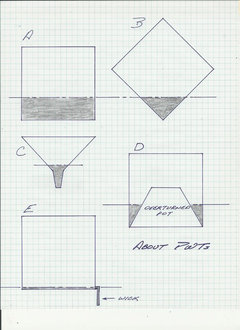
    3. Should I drill more holes in my pot to allow for better drainage? One hole is as effective as 100 insofar as drainage is concerned. All else equal, in either case when the pot is done draining, the amount of water left in the pot will be exactly the same. You CAN gain an advantage, however. If you have or add a hole through the bottom of the pot where the bottom and sidewall meet - see what happens:


    Compare B to A. The shaded area represents perched water. By tipping the pot with a hole at the edge of the bottom - see how much unwanted water you can force out of the pot.

    4. Should I use a humidity tray underneath? No need. FLF's leaves are rich in cuticular waxes and well-equipped to deal with humidity levels down to around 35%. If you want to raise humidity, use something that raises the RH of the entire room. I have an R/O water system, so I can use water from that in ultrasonic humidifiers. I do a quick clean once per month and that's it. No filters or additives needed, though I do add a TBSP of 3% H2O2 (hydrogen peroxide) to every gallon that goes into the humidifiers in winter. I read in a few different places that rocks and water create humidity but I also used to mist my flf and now know that’s a futile practice (thanks again for enlightening me).

    Thanks for the time you’ve devoted to helping people like me! ...... a pleasure.

    Al


  • 7 years ago
    So if I understand my homework correctly (thanks for the link to ballast info!), I’ll repot in June using the less-than-stellar Miracle Gro potting/cactus soil mix that I already own and remedy that with two bricks lying horizontally at the very bottom of my terra cotta pot - with a gap between them? And that effectively reduces the amount of soil that will retain water. And this can be done to aid all my plants as well? Can I use anything other than brick for smaller pots/plants?

    Correct me if I have it wrong! Thanks!
  • 7 years ago

    You can use anything inert that takes up space for ballast. Physics dictates that the ht of the perched water table (PWT) any soil supports will be a constant ht. So a medium that supports 4" of PW in a plastic pill bottle will support 4" of PW in a 55 gallon drum. The ideal scenario is to almost fill that bottom 4" with ballast, but not quite. There must be a continuous soil column that reaches the bottom of the pot, or the PWT will simply perch above the ballast. By using ballast judiciously in the bottom of a 55 gallon drum, you can end up with a cup or less of medium capable of holding perched water. A typical 55 gallon drum is about 22.5" in diameter, so without ballast, a medium that supports 4" of PW will have almost 1,600 cubic inches of saturated soil at container capacity. With ballast, you can reduce that amount to a cup or less. There are 14.5 cu. in. in a cup, so you can eliminate more than 99% of the PW with ballast.

    That's the upside. The downside is, ballast doesn't increase aeration in the rest of the soil. You need lots of coarse particles to do that ...... as in 80% of the soil particles being 1/8" or larger; and, adding perlite to your MG is actually counterproductive from the perspective of aeration. If you start with a given volume of MG soil, then add perlite, you have a larger volume of soil, but only the volume of air contained in the original volume of MG. If the volume of soil increases while the actual volume of air remains constant, o/a air porosity is diminishing. The more perlite you add, the worse it gets, up to the point where there is no longer enough of your MG soil to fill the spaces between the particles of perlite. Only then does o/a air porosity start to increase meaningfully.


    Al

  • 7 years ago
    Yes! That’s what I’ve come to understand. Thank you. I’m assuming (but double checking with you in case something has gone over my head) that I can then use large rocks as ballast? As long as columns are left between them. Just thinking of items I might already have available to me. Wood as well?

    For air circulation, I’ve seen you mention pine bark as an option. Any other suggestions (that are easy finds at home improvement stores)?

    Thanks!
  • 7 years ago

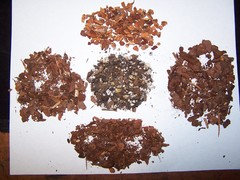
    If you come across pine bark of appropriate size, you can easily make a medium that won't need ballast.

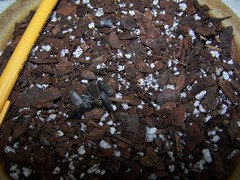
    At 3, 6, and 9 o'clock, you'll see bark that's perfect for making the 5:1:1 mix. Each sample was from a different packager/brand. In the middle is what I use for veggies and plants that need repotting frequently, in its dry state.


    I’m assuming ..... I can then use large rocks as ballast? Yes As long as columns are left between them. That's correct - only takes one continuous column. Just thinking of items I might already have available to me. Wood as well? ..... as long as it has no phytotoxic ingredients like varnish or preservatives. It would be better though, if you could find something inert. Plastic soda bottles with or w/o water in them, kid's plastic building blocks, an overturned pot, ......

    Al

  • 7 years ago
    Okay! I’m about 90% more confident now than ever before! I really can’t thank you enough, Al. The info you’ve generously shared in this thread and in others has been such a great help to me. I can’t wait to see how my plants thrive from here on!
  • 7 years ago

    Some hobbyists only want directions that will allow them to reverse the decline they recognize in their plants. Others want to understand why the advice is offered. I find that almost every piece of advice offered should be qualified in some way to maximize its value. That is to say the exceptions to the advice given should be mentioned so the original poster or others who might follow and read the advice won't apply it in a manner much broader than was intended within the context of the thread in which it was written. I also find that growers who aren't interested in WHY plan A is superior to plan B aren't too interested in learning what can't be learned by osmosis (passively). I can't speak for everyone, but I know I'm always more enthusiastic about offering guidance to those who find themselves actively seeking the knowledge that will allow them to identify and fix problems soon after onset (that's really our only job when it comes to tending our green friends) or to avoid them entirely. The sum of what I just said is, I've noted your enthusiasm, and it's refreshing - makes me want to offer you an extra measure of good fortune. Take care, K.

    Al

Sponsored
Industry Leading Kitchen & Bath Remodelers in Franklin County, Ohio