Software
Houzz Logo Print
jason_white3327226

Crawl space vents

7 years ago
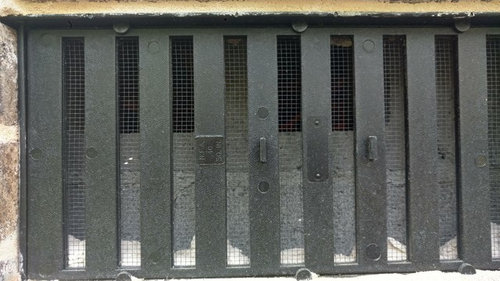
I posted a few days ago about mold in the crawl space of our new home we haven't even moved into yet. Our private inspection guy we hired found it throughout most of the crawl space, but dormant. His opinion was due to lack of ventilation. Due to the garage placement and front porch, there's large portions of one wall and one entire section of foundation with no vents.


We went out yesterday and I was checking and feeling for any air moving through, and 1/3 to 1/2 of all the vents were in the closed position, and have probably been that way since they were installed. But the biggest thing I noticed was that most of the vents were blocked by foundation blocks. More than half of every vent has a piece of concrete block in front of it. I found code guidelines regarding the number of vents required per sq/ft, but nothing about this.


Would this be considered acceptable for crawl space vents? This is how all of them are.


Comments (25)

  • 7 years ago

    Have you thought about opening the closed vents?


    you found the code requirements, do your vents meet code? Where I live, code is square inches per ft.

  • PRO
    7 years ago

    Whether this meets code or not is moot. Clearly something is wrong if mold has developed. For your family's health and your investment in the home, find a mold remediation specialist who can treat the mold, determine if you have a water source that is wetting the crawl space and offer a ventilation solution to keep the mold from coming back.

  • 7 years ago

    The better option is an encapsulated, unvented, crawlspace.

  • PRO
    7 years ago

    To clarify, all crawl spaces must be ventilated. I think what live_wire_oak meant to say was "encapsulated mechanically ventilated".

  • 7 years ago
    last modified: 7 years ago

    "The better option is an encapsulated, unvented, crawlspace."

    I thought this was recommended only for areas with high humidity in the summer time?

    Not all of the country is like that. This person hasn't said where he's located. If the house is now new, is it likely to have experienced the kind of humid hot weather that sealing a crawlspace is designed as a remedy for?

    I think the source of the mold needs to be investigated, don't you?

    Edit to add - poor drainage, wet ground?

  • 7 years ago

    I would exam the floor or ground area. 6mil plastic or better with pea gravel is one option to cut down moisture.

  • 7 years ago

    ' 1/3 to 1/2 of all the vents were in the closed position, and have probably been that way since they were installed. '

    That's probably why you have the mold. The GC is responsible for this. 6mil plastic is code in this area.....around Charlotte.

    What did your private inspector say about vents being blocked? Vents are in the crawl space on the outside. I don't understand how they can be blocked......in corners? Vents should NOT be blocked.

  • 7 years ago

    OP you must post location to get best advice.

  • PRO
    7 years ago

    When foundation vents being used you need 1 SF of screened vent space penetrating the perimeter foundation for every 150 SF of space in the crawlspace. So lets say if your foundation size is 20X20 =400 SF/150 you will need vents that have a combined square footage of 2.7 SF


    That said, if you have approved vapor-barrier like 6 mil plastic under the slab, you only need 1 SF of vent for every 1,500 square feet of space.

    I don't think you have sufficient vapor barrier under your slab and having this vents blocked half way which causes insufficient air circulation you getting all that mold from moisture being trapped there.

    I would clean up that place and provide good mechanical ventilation to solve this issue.


    Good luck

  • 7 years ago
    last modified: 7 years ago

    > approved vapor-barrier like 6 mil plastic under the slab

    1) Make sure you have good grading at least 1/4" per ft

    2) Make sure downspout take water away .. away from the foundation

    3) Make sure the 6 mil plastic overlap 12"

    4) Make sure that the seams are taped.

  • PRO
    7 years ago

    Read Building Science for the different approaches regarding crawl spaces. In general, preventing moisture intrusion by vapor sealing at the perimeter is a better approach than allowing water vapor into the space and placing the vapor barrier at the house plane. https://www.buildingscience.com/file/5850/download?token=cqthd8lA

  • 7 years ago

    I am in Georgia near the Augusta area. The house plan called for everything to extend to the end (I'm probably garbling this) - but the exterior bricks are actual structural brick vs the spec house norm around here where fascia brick is added on the outside for decoration.


    The inside row of block apparently was set, then the exterior bricks were set outside of that, and the vent holes for the ext. brick don't meet up to the holes left in the concrete block wall.


    There is a plastic vapor barrier on the ground and sand inside.

  • 7 years ago

    The problem is not ventilation, it's humidity. Unfortunately, open vents simply let in humid air in the summer. You need to encapsulate (seal off) the crawlspace and seal the vents if you want to prevent moisture getting into the area and mold growth. Alternatively, get a professional dehumidifier in the crawlspace (and seal off the vents still). Unfortunately, you already have mold so you need to getrid of it before you do anything. You can spray with bleach or get a professional to use a non-bleach solution of you don't like the bleach idea.

  • 7 years ago

    Mold in crawlspaces is not that common of a problem here. I personally don't know anyone who has had to deal with it, and I've lived here my entire life for 34 years. No one encapsulates as standard practice here, and summer time humidity after 12:00 each day usually gets down to 35-50% range if it isn't raining.

  • 7 years ago
    last modified: 7 years ago

    Moisture coming up from soil in crawl space - couple of good suggestions re Vapor Barrier found above!

    Make sure things like A/C condensate are not being dumped into the crawl space - it happens!

  • PRO
    7 years ago

    Jason, sorry but moisture problems in vented crawlspaces are very common in the region and why I mentioned in your other thread that new, vented crawlspaces should be illegal in humid climates. Building researcher Bill Rose agrees.


    Unvented (encapsulated) crawlspaces are standard practice for Energy Star certified homes and encouraged by your local certification Earth Advantage. There may be many more problems with your foundation and being vented is just one of them. It's probably wise to consult with a HERS rater, home performance contractor or third party contractor who specializes in sealed crawls.


    Your observations are different than average humidity which is much higher. It's hard to dry out the cave (crawlspace) below a home with humid air.

  • 7 years ago
    last modified: 7 years ago

    Sweep the sand off one section at a time to check for moisture under the plastic and any breaches or something else even an underground spring from a adjacent hill. Once we found a water leak from a supply line above that collected on the plastic..

  • 7 years ago

    Just for an update, I bought a hydrometer and stuck under there. Just a home temp./humidity digital meter. Sat. & Sun. here were both beautiful days. Daytime humidity around 30% & nighttime was low to mid 50%. Sunny, breezy, 80 degrees. Saturday afternoon when I put it under there, it said 27% after walking across the yard. Saturday night at 11 pm it was 64% & 65 degrees. Yesterday at 1 pm, 68%, at last night at 11 pm 78%. So, the humidity is staying approx. 30% higher in the crawlspace vs outside air.

  • 7 years ago

    If there is a platic liner, try putting the hydrometer well under that barrier - between the plastic and the dirt.

  • 7 years ago

    Jason........WHAT did your private inspector say??? WHAT did the city/state/county inspector say????

  • 7 years ago

    "So, the humidity is staying approx. 30% higher in the crawlspace vs outside air."

    You are measuring relative humidity. Is outdoor temperature and the crawl space temperature the same? If not you have to compensate for the temperature difference. If the crawl space is 10 degrees cooler then the relative humidity is going to be higher.

  • 7 years ago

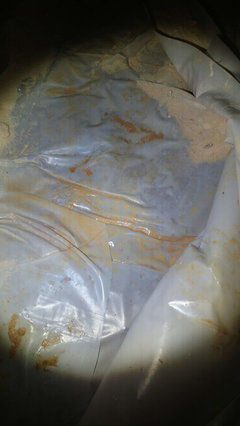
    Went back last night to empty the dehumidifier, and out of curiosity pulled back an overlap. The house was closed up in November. The seams aren't taped, but folded back and overlapped with sand on top. There was enough water between the folds to run out when I lifted it. The ground is absolutely soaked underneath the plastic, and half a dozen spiders ran out along with other bugs and grubs under the plastic. Considering the seams aren't taped, I'm afraid we are going to have the termite equivalent of a rotten log in the forest - cool, wet, undisturbed dirt.


    Are the seams supposed to be taped? The wall nearest where I was at has a bricked/enclosed back porch on the other side and a big concrete patio beyond it. It hasn't rained in more than a week, so I find it hard to believe that rain/ground water is leaching that far. We are on solid red clay - the big thing in this area is having to have a perc test before you get your hopes up for a home site.


    MY GUESS -- they put the plastic down on wet dirt before the put any of the floor down. We had a lot of rain in the fall & winter. I have no idea what standard practice is, but I imagine that if it had been closed in and allowed to dry out for a week or two before the plastic went down, this wouldn't have been an issue. The HVAC guys had to run everything after it was closed in, so it's not like it wouldn't have been possible to do. I think the ground was soaked, the put the plastic down, and now its a saturated ground beneath the vapor barrier that isn't sealed to keep it out.


  • 7 years ago
    last modified: 7 years ago

    My previous post above has been ignored, but in the vast majority of cases the moisture is coming UP from the ground beneath. The plastic barrier needs to be taped and weighted or otherwise fastened.

  • 7 years ago

    I'm in the Washington DC area and my architect designed our encapsulated crawlspace with the 6 mil plastic barrier against the ground, then 4" of 57 stone, and then 2" of foam insulation. We added 3/4" plywood on top of the foam because I wanted to be able to easily move around in the crawlspace without damaging the foam. There is also 2" of foam on the block walls, and a vent on each end that opens into the basement.

    Bruce