Software
Houzz Logo Print
sergey_beketov

Ficus elastica shaping and dead buds

7 years ago
last modified: 7 years ago

Hello,

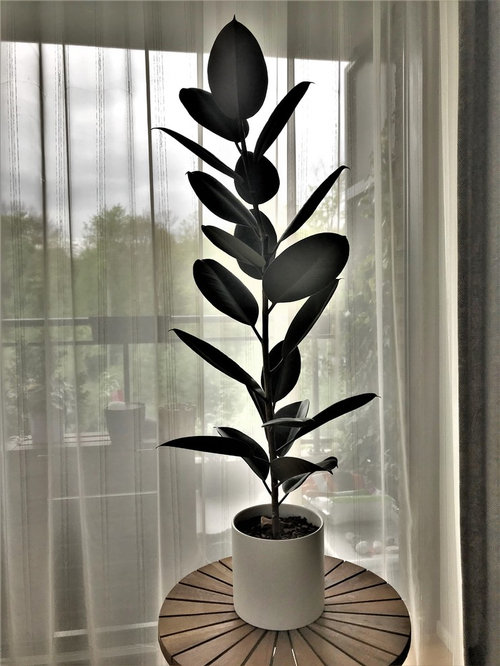
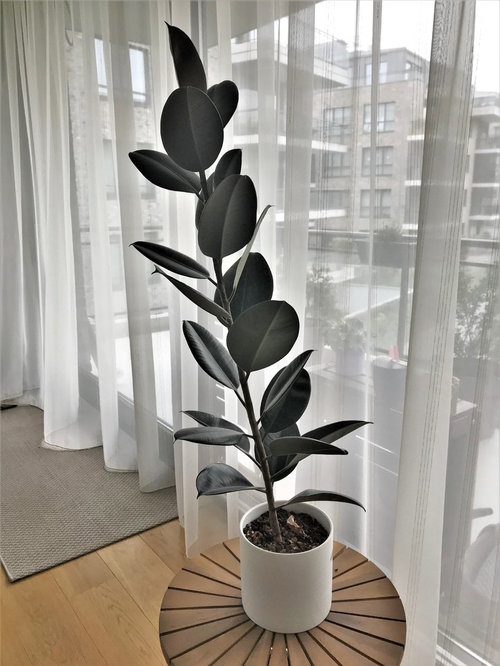
I hope somebody could assist or guide me in a right direction. My ficus elastica plant is resisting my attempts to shape it into a bushy tree and is growing straight upwards instead, without giving side branches by itself.


Having read numerous posts here, most notably by Al, I first tried to make small cuts in

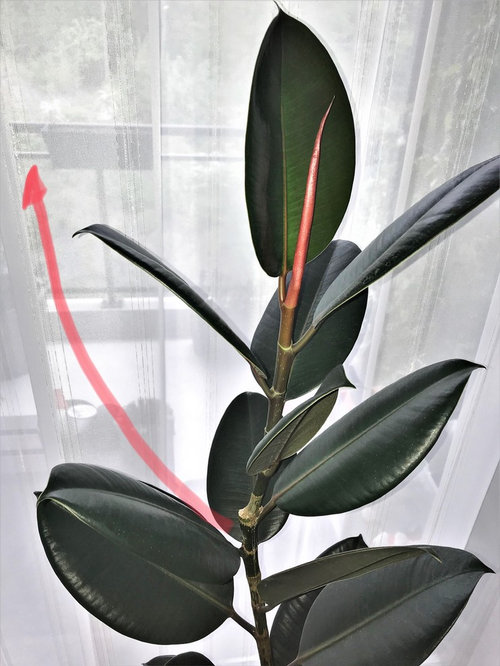
circumference just above the dormant buds, but nothing happened. I then pinched the terminal bud/leave in order to stimulate side branching from the top, and this helped, but not in a way I wanted. Indeed, there was only one new branch which went side-way, and no other branch in an opposite direction (red line shows where I expected the second branch to happen):


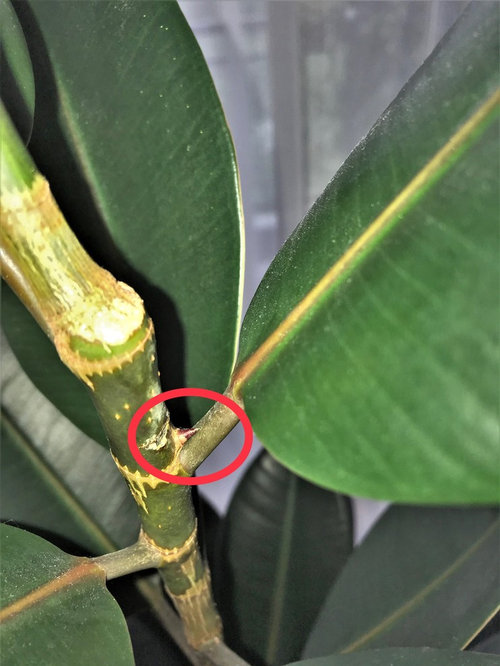
One of the issues is that another dormant bud which would grow into a branch in the opposite direction just didn't grow out and is just stuck right out of the main stem as seen on the photo:


I tried to make a small cut just above it to stimulate the growth, but it didn't help and the bud it stuck, I'm afraid it's dead by now. If it would grow, then this would solve the issue and make the whole plant branching out at the top, as I wanted.


Clearly I'm doing something wrong, so would appreciate your advice.


I would also appreciate your opinion about two more things:


1) do you think the pot looks too small for this size of the ficus, so that I should re-pot it (the plant sits in this pot for more than 1 year by now).


2) what's the best way to straighten the plant, as it's clearly growing not upright and looks more like the Italian Pisa building :)


Many thanks!

Comments (5)

  • 7 years ago

    This is a very easy fix. The question is, are you daring enough to do it?

    If it was my plant, I wanted branching, and I lived in the northern hemisphere, I'd move it outdoors as soon as night temps are reliably above 55*F/13*C. After 3 weeks to a month, I'd cut it back by half. This should occur sometime around the summer solstice when the plant's energy levels and it's ability to make food (photosynthesize) are both at/near peak levels. Cut the top leaf in half, cut through the petioles on all leaves proximal to what is now the half leaf at the top. This will force enthusiastic back-budding with new branches growing in all or most of the old leaf axils (crotch formed by the leaf stem and the branch it's attached to). When these new branches have 2 mature and a third leaf that's maturing, pinch the branch back to 2 leaves. This will then force 2 new higher order branches from 1 lower order branch; so, from 1 you get 2m from 2 - 4, from 4-8, then 16 -32. You should be able to coax your tree into producing several orders (like generations) of branches each summer. Stop pinching in early fall & let the branches grow until summer of 2020, then prune off ALL long winter growth and start the pinching again. This ensures your tree will not have large numbers of overly long winter internodes due to pruning w.o a plan.

    If you can lift the root/soil mass from the pot intact, the plant is in want of repotting - but doesn't necessarily need a larger pot. I very often repot ficus from 3 gallon/12L pots into pots smaller than 1 gallon after the root pruning/reduction that goes along with a repot. If you don't already know, I know you're getting hints that repotting is much more involved than simply potting up; but, one ensures your planting will forever lose potential and be limited by root congestion at the center of the root/soil mass, the other ensures there will be no limitations due to root congestion until it's time for the next repot, which is like hitting the 'no-limitations-due-to-root-congestion' reset button.

    After you shorten the plant (or don't) you can correct the lean very simply by changing the angle at which the plant is potted at repot time.

    The planting angle of this tree (shrub)


    will be changed to this:

    at repot time, so the slight correction to the lean of your tree is only the most minor of considerations.

    Al

    Sergey Beketov thanked tapla (mid-Michigan, USDA z5b-6a)
  • 7 years ago

    Hi Al,


    Many thanks for your detailed and useful comments on all my points raised, much appreciated! As I'm an amateur in this area (at best), and not sure if I understood all your instructions correctly, could you please confirm my understanding that based on the color marking in the photo below:


    1) I can cut the plant at the red marking;


    2) I should cut the leaf in blue circle in half. When cutting in half, should I remove the other part of the leaf, or it's just a cut through along the petiole, up to the stem, with both parts of the leaf kept attached to the stem?


    3) I should cut through the petioles of the leaves with yellow marking. When doing so, the leaves should still remain attached to the branch, with their petioles just being cut through (see point 2 above)?


    Finally, do you think I can make good use of the top part of the plant (above the red marking) once cut off? E.g. forcing it to grow the roots and then plant in the soil? Or it wouldn't work like this?


    Thank you so much.


  • 7 years ago

    1) I can cut the plant at the red marking; You can cut it anywhere along the entire length of the stem. If you want a shrubby tree with several trunks that originate at/near the soil line, you can cut it back to one leaf if you like, and even cut that leaf in half.

    2) I should cut the leaf in blue circle in half. When cutting in half, should I remove the other part of the leaf, or it's just a cut through along the petiole, up to the stem, with both parts of the leaf kept attached to the stem? Sorry for my lack of clarity. Cut the leaf marked in blue in half across the veins. If your hand was the leaf, it would be the equivalent of truncating all fingers at the second knuckle. The petiole (leaf stem) and the half of the leaf immediately distal to the petiole remains entirely intact.


    The technique of defoliating, partial defoliation, and cutting leaves in half are simple-to-use tools that bonsai practitioners use to balance the tree's energy flow and force back-budding wherever it's wanted/needed. Then, remove all leaves below the half leaf such that the half leaf at the top is the only leaf left on the tree.

    3) I should cut through the petioles of the leaves with yellow marking. When doing so, the leaves should still remain attached to the branch, with their petioles just being cut through (see point 2 above)? Covered above.

    Finally, do you think I can make good use of the top part of the plant (above the red marking) once cut off? E.g. forcing it to grow the roots and then plant in the soil? Or it wouldn't work like this? Absolutely, you can. You have several choices and I'll list them in the order of likely success.

    1) Simply sever the top with an extremely sharp tool and treat it as a cutting. A practiced propagator would expect near 100% success getting cuttings from a healthy F elastica to strike (grow roots).

    2) Act now to predispose the plant to form roots immediately distal to where you intend to remove the top. IOW, you coax the plant to form root initials 2-4 weeks BEFORE you take the cutting. It involves little more than wrapping some gauze or a piece of towel soaked in IBA rooting hormone around the trunk, then wrapping plastic electrical tape around the gauze to block and keep the gauze moist. You might even already have roots forming when you separate the propagule.

    3) Start an air layer of the top now. If you wait until the summer solstice to do what we've been discussing, it will mesh perfectly into the plan. With an air layer, the roots will already have formed on the propagule before you separate it from the plant.

    I'll reiterate, the best results will be had if you move the plant outdoors as soon as temps allow. There is no comparison between how much food/energy the plant will make outdoors/indoors, which ensures a much more enthusiastic response if the plant.

    Al

    Sergey Beketov thanked tapla (mid-Michigan, USDA z5b-6a)
  • 7 years ago

    Thanks so much, Al. I think that I have all the necessary instructions and guidelines now on how to try and alter the plant. I'll write back in a few weeks'/months' time to share the results (hopefully, there will be something to be proud of).