Software
Houzz Logo Print
jseson

Is this normal?!

7 years ago
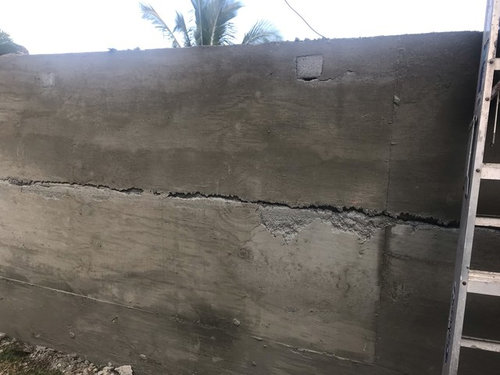
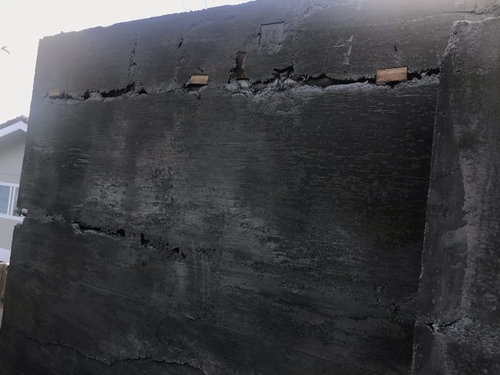
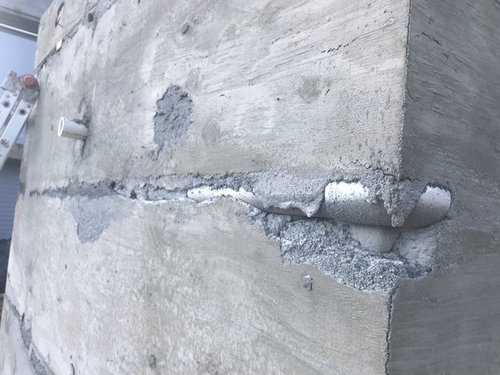
I am having an above ground gunite pool built and the gunite was done 2 days ago. Yesterday the form was removed and this is what the outside of the pool shell looks like. I freaked out, my pb said this is normal and not to worry. Wouldn’t these cracks eventually make its way to the surface of the pool? Please help!

Comments (13)

  • PRO
    7 years ago

    Poor placement of the material. This may be problematic in the future. I can see what I think is a wood 2x4 in the shot. Not good.

    Last photo looks like PVC pipe in the corner. It was set too close to the form. Should be a minimum of 3" of coverage around the pipe. In other words, the pipe should have been spaced to the inside 3" off the form.

    I would contact a structural engineer for a look. Your plans submitted to the city/town for a permit application should have a structural detail included designed and sealed by a structural engineer. Probably provided by PB. Find that engineer and get his opinion.

  • 7 years ago
    Thanks for your help. The plans that were submitted were stamped by an architect. I am really lost as to what my next step should be. I asked my PB about it and he said nothing is wrong. Do I hire a 3rd party structural engineer to look at the work which will cost me more money? Do I let my PB finish the job with the structure being like this? Do I need to look into litigation to get my money back? Please, any advice will help.
  • PRO
    7 years ago
    last modified: 7 years ago

    In my experience with any permit application for a new swimming pool, a structural detail completed by a professional engineer is required.

    Sometimes architects take "liberties" and include a structural detail drawn by them with their plans. The problem is, unless they have P.E. at the end of their name, they are not professional engineers and the detail is meaningless to a building department reviewing plans. The detail may be correct, but without that P.E. and the seal saying so, it's not valid.

    Yes, consider hiring a 3rd party structural engineer who has experience with swimming pool construction to look at your pool.I would hold off on continuing the project until this is performed.

    As far as litigation and/or compensation, until an engineer reviews this. Don't want to jump the gun. Just take it one step at a time. Document with photos and/or any verbal and written conversations with the PB.

    Perhaps speaking with the building officials in your city/town is a good idea. The inspectors could perhaps give you some good information.

    What part of the country are you in?

  • 7 years ago
    Thank you. I live in Hawaii. This is my first time hiring a contractor to do any project so I am overwhelmed and need guidance.

    I will search for a 3rd party engineer on Monday. There is an inspectors name in the building permit. Should I give him a call too?

    My contractor was very upset that I even questioned this which makes this process even more difficult. All I want is a structurally sound pool....which is what I paid for. He says it is, but it doesn’t look that way.
  • 7 years ago
    Also is this even repairable?
  • PRO
    7 years ago

    I would speak with the building inspector. His purpose is to ensure the work is done correctly and according to the plans submitted. They work for YOU and all the city's resident's.

    Everything is repairable.

    Check on warranties PB gave you.

  • PRO
    7 years ago

    jseson

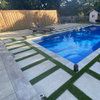
    Here's a project we are working on presently. The pool was shot the end of January. We removed the forms a few days later. This pool had a freestanding form only because of the site conditions.

    It will be backfilled to grade. I wanted you to see how the gunite should look after the forms are removed. The surface has a waterproofing material applied in this pic, but, the surface is clean-no cracks or fissures.


  • PRO
    7 years ago

    Different section, same pool.


  • 7 years ago
    Thank you. I have asked another pool company to come and inspect the project. They told me the same thing. The cement should be flat. I am waiting to see if they come to patch the work like the building notes say that they should.
  • 7 years ago
    The reason I believe there are cracks in my pool is because they attached the piping to the form. I asked them before they shot the gunite why the piping is attached to the form. They said it was fine. I could see even before they shot the gunite it was a problem. Now they are telling me the gunite is 12” thick. I am measuring 9.5-10”thick. Should I stop the project?
  • PRO
    7 years ago

    That's what I suspect. With the piping against the form there is no concrete coverage or at the very lease a very thin skin layer which will de-laminate.

    The structural plans should reflect the wall thickness detail. Generally speaking in your climate, that thickness is ok, but I would refer to an engineer. I would stop the project until an engineer reviews any plans and the structure itself.

    Check your contract if it indicates concrete thickness. Even it it does not, that would be on a structural detail.

  • 7 years ago
    On the structural detail that was submitted for the building permit it says the concrete is 12 inches thick. I am measuring 10 inches. Are builders allowed to deviate from plans like that?
  • PRO
    7 years ago

    We stick to the engineer's plans as they have a reason for certain aspects. I would confer with an engineer and see if there is any wiggle room. There's a reason a 12" wall was called out for.


    Generally, the top 18" of a wall is 12" thick and then it tapers to 7" thick and will include the floor thickness at 7" also. Sometimes the walls are 12" top to bottom and the floor are 10"-14".

    But, engineers may call out a different spec based on the actual planned structure, the size, the site conditions and the location. Freeze/thaw conditions drive specs also.(not an issue for you)

    There really is no "boiler plate" structural plan for a pool.


    Looking at your photos again, the crack is at a consistent height which to me indicates the pipe location.


    I would not allow anymore work to progress until an engineer checks it out and gives it his blessing. Get it in writing to CYA.