Software
Houzz Logo Print
emmett_z

Hanging a heavy antique blanket/quilt

7 years ago

Hi,

I have a very special antique patchwork farm blanket. It is large, about 65x80" and heavy! It's beautiful and I really want to display it.


The main method I keep seeing is to sew a sleeve on the back and run a rod through it. I really would like to avoid doing this and because of the weight of the blanket I don't think this would work.


Right now I have it completely unfolded, draped over an antique clothes rack. Is this safe? Or is it putting undo tension where each side folds over?


Another option I considered was "sandwiching" it between two pieces of large plexiglass. Would this harm the blanked have the plexiglass in constant contact with the fabric?


I am open to any other suggestions. Thanks!

Comments (34)

  • 7 years ago
    last modified: 7 years ago

    I was going to suggest the American Folk Art Museum, in NYC, but looked at their site & can't seem to find a way to contact them.

    I suggest them as I've personally seen several quilt exhibits there including some older, heavier quilts (woolens, made by tailors).

    If you'd like to try them:

    https://folkartmuseum.org/about/social/

  • 7 years ago

    any time you hang something heavy you put a strain on it....likely the way you re now displaying does the least harm. Refold every few months to even up the tension and what is getting light.....and of course keep it out of the sun.

  • 7 years ago

    Thank you for the advice and the suggestions to reaching out to museums! Since it is draped right now (half of the quilt hanging on each side) how would I refold it since there is only really one place it can sit (center of gravity)?

  • 7 years ago

    An aside. Because the quilt is so heavy it may have a horse blanket inside. My husband's grandmother made one like that. Be aware if it has this center is made of wool. Her husband died in 1910 so it was made before then as she left North Dakota at that time.

  • 7 years ago

    I believe you may be right and there might be a horse blanked sandwiched in between

  • 7 years ago

    Any other thoughts on if draping is a safe option even if there is no way to change the position much? (I could shift it a little up or down but for the most part it would be in the same spot with half the blanket hanging on each side)

  • 7 years ago

    Can you post a picture?

  • 7 years ago
    last modified: 7 years ago

    There should be several options of folding it. Find a bath towel and practice folding it in different shapes. The quilt does not have to completely cover the rack. Without folding or turning the quilt the displayed side will eventually fade more than the rest.


    Edited to add that a large bath towel is the same shape as the quilt which is why I used it rather than a piece of cloth in the exact same dimensions.

  • 7 years ago

    I have at least 30 antique quilts. I have them displayed in multiple ways. I have a clamp type bar that is one of my favorites. It doesn’t damage the quilt and is pretty simple to rotate the quilt to preserve it. You want the stress on the rack or the wall, not the fabric of the quilt

    Look at Etsy for options.


    Rack

  • 7 years ago

    Thanks! How does that clamp put stress on the wall and not the quilt?

  • 7 years ago

    Annette while I do not know how much the OP's quilt weighs the one I posted above weighs ten pounds. Older quilts often weighed 3-5 pounds which would be a lot of weight to hang by one edge.

  • 7 years ago

    The rack is screwed into the wall with some pretty sturdy bolts. Then the quilt is pressed between the 2 flat bars and the pressure is distributed along the bar. I rotate my valuable quilts every month or so to release the pressure from one end. Pretty user friendly method.

  • 7 years ago

    But isn’t the weight of the quilt still pulling down on the area that is being “pinched”? Do you see any depression or discoloration on the areas that are between the bars? Thanks!

  • 7 years ago

    Yes....the weight of the whole quilt is on the edge. Because you change the edge doesn't change the fact that the weight is all on the end.
    You can re fold your quilt, like side edge to side edge....then top edge to bottom edge....and side edge to the middle and bottom and top to middle and vary it every few months.

  • 7 years ago

    Also fold diagonally. There is less stress along a bias.

    http://quiltingdigest.com/how-to-fold-a-quilt-to-minimize-creases/

  • 7 years ago

    Thanks guys. I do not plan on folding the quilt though. Buy I appreciate the info. More curious about strain when hanging. It will either be draped or hung from a hanger like mentioned above. When draped, I can’t hand diagonally since the blanket is not a square unfortunately. It is 60x80”

  • 7 years ago

    You can hang diagonally....it just won't be a neat triangle.


  • 7 years ago

    Thanks for the help! Thinking about just getting one of the compression hangers. I want to preserve it but I also want to display it without driving myself insane. And I definitely do not want to sew a sleeve onto it. Thanks again

  • 7 years ago

    I would use plain white or natural cotton thread to tack a heavy textile to a clean, non-acidic fabric backing (well washed heavy muslin or a sheet) in an all over pattern, not just suspend it from 1 edge. That would help distribute the weight better, I think.

  • 7 years ago

    I just really don't want to sew or put any holes through the piece.


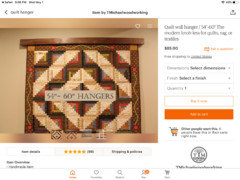
    Right now my plan is to use one of the top hanging compression hangers (that "punches" the top and distributes weight across the whole top). I plan to wrap the top in muslin so that it is not pinching directly onto the piece. And then every few months, swap the end that is being clamped.


    Does this sound like a decent method for display? Any issues with this?


    The blanket I am hanging has the stitches going only up and down, so the way I am hanging it will never pull against any stiches. The blanket is also denim, which I don't think will stretch or anything with weight.


    Thanks

  • 7 years ago

    Everything will stretch with weight. My denim jeans get bigger as I wear them and then shrink back when I wash them.
    I don't like hanging the entire weight of the quilt from one end.

  • 7 years ago

    Makes sense. What would be your suggestion for hanging then? I just don't see the practicality (If I'm trying to preserve the blanket) sewing a backing all across the back side. Out of all of my research I just don't see any way to both not stretch the quilt and not jeopardize the integrity by sewing something directly to it, and also display it. It's really unfortunate. I don't have a bed to lay this on and I really just don't want to put it away in storage and not enjoy looking at it

  • 7 years ago

    I did say 'tack', which would be hand sewing - preferably with a very fine needle and thread.

  • 7 years ago

    That still scares me with an antique quilt, but maybe I'm just being paranoid. I just know personally I could never do that so unfortunately it's not an option for me

  • 7 years ago

    Also, if I sew a back on it, then hang from that, it will still be pulling from whatever points it is hun from right?

  • 7 years ago

    That’s why I use the rack that allows me to rotate the quilt regularly.

  • 7 years ago

    The rack you mentioned is what I am looking into. But my quilt is not a square, so I can only rotate it from end to the other (which is what I would do if I went with this option)

  • 7 years ago

    One last question, if I ended up folding it and hanging it on a blanket ladder or something similar, how often would I need to re-fold to prevent permanent fold lines or anything? Thanks again guys!

  • 7 years ago
    last modified: 7 years ago

    You can use archival tissue paper for textiles to pad out the folds. Just make sure the tissue paper is made of cellulose fiber (such as cotton or hemp, but NOT wood) and meets these three requirements - acid-free, lignin-free and unbuffered (neutral pH).

  • 7 years ago

    Oh ok cool! Is there a correct/proper method in doing this? Is it just to make the folds less harsh?

  • 7 years ago

    There are quilt museums with hanging quilts that I am sure are more valuable ( speaking of $$ not sentiment!) than yours...
    What they do is get a piece of muslin well washed and rinsed Sew it by hand, using basting stitches in strips about a foot apart to the back of the quilt and then make a pocket for your rod to hang it on. The muslin strips help support the weight of the quilt....sew 2 rod pockets so you can reverse it.
    Then every few months, lay the quilt on the floor, cover it with a layer of nylon netting and using the hand held attachment vacuum it. The netting keeps the vacuum from abrading the fabric....but dust in the enemy of antique fabrics....that and acid as is found in paper and wood.

  • 7 years ago
    last modified: 7 years ago

    yes, the tissue prevents the folds from becoming creases and reduces the stress/tension on the textile. Unbleached/undyed muslin/100% cotton fabric (washed in hot water to remove sizing/finishing treatments) can also be used.

  • 7 years ago

    Thanks. And yes, from a monetary standpoint, mine probably isn't worth a ton.


    I have seen that as well with the sleeve. What is the benefit (from a preservation standpoint) of using this method over a compression quilt hanger as talked about above? It seems that sewing a sleeve puts strain on very specific stitches whereas a compression mount at least evenly distributes the pull of the weight across the top. Both can be turned around. Just curious why curators suggest the sleeve instead of the less invasive (and seemingly better at distributing weight) method of a compression hanger. I would also line the edge of the blanket with muslin to help preserve from acid, etc.


    I am referring to hangers like this:


    https://www.ebay.com/itm/263739854523?ul_noapp=true

Sponsored
Wannemacher Interiors
Average rating: 5 out of 5 stars26 Reviews
Customized Award-Winning Interior Design Solutions in Franklin Cnty OH