Software
Houzz Logo Print
uscroy

Gas dryer maintenance vs electric dryer

7 years ago
last modified: 7 years ago

I was about to have a vent put in for a gas dryer when I was informed about the annual maintenance of cleaning the vent that a gas dryer requires. In my case cleaning will be tricky due to the elbows so the WD/dryer stack will have to be pulled out to do a thorough cleaning from both ends.

I read plenty of articles about getting a gas vs electric dryer. You see many of the same pros & cons in every comparison but why doesn't anyone talk about the extra maintenance a gas dryer requires? It's never discussed.

If I have to call a pro to clean my duct every year that will probably nullify any operational savings I see from gas. Plus the time I have to take out of my schedule for it. I prefer products that require as little maintenance as possible.

Other than cost, the big knock against electric dryers is they take longer but I can't find any specific details. Are we talking 10% longer? 50% longer 100% longer?

If you've had both, did you notice much a difference in ordinary use?

Comments (20)

  • 7 years ago

    Vented dryer exhaust ducts must be cleaned on a recurring basis ... unless it's a short, straight path directly through an exterior wall ... makes no difference whether the dryer is electric or gas.

    It's also recommended that dryers be opened and the interior cleaned every couple/few years of lint that accumulates. The drum, blower & filter housing are not so much air-tight so some lint inevitably escapes into the confines of the machine, and a vented dryer continually pulls room air into the machine along with house dust and such.

    uscpsycho thanked dadoes
  • 7 years ago
    last modified: 7 years ago

    All dryer ducts require semi annual cleaning. It’s not just gas. Time it with the spring fall maintenance chores. Dryer duct fires are the #2 source of home fires behind cooking fires. Which is why laundry units MUST be accessible to routine maintenance requirements.

    uscpsycho thanked User
  • 7 years ago

    But I understand with an electric dryer it can just vent to a dryer box vent. In my case this would be right on the other side of the laundry wall in the garage. Super accessible and a very short duct to clean. Not like the long vent run with multiple elbows that my gas dryer would require. And I probably won't have to move the laundry stack to properly clean it.


    I was totally on board with the gas dryer until I learned how much more maintenance it will be for me. I hate having to revisit this decision I had already made.

  • 7 years ago

    The vent needs to go to outdoors regardless. You do not want dryer lint and all that moisture dumped into your garage.


  • 7 years ago

    What is your conception of a dryer vent box?

    Any vented dryer should not be exhausted into an "indoor/living" space ... all the moisture evaporated out of the clothes, and some amount of lint that isn't caught by the machine's filter, will be put into that space.

    Is your garage normally kept closed, or does it have a reasonable amount of ventilation ... i.e. a side-door to the outdoors that can be opened and the vehicle-entrance door opened at least partially when the machine is running. Exhausting the dryer into the garage isn't necessarily non-doable unless it's prohibited by local building codes ... and the moisture / lint isn't objectionable or unmanageable due to insufficient ventilation of the garage.

    That being said, codes are likely to prohibit a gas dryer from being vented to anywhere except directly outdoors due to concern of carbon monoxide emissions. A properly-operating gas dryer doesn't emit any more CO than a gas range/oven ... and those are operated in the living space ... but codes still must be followed. The risk is if there's a malfunction that causes incomplete combustion, which is what can generate CO.

  • 7 years ago

    I know that a gas dryer has to be vented outside, that's the issue I'm having vs electric.


    As for the electric, there are indoor dryer vent boxes for electric dryers, here is an example and this is another. That is all I know about them. I don't know the codes but I don't think my plumber would have advised the indoor box if it was a code violation.


    My garage is opened regularly but I wouldn't want to open it every time I do a load of laundry.


    I'm a little surprised by the insistence that an electric dryer has to be vented outside. In many of the "gas vs electric dryer" articles, the lack of a duct being necessary for electric dryers is one of the big pros for electric -- it's much easier to install as long as you have 240v. Are all those articles wrong about electric dryers needing to be vented?

  • 7 years ago

    No one should plan to install a vented dryer, either gas or electric, without provision to exhaust it properly outdoors. Those vent boxes are a last-resort solution. The filters need to be cleaned or replaced frequently to avoid impairing the airflow (which increases drying time), and the heat (high temp setting typically is 155°F to 160°F) and moisture blowing into the living space is not a pleasant thing.

    There are electric non-vented condenser dryers. They either have a pump to drain the extracted moisture into a standpipe (like a washer does), or deposit it into a collection bucket that must be emptied by the user.

  • 7 years ago

    Please do not vent your dryer inside your home using that silly thing. My dryer is vented to the garage right where the vehicle door is located. Some days I raise it a few inches while in use some days I don't. It really does not matter much anyway. The only thing out there are cars and tools and it is far from air tight. There is even a window out there I open if I want. Many years it has been this way and there is no issue with excessive moisture or mold. If it were gas I may not do it that way, but with electric it works fine

    uscpsycho thanked kevinande
  • 7 years ago

    Guys, I said I would vent the electric dryer into the garage. Of course I wouldn't vent it into the living area so let's get off that track. And it's a large two door, three car garage. Like kevinande, probably won't affect things in there too much.


    Still a bad idea to vent the electric into the garage?

  • 7 years ago

    I live in Wisconsin so I would not even think of venting a dryer into the garage. We can have days & days of rain. High humidity in the summer. Extreme cold in the winter; the moisture would condense and freeze inside the garage. Tools would rust.


    If you live in south Texas, New Mexico, or the Arizona desert, you might be able to get away with it. But then you would not want to be dumping all that heat out there.

  • 7 years ago
    I’ve had a gas dryer and a electric dryer difference nothing!
    Now I also had a crazy long dryer vent that ran all through the basement before it finally vented to the outside. That crazy long run ate up two dryers and took forever to dry towels whether we had an electrical dryer or gas, it didn’t matter it just made the dryers work to hard and yes we had it blown out annually.
    So the lesson here, shortest run from the dryer to the outside is best no matter what type of dryer you have.
  • PRO
    7 years ago
    last modified: 7 years ago

    It would be a code violation to vent into a garage, or to have any penetration like that into a garage. That’s another fire risk issue, as well as keeping the moisture and lint inside the home. And on your car. You can run a drywall covered chase with hard duct through your garage and terminate externally. But it has to be sealed properly. Some jurisdictions will want X drywall for that duct covering given the issue with dryer fires. .

    Unless you choose a condensing dryer that utilizes the drain system to rid itself of moisture, any dryer must vent externally. Those joke boxes are ineffective, keep moisture and heat inside your home, and result in prematurely burning out your dryer. They also require cleaning every cycle, just like your dryer lint screen will. You’d be introducing far more maintenance into the equation than just venting it properly and then cleaning the ducts a couple of times a year.

    The best choice, always, is an externally vented dryer. Just like an externally vented range hood. Similar principles apply. Short straight runs, with no flex duct. And a proper vent termination on the exterior.

    uscpsycho thanked User
  • 7 years ago

    OK guys, you've convinced me to stick with the original plan of getting the gas dryer since there doesn't seem to be a lower-maintenance benefit with the electric.

    However, now I'm rethinking my configuration. I want to stack them but that would make the duct longer with more bends than if I have them side by side. If I stack them I can have a broom closet, if not I'll have to keep brooms and such in the garage.

    Cook's Kitchen - Do you mean no duct can go through the garage unless it is drywalled? Or are you just saying it is a code violation to terminate inside the garage?

    I think you are saying the former which has me a little concerned. The duct has to go 10 feet along the garage wall to get outside. I will be using a solid metal (non flex) duct through the garage but had no idea it's a code violation if not drywalled. Part of the duct may be impossible to drywall because it's path.

  • 7 years ago

    One hour fire separation is generally required between garage and dwelling. They can’t share HVAC. Make sure anyone working on this is licensed. Whoever advised you that it’s ok to vent into the garage does not sound like he‘s above board.

    And I have had both gas and electric, the latter is a heat pump dryer (Miele) that I opted for when I decided to relocate the laundry. The extra expense of the heat pump dryer was easily negated by not having to a) plumb a gas line and b) run a dryer vent. Hadn’t thought about the maintenance costs, but you bring up a good point. My old vent was hard to get to and it always worried me that I wasn‘t getting it cleaned frequently enough. I’m very happy with the HP dryer, but it’s not going to dry a big load of beach towels to a crisp. If your vent is going to be expensive and a hassle, and you need the space, you might just pay up front and get the heat pump dryer. Bonus, it seems to reduce humidity, and doesn’t heat up the room the way that a traditional gas or electric dryer does.

  • 7 years ago
    last modified: 7 years ago

    Why do you think code requires a fire door between house and garage? Garages have things with gasoline in them. And things that produce carbon monoxide. Kitchens have things with fire in them, and people.

    No direct connection can exist between a house and garage. No venting through a garage without that same fire protection surrounding the vent. That means a dry walled chase, built to the same fire resistant standards as the wall between the house and garage.

    I have have a gas dryer. It is only advantageous on heavy sturdy things like towels and jeans. You’re basically “cooking” the clothes, which is very slightly faster than electric. For more delicate things, it actually takes longer, as the delicate cycle is still on the hot side for many fabrics. Synthetic and blends. Like polyester microfibers, and ramie nylon blends. Dress clothes. Etc. Those get a very damp dry, and then hung to dry, or laid flat the rest of the way. Many of those were able to be fully dried in the electric on delicate. It was a lower temp. So, it actually takes more time for many things now. YMMV depending on your laundry makeup and frequency.

  • 7 years ago

    I just did some research on this and I don't see anything that says the dryer duct has to be in a fire resistant drywall chase.


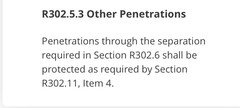
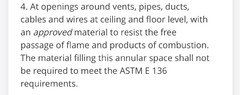
    Specifically the code states "Ducts in the garage and ducts penetrating the walls or ceilings separating the dwelling from the garage shall be constructed of a minimum No. 26 gauge (0.48 mm) steel sheet or other approved material, and shall have no openings in the garage."


    That is literally all there is. Can you show me some language that says the fire resistant drywall chase is necessary for a dryer vent?

  • 7 years ago
    last modified: 7 years ago


  • 7 years ago

    That covers the opening in the wall between the home and the garage, where the vent passes through. No doubt that has to be made fireproof or it renders the fireproof door to the garage useless.


    But there is no need to cover the entire vent pipe in drywall through the entire garage.

  • 7 years ago

    I, for one, would not want a dryer vent enclosed in a drywall chase. Especially on a long run where you could very well need to disassemble the vent periodically in order to clean it. (DIY cleaning vs calling a duct cleaning service.)


    Fireblock the penetration, for sure. I used Great Stuff Fireblock (orange foam) to seal where my dryer vent exit to exterior.