Software
Houzz Logo Print
webuser_475993395

Ground Cover Advise Under trees in NW

7 years ago
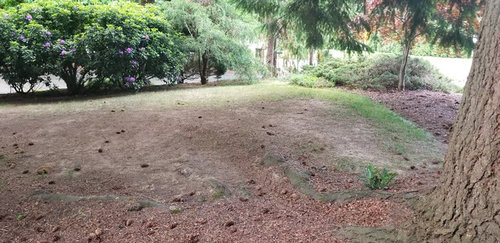


We have tried everything we know to grow grass in this area. Under the tree line is now basically bare dirt. We have tilled it, planted "grass for shade", etc. It will grow a little then not so much. We are even thinking of fake grass. Does anybody a success story for an area like this?

Comments (25)

  • 7 years ago

    I've tried everything I could think of under my large PNW maple tree, and the only plant that has worked is epimedium. It's a ground cover that thrives in dry shade, many varieties available. I love it.

    Richard Obendorf thanked einportlandor
  • 7 years ago

    Thanks Einportlandor.... I'm looking for something that we can actually walk on. Not heavy traffic just occassional. Something pretty dense. Do you know the type of epimedium that you planted?

  • 7 years ago
    last modified: 7 years ago

    In addition to the shadiness area shown is visibly quite dry (as would often be expected under conifers) - your shade grass mixture may have simply needed to be watered in summer, you didn't say anything about doing that in your post.

    Don't do anymore tilling under the tree if you want to keep it healthy.

  • 7 years ago

    Even a shade grass mix is not going to work well in this situation, despite any summer irrigation. It is just too shady and with other conditions not at all conducive to growing a lawn. I agree that another type of groundcover would work better however few are as walkable or tolerant of foot traffic as turf grass.

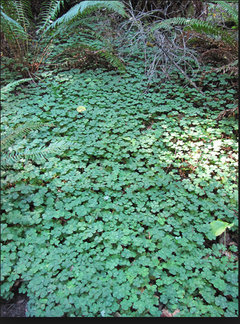
    Some of the better choices are native plants that thrive in similar environments in the wild - like salal or creeping Oregon grape. But these are not very walkable. And can sometimes look a bit too "woodsy" for a cultivated garden. Another choice is Oxalis oregana, aka redwood sorrel, a spreading herbaceous native groundcover that is able to photosynthesize under very low light conditions. This is a handsome little plant and one that I am finding very useful but it likes a bit of moisture so will appreciate summer irrigation

    There are also a selection of other very shade tolerant groundcovers you could use - wintergreen, Vinca minor, Himalayan maidenhair fern (Adiantum venustum), epimediums, London Pride (Saxifraga xurbium or primuloides) or deadnettle (Lamium maculatum). Some are more tolerant of dry conditions than others but all will need regular irrigation until established and several will appreciate some routine watering in our dry summers.

    A number of these are PNW Great Plant Picks, so well recommended for this area. Check them out to see what you like.

    Richard Obendorf thanked gardengal48 (PNW Z8/9)
  • 7 years ago
    last modified: 7 years ago

    The Evergreen Redwood sorrel (Oxalis oregana)


    There are not too many pictures of the redwood sorrel that show perspective (surroundings) but the appearance and characteristics look pretty good to me. Low growth, capable of light foot traffic. My area is pretty hard clay as you might be able to see in the original picture. I would love to hear any stories of personal experience with this ground cover. We have a sprinkler system for that area- so watering should not be an issue. Does anyone have an suggestions re: purchasing in the Seattle Area..? Planting tips... BTW- This forum is great!

  • 7 years ago
    last modified: 7 years ago

    The sorrel can sometimes be difficult to find. I'd look at native plant nurseries, possibly the Arboretum and at better, larger independent nurseries that carry a good selection of natives. Not all do :-)

    Richard Obendorf thanked gardengal48 (PNW Z8/9)
  • 7 years ago
    last modified: 7 years ago

    You really won't be able to trod on the sorrel with much frequency, same as any other flowering plant that isn't a very low and compact creeping carpet. (Look in the ground cover sections of large independent garden centers to see possible candidates, in later years there was even a supplier that was sending out a range of kinds supported by the promotional designation "Stepables", with tags identifying them as such stuck in each pot.) Otherwise if you want to see a local planting of the sorrel that is of some size and the environmental situation it is in visit the Kruckeberg Botanic Garden in Shoreline. They are open on weekends.

    Richard Obendorf thanked Embothrium
  • 7 years ago

    I wouldn't put much confidence with anything with a 'Stepables" tag being necssarily a reasonable replacement for lawn afa foot traffic is concerned. Many sold with that designation are not at all tolerant of foot traffic....even less so than the oxalis. And with the conditions that exist under the large conifer, your choices are going to be limited :-) That is a challenging gardening situation.

    The oxalis can also be seen in situ in large swaths at the Bloedel Reserve on Bainbridge Island, great day trip.

    Richard Obendorf thanked gardengal48 (PNW Z8/9)
  • 7 years ago
    last modified: 7 years ago

    "Stepable" will be very infrequent. I made a decision to move ahead with oxalis. Because they were cheap I purchased 300 seeds. $5 for 100 seeds and $2 for another 200. Now I am faced with the question of the best way to grow these seeds. Since it is the early spring I am thinking that I could simply plant them into the area. Any ideas regarding planting and growing these seeds? Even though I have a farming background this is not in my comfort zone.. i.e. in S Idaho, where I am from, I swear grass would grow almost anywhere. No moss! Of course no trees either!

  • 7 years ago

    Do the seeds not come with instructions for germination? I have never attempted from seed - far too impatient - but any online info seems to indicate a late winter/early spring planting with fresh seeds the best method.

    And I hate to tell you but it will be summer in only 2 weeks so well past "early spring" :-)

  • 7 years ago
    last modified: 7 years ago

    Time flys- almost summer. I'm impatient too but with seeds in the ground at least we are not totally hopeless. There might be redemption for that barren area.

  • 7 years ago
    last modified: 7 years ago

    These were definitely Oxalis oregana seeds, right? And the southern evergreen type like in your picture, and not the deciduous northern version like we have on the coast at this latitude?

    Richard Obendorf thanked Embothrium
  • 7 years ago

    It can be difficult to get plants est. from seed in the conditions you describe, I wonder if it would be better to start them in flats first? You might need some mulch for that area, at least until you get some plants going, and maybe create a walking path with less plant density?

    Richard Obendorf thanked J Williams
  • 7 years ago

    I was thinking of flats too. I also thought I might be able to create a small growing environment within said area, nurture them along, and then when appropriate separate them and replant the (hopefully) healthy starts in the whole area. However--I don't have any experience with separating and replanting starts like these. Back on the farm we would simply thin out the onions and sugar beets plants after they came up-- but not rip them out of the ground and replant. Sounds extreme when I say it. Maybe it would be better to start with a flat where I can replant a small root ball. I've been away from the farm for awhile but they were starting to experiment with planting starts- I'm not sure if it was cost effective on a grand scale. My scale isn't that grand :)

  • 7 years ago
    last modified: 7 years ago

    Look at local independent outlets for 4 in. pot sized ones, I just saw some at the Sorticulture event in Everett yesterday. And in the not distant past I have seen more than one named selection offered by retailers in this area - a body could get varying levels of purple-ness in the leaves and pinkness in the flowers. Including a form that had the bright green leaves of the northern type combined with the pink flowers usually seen only on the southern.

    Also the MsK nursery of the Kruckeberg Botanic Garden has offered flats (sod-like sections) of the plant in recent years but I suspect they don't have any of those right now. All the more so because they just had their big spring sale last month. But you should go there and see for yourself, I have not been looking for this plant specifically when I have been there this year (and I guess I did not make it to the spring sale, probably due to illness).

    Richard Obendorf thanked Embothrium
  • 7 years ago

    Kruckeberg garden has a small number of 6 in. pots for sale and a larger number of 4 in. These last were just potted so they won't be on offer for a bit.

  • 7 years ago

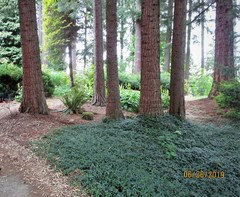
    Vinca minor might work. I have it planted under large trees where most plants won't grow without supplemental water.


  • 7 years ago

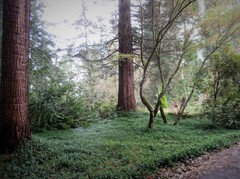
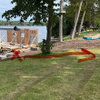
    Here's another view looking the other way. I never water this area. The only things I water are plants in pots.


  • 7 years ago
    last modified: 7 years ago

    Thanks for the pics Mike. My neighbor has offered me some Periwinkle (Vinca minor)- to replant. I think I may take her up on it. I've never tried to replant Vinca minor.. Any tips would be greatly appreciated.

  • 7 years ago
    last modified: 7 years ago

    Wait until Fall. Any piece of Vinca stuck in the ground will root. Might be a little slow to get started so use a mulch between starts.

  • PRO
    7 years ago

    Mike, that's lovely. So much better than bare, dry mulch.

  • 7 years ago
    last modified: 7 years ago

    This aspect of the plant should however be kept in mind:

    https://www.nwcb.wa.gov/weeds/periwinkle

    Note in particular this account linked to at the preceding page:

    https://www.nwcb.wa.gov/images/weeds/Periwinkle_Whatcom.pdf

  • 7 years ago

    If you live in an urban area or in suburbia without being surrounded by greenbelts, native areas or woods, you are quite safe planting vinca in the PNW. It does not have the ease/multiple means of propagation that typically define invasive species. It rarely produces any seed and spreads primarily by rooting stems/rhizomes. No direct access to natural areas = no spreading. And it is very easy to manage in the garden setting as well.

  • 7 years ago

    Another plant to consider for another color & height in that area is Geranium macrorrhizum, big root geranium.


    Its attractive foliage has an aromatic, spicy scent, and is nearly evergreen. Leaves turn red in fall. Maintenance is easy to get nearly year round foliage. Just cut back plants after flowering. I usually do it between Father's Day & 4th of July then water if not wet weather. Takes 2 weeks to look good again.


    Plus you may be able to get a start from another gardener. It is easy to just pull off the bigroot divisions to transplant in fall or early spring when soil is soft. Add mulch & you're set. I've done this lots of times. I'm 1 hour south of Bellingham. Contact me if you're interested in some starts. I have 3 colors.


    Another way to get them is attend a Green Elephant free plant swap in east Redmond. Held 4 times a year on the 1st Saturdays of November, January, March & June.