Software
Houzz Logo Print
heruga

What determines if you can divide perennials in spring or fall?

7 years ago

Sure some of them are common sense such as dividing ornamental grasses in early spring because foliage will be in the way of dividing if you were to do in fall. Adonis after they have gone dormant because it is too early to dig up the plant in February when they wake up from dormancy. But for others, what makes certain plants benefit from either spring or fall dividing? Peonies and filipendula are best divided in fall from what I hear but I don‘t know the reason behind it.

Comments (10)

  • 7 years ago

    The above is exactly the recommended timing....early blooming perennials get divided in fall; later blooming perennials get divided in spring. And ornamental grasses also get timing differences depending on whether they are cool season grasses (fall division) or warm season grasses (late spring division).

    fwiw, I do not consider the summer solstice (June 21st or thereabouts) as midsummer :-) In the US that is the official start of summer. Midsummer to me is middle to late July.

    btw, this is also the practice advocated by Tracy diSabato-Aust in her definitive text, The Well-Tended Perennial Garden.

  • 7 years ago
    last modified: 7 years ago

    I see. That makes sense now. Although I’m curious how do you possibly divide a shrub? Without breaking its main trunk? Certainly doesn’t seem possible to me to divide azaleas without breaking its main trunk in half. Raspberries and aralias I know are suckering so you can divide a baby shoot in early spring but shrubs with only one crown?

    ... I actually own that book. My co worker back when I was an intern at a botanical garden gave it to me as a graduation gift. I should’ve read it more thoroughly.. I just mostly read individual plant info and only skimmed through the general maintenance and care part of the book. Maybe it’s time I start re reading it.

  • 7 years ago

    Most woody plants are NOT divided. Only suckering shrubs lend themselves easily to this process.

  • 7 years ago

    I didn't suggest dividing shrubs (although multi-stemmed subsghrubs such as santolina, young lavender and shrubby salvias can be divided with a sharp spade). However, I do all transplanting, shaping, propagating, moving evergreens when in full midsummer growth. Don't need to get hung up about the exact dates because most plants will quite obviously fall into early/late categories (using a bit of common sense).

    Interestingly, I came across a gardener who endorses moving and dividing herbaceous plants while in full vigorous growth. Jimi Blake, of Huntingbrooke does this...emphasising that watering is key. Herbaceous plants can be cut back to diminish transpiration (not advisable with woodies though).

  • 7 years ago

    to simplify ... if you dont want to skip a year of bloom ... time the move or division so that it can be ready to bloom next season ...


    the Brits are very unique... being 2/3 of the way to the north pole.. and still being z 6,7,8,9 ... its that giant pond.. and the north atlantic wind patterns that make it rainy and very mild ...


    that said.. i NEVER move or do anything in july and august... with 100 degree potential.. and hot nights ... no cool night recovery period .... and drought .. i invested in a lot of english garden books before i figured out.. the info didnt really equate to my gardens ... [no WWW back then .. in the prehistoric 19802 ...lol]


    so its very important.. when reading anything.. to try to figure out where the writer is.. and if it actually applies to your situation ... and when you find two differing opnions.. red lights should start flashing in your head.. and make you wonder.. where are they .. whats the reason .... https://makeagif.com/gif/flashing-red-beacon-light-LdLNsI


    ken


    ps: 100 F is really stinking hot in C ... lol ... put it this way.. if its so hot.. you feel like you will die if you start digging.. theres a chance.. the plant might die also ... lol ...


  • 7 years ago
    last modified: 7 years ago

    I have successfully transplanted perennials, shrubs including azaleas and trees(in full sun too) in July with no negative effect. Like you say frequent watering did it’s job. Although I start suffering myself from digging when temps are above 85 degrees like you say Ken lol.

    I also have 2 more questions regarding this. Are so called perennials that produce new growth on old wood such as chrysanthemum pacificums, dracocephalum argunense classified as sub shrubs ? I know montauk daisies and caryopteris are officially considered as sub shrubs but there are no info regarding certain perennials such as dracocephalum and C. pacificum as sub shrubs. I’m sure there are many more perennials that grow on old wood.

    One other question. So dividing is considered a method of propagation. That practically means a new life is born. So if you divide a perennial does that start over the plants life? I know that they retain maturity of the parent plant but is that also associated with its lifespan? Let’s say I divide a columbine, a plant with a very short lifespan and let’s say it will only live for 5 years. However if you divide it and you decide to grow the divided plant, does that start over its life span and live for another 5 years? Or say that I decide to divide my 5 year lifespan columbine at 3 years old. If the lifespan does not renew does that mean the newly separated plant will only have 2 more years to live? The 5 years is just an example I’m using, I’m not saying columbines all have a lifespan of 5 years. Also please don’t say they reseed a lot to make up for it’s short life span. I’m already aware of that and that’s not what I want to know. I’m also curious if biennials like forgot me nots Renew their 2 years lifespan by dividing them..


  • 7 years ago

    No, forget me nots won't live longer if you divide them and I'm not even sure it's physically possible to do so. They don't develop a crown.

  • 7 years ago
    last modified: 7 years ago

    Actually Heruga, you have brought up some interesting questions there. The age thing is quite important...which is one of the reasons, when propagating, we usually look for juvenile plants...but, the effects of pruning and division also goes both ways since pollarding/coppicing a tree will significantly lengthen it's lifespan while division is a necessity with vigorous perennials such as heleniums which will die off without dividing at least every other year.

    I will have to search out my college notes (way back to 2006)...or mooch about the internet...but I confess to spending far too much time doodling in my work books and hanging out in the greenhouses instead of paying full attention. Whole sections of soil science (anions?) are lost in the fog of memory...and caregories of shrubs/subshrubs have always been a little vague in my mind.

    Ken does make a perspicacious point regarding origins of garden writings. Huntingbrooke, Jimi Blake's garden is actually situated in lush Ireland - a long way from arid East Anglia...but if water is available, it is one of the easiest conditions which need to be met for successful plantwork.

    While your endless queries can seem a little irritating, Heruga, they are a sign of an actively curious mind and should be applauded...but the thing is, you will also learn as much by experimenting, taking risks and accepting that there might (will) be fails.

  • 7 years ago

    @ Heruga


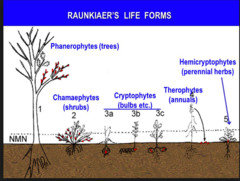
    there is a botanical specification of plants/ life forms which is based on the location of the buds that overwinter


    so, strictly speaking perennials are hemicryptophytes, the rest has other names/ categories


    short lived plants dont really live longer after dividing (columbine having a tap root reacts badly to dividing...)

    ---

    having said that I know that some old, fancy cultivars of Viola cornuta-hybrids are propagated by cuttings, so at least this seems to help with the life span...


    there are some species of which single specimen grow really old


    off the top of my head:

    herbacoius Paeonia

    Hemerocallis

    Hosta


    ----

    apart from that most plants move about when multiplying, so the genetics should be more or less the same, but by growing new shoots and buds the plant keeps young in a way.


    ---

    I think the "inner age" of cells can be a factor when cloning animals(?) otherwise tissue culture overrides that I think


    and I read somewhere that with clumping bamboo (Fargesia) the plants and all its divisions would flower in the same year and then die, so their "cell age" is the same


    sub shrubs (suffruticosa) are part of the chamaephytes


Sponsored
Peabody Landscape Group
Average rating: 3.5 out of 5 stars8 Reviews
Columbus' Reliable Landscape Design & Contracting