Software
Houzz Logo Print
webuser_784937324

moisture/water in basement

7 years ago

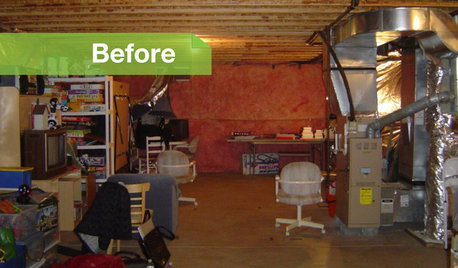
We're well into a gut-renovation and expansion of our 1920's colonial, and we've run into a moisture issue in the basement. Hoping someone out there can help us out!


In the early part of the renovation, our contractor ripped out some old raised/elevated wood flooring in the basement, exposing the original concrete floor. We were told that the elevated wood flooring was there to minimize issues if there was ever flooding in the basement.


Our contractor thought it would be fine to place tile directly on the concrete floor. In the winter months during our renovation, we did not have any obvious moisture issues. A few weeks ago in June, our contractor went down to the basement and noted that the entire tile floor was covered in drops of moisture, and mold had started to grow all over all 4 walls of drywall. I don't think we had any cracks in the concrete floor or cracks in the foundation itself. There were no large puddles, just beads of moisture all over the tile floor.


Of note, we also have a new 3-story addition on new foundation, which extends the square footage of the original basement. The original basement is where all the moisture is. The new addition to the basement is dry.


Our contractor says he has never seen this before. He spoke with our HVAC person, as well as someone supposedly familiar with waterproofing homes. The consensus is that it does not seem like we have a crack or leak in the foundation or floor, but this might be due to poor drainage under the original basement itself, leading to condensation.


From what I'm reading online, rather than condensation, it seems more likely that this is due to water evaporating through the porous concrete slab floor.


It seems that my options include:

-Improving the drainage around the house (making sure the grade is accurate, placing french drains?)

-Installing subflooring to elevate the floor

-Installing some kind of vapor barrier

-Commercial grade dehumidifier


I'd very much appreciate your thoughts! What do you think we should do? And please be gentle--I'm a first-time homeowner with zero baseline knowledge about these things. Thank you!


Comments (13)

  • 7 years ago

    yep you've done your homework. All options listed should be incorporated. But I am no way a professional get three opinions/estimates from some bonafide basement waterproofers in your area. Also the city/township engineer may be able to offer some advice.

  • 7 years ago

    Where are you? My guess is the temperature of the slab is cold enough that the humidity in the air is condensing on the floor. The subfloor prevented this problem by being separate from the cold slab.

  • 7 years ago

    Thanks to both for your thoughts. Mainenel, we are in Westchester, NY, a suburb just north of Manhattan. I’ve been thinking about this more and more after your comment. Perhaps it is condensation after all. I believe the tile that was placed directly on the concrete is porcelain tile, which I believe is not very porous or permeable. Hard to imagine that water seeping up from the concrete could possibly seep through the tile as well.


    I guess it it could be both issues, though? Maybe the water is seeping up through the original concrete and causing some degree of generalized moisture, then it’s resulting in condensation on the cold tile floor. There must be some reason why the new addition stays dry but the original

    basement had the moisture issue. It can‘t be purely a condensation issue, otherwise both the old and new basement would have the same issue, no?


    Very grateful for the comments so far!

  • PRO
    7 years ago
    last modified: 7 years ago

    Hard to guess without more info but didn't the new portions include modern details to help prevent moisture intrusion? Even if the spaces are well connected, moisture will condense on coldest surfaces which would be the portions without insulation.

    The moisture could be coming from ground, walls and air-leaks, but also interior sources like poorly vented bathrooms and cooktops. You might consider a home performance contractor evaluate your situation and start with a blower door test if you haven't already. A dehumidifier could work but is a sort of band-aid. If an oldish or cheapo water heater is down there, consider replacing it with a heat pump water heater which has dehumidification benefits.

  • 7 years ago

    There are SOOOO many reasons why this is happening. The slab will be porous (no vapour barrier underneath an 1920's build). The ground water under the house could be moving up (global warming and rising sea levels anyone?). The condensation, aka sweating slab syndrome (yep...go ahead and google it), is a very likely culprit. Excess air moisture together with poor ventilation (whole home dehumidifier for the East Coast somewhere around Manhattan?).


    All of these are candidates for your issues. In fact, I'm going to bet all of them are working in concert to create this issue.


    One way to see if the slab is causing issues it to see if there is efflorescence occurring. You would see this in the grout lines...it should look like someone spilled salt over the area. It should 'scrub off' but then come back rather quickly. If this is visible (the tiles could be so new this hasn't shown up yet) then we know the slab is part of the problem.


    Did your renovations include a 'wet basement' professional who came in and sealed the entire 'old' basement (including the concrete/brick walls)? If not, then this might be where you have to start.


    But definitely get a dehumidifier down there ASAP! Like yesterday. You do not want 'mold remediation' added to an already expensive fix.


    Photos would be super helpful.

  • 7 years ago

    Thanks SJ and Springtime Builders. We did not have a basement waterproofing expert on hand. Definitely should have done this before starting to finish the basement!


    The house had been gutted, including the basement. We had basically exposed concrete floors and walls (foundation). No visible cracks. The walls (old and new) were insulated before the drywall was placed.


    Our contractor thinks this is a condensation issue. While he does think there are drainage issues under this very old house, he thinks addressing this would involve tearing out the concrete floor and digging several feet further to install a drainage system and would be extremely expensive.
    He does not think we have a crack/leak in the slab or foundation. He has advised that we install this:


    https://www.wavehomesolutions.com/wave-moisture-control-basement-unit/


    Of note, as the house is nowhere near being completed, none of our HVAC components are up and running yet, so there's no air circulating in the house at all. Perhaps once the house is powered up (and with the addition of this ventilating/circulating unit), the moisture issue will improve?


    Is there a reliable way to test if we are dealing with condensation vs seepage from a porous slab?


    We are not currently living in the house and are not on-site regularly. I will try to take some photos, especially if there are active moisture issues when I am there.


    Thanks again to all!

  • 7 years ago

    Tape down a piece of impervious material like aluminum foil on top of the tile and leave it for a day or two. If it is condensation, the moisture will be on the top of the material, if seepage, it will be underneath. Of course, you may have moisture both places but at least this might help you understand the issues more clearly.

    In my previous house of that era, we had an underground drainage system and after a heavy rain, we could hear water drip into our sump pit. However, there was one place on the floor, probably 5 feet from the exterior wall, which would get wet after a rain. The first few times we noticed it, we thought it had to be a spill from the sink or somehow coming from the window well. Over the years, we concluded there must be an issue underneath the slab at that place, likely two drainage pipes with a small leak in the fitting. We ran a dehumidifier in the summer and that took care of the jssue.

  • 7 years ago

    Uh Oh. You have completed walls/floors/interiors WITHOUT power/HVAC? Oi vey. Not good. Every single warranty hangs on "Indoor living conditions" being maintained before, during and after the installation of ANYTHING...especially drywall/lumber in a basement.


    You will need to remove anything that has mold showing (could require remediation...but might not) and cleaning everything properly...and then turning EVERYTHING ON. Get your HVAC up and running (and start paying the bills for it) and keep it running....forever.


    Once you have your HVAC and your whole home dehumidifier up and running, you can then reassess the issues in the basement. By drying out the air (with your whole-home dehumidifier) you will remove the possibility of condensation. Once the condensation issue has been solved you can then reassess your slab concerns. This is where efflorescence (or lack thereof) will point you in the right direction.


    But first...your HVAC needs to run and you need to have any/all items with mold on it (drywall, lumber, etc) removed and replaced. And then HOPE that it doesn't come back.


    Photos would really help.

  • 7 years ago

    I agree with above suggestions.

  • 7 years ago

    SJ McCarthy: Uh oh. Yes. Yes we did. We have electricity of course so I just told our contractor to speak with our HVAC guy to turn on the AC and get that going. I do not think we installed a whole house dehumidifier, but I'm reaching out to the HVAC guy to do so. We'll have to rip out dry wall if that involves more ductwork, but I think it needs to be done, no? Is installing a whole-house dehumidifier a standard step in HVAC work for a gut renovation? It was never suggested to us or discussed as an option. The only HVAC decisions we made were to split the house into multiple zones and have two dedicated heating/AC units (basement and attic), and to replace all the existing ductwork.


    Is keeping the HVAC running a very basic and obvious thing that needs to be done when renovating a house? I don't think our contractor thought this was necessary, which worries me in terms of other things he may not have thought of.

  • 7 years ago

    The difference in the old and new construction could be that the new foundation has insulation under the floor slab making that floor warmer.

  • 7 years ago

    So while I don't know what can be causing the water on your floor tiles, we had our basement finished last fall (started in September, finished in December) and this was the basic order things were done:


    Waterproofing

    Framing

    Electrical (we had some electrical already in the unfinished basement but we added a lot more)

    HVAC (like above, we already had some vents but added more)

    Plumbing

    Insulation

    Drywall

    Painting walls/ceiling

    ..then flooring.


    So flooring was the absolute *last* thing to be done. We had a bathroom put in the basement and have porcelain tile in it, installed on the concrete slab. We have no water issues (knock on wood). We have LVP in the rest of the basement except for the unfinished storage area. We had the HVAC running the entire time renovations were being done. I live in the Midwest and get all 4 seasons. Our renovations started right after Labor Day so we actually did experience a ton of weather differences in the months our basement was being finished. There was no way I was going to let our contractors work in sweltering conditions, nor freezing conditions, but I was also told the HVAC needed to run to keep things at a relatively constant temperature.


  • PRO
    7 years ago

    You've experienced some hot, humid weather conditions. My bet is that you've got condensation occurring on the (relatively) colder floor surface. In your climate zone, I don't think a whole-house dehumidifier is necessary, but I would definitely invest in a ducted dehumidifier for the basement level HVAC system.

    I'd rent a high capacity dehumidifier and get it running ASAP. Once you've got the relative humidity down below 60% the mold/mildew should become inactive. Get a professional's assessment of whether the drywall needs to be removed. You may be able to treat the mold/mildew and carry on.