Software
Houzz Logo Print
heruga

Will Camellias grow in borderline hardy zone?

7 years ago

I'm in zone 7a. I have never attempted to try growing camellias before. Aside from hardiness issue I hear that they are susceptible to a lot of diseases just like fruit trees and is not worth growing. Is that true. I want to grow camellia hiemalis 'Shishigashira'. I plan on having it under some deciduous tree but not surface rooted ones like maples.

Comments (18)

  • 7 years ago

    playing the zone pushing game.. can be very frustrating.. and very expensive ...


    in my experience.. things thrive for a number of years.. until you get excited enough to brag that you succeeded where other locals have failed ... and then that one colder than normal winter rolls around.. and kills it ... whatever.. i just quit trying to beat ma nature ...


    ken


  • 7 years ago

    As with anything that is borderline hardy for your zone, it will grow until some sort of out of the ordinary winter conditions knock it back or kill it.

    btw, camellias are no more easier or harder to grow than any other evergreen shrub, provided you have the correct conditions for them. There are a couple of diseases that can affect them but nothing like what can affect fruit trees. IME, they have very few issues.

    There are an assortment of camellias growing in the Brooklyn Botanical Garden, including a number of fall/winter bloomers. And that is a hardiness zone very similar to your own.

  • 7 years ago

    Well this is why I plan on planting the camellia in a sheltered location such as near a fence. Right against a foundation may not be ideal since it may give off alkalinic effects which the camellias do not prefer. But if anything I can place a temporary fence around it and stuff it with leaves or something just for the nights it goes below 0 degrees. There is an aucuba japonica at my workplace that survived a -2 F with just a thin layer of snow cover so I have my hopes.

    I always had the impression that camellias are like daphnes where they just die randomly on you or gets stricken by some disease no matter how much you care for it. I plan on getting one next spring. Brooklyn is slightly warmer than I am and there are lots of buildings in that city so I think it give it even better protection.

  • 7 years ago
    last modified: 7 years ago

    Of course you will need to search out only the hardiest varieties. 'Shishigashira' is not one of the hardy ones and you may be in for a disappointment. Generally I find the spring bloomers (japonicas) to have a hardiness edge over fall bloomers -- and have more success blooming. Fall bloomer in the north often have their bloom periods cut short by the cold weather.

    Whatever you plant, make sure it's well watered going into the winter and well mulched. As for siting, make sure it gets winter shade. Sun in winter, especially in the mornings will often cause severe die-back in cold winters or extended cold periods.

    The other thing is to make sure you plant the largest plant you can afford. At least a 3-gallon. Smaller plants are more vulnerable to winter kill.

  • 7 years ago
    last modified: 7 years ago

    That's why experimenting with particular garden plants beyond their expected cold tolerance parameters has been called "Zonal Denial". And if there is a history in a climate area of specific temperatures that kill off such plantings having occurred, then those temperatures aren't in fact abnormal for that area - if it happened blank number of years ago it can happen again any time*. With how long ago the last killer winter was being therefore irrelevant. Also hard winters can come in clusters, so that re-planting immediately after one because "it's not going to happen again for 30 years" has the potential to backfire as well.

    *Unless and until Climate Change has actually produced a permanent shifting to significantly higher minimum temperatures in that same area

  • 7 years ago
    last modified: 7 years ago

    Zone denial is easier with geophytes (bulbs) because the bulbs are underground. I too would love to do camellias, but it's just a shade too cold (7a). And my 7a is warmer than yours.

  • 7 years ago

    Heruga, camellias are extremely easy to grow, as long as you aren't pushing the temperature zone. I don't know where you heard/read that they are tempermental plants as that is absolutely not the case.

    My north Alabama location has recently been elevated from zone 6b to 7a. Camellias are everywhere, growing perfectly in the hard red clay that is native to the area. I don't see the long hedges of them that are common to the deeper south, but remain a fairly popular specimen shrub.

    My neighbor has several planted as a foundation planting, against a concrete and brick.

    I am not familiar with C. hiemalis and its cultural requirements. A quick look indicates that it's not particularly different from the common C. japonica or sasanqua.

  • 7 years ago
    last modified: 7 years ago

    I have grown Camellia japonicas in the Metro NJ/NYC/Zone 7A area for over a decade. My varieties are 'Kumasaka' and 'April Promise'. Have never had any issues with diseases and do not find them finicky at all. My bushes are near the south side of the house (but heavily shaded in the summer by a large Japanaese maple 'Bloodgood'. My problem is that the local DEER have recently discovered that Camellias are edible. (I have the same issue with Aucuba japonica, and Euonymus japonica btw.) The 'April Promise' is seven feet tall so the deer can munch at the lower leaves but can't reach the upper portions (so they helped to create a 'standard'), but I had to containerize the 'Kumasaka' plants as they are still short and were bothered by the deer last winter big time. Once they get tall enough, I will plant them in the ground.

    P.S,, Btw, which species are hardier japonica or sasanqua?

  • 7 years ago

    If you do the research, there is a whole series of camellias that have been bred for colder, more northerly climates. They often have names beginning with 'winter' or 'April' - 'Winter's Joy, 'Arctic Dawn', 'Winter Waterlily'. 'April Tryst', 'April Remembered', 'Winter's Interlude' are just a few. Most are hybrids involving C. sasanqua, japonica and oleifera.

  • 7 years ago

    Yup, I am only looking to get the hybrid and not the pure species of either C. Japonica of sasanqua. I’ll try it out next year. I was in hesitation because according to Missouri botanical garden, there were a bunch of diseases and issues that could affect camellias. And many plants in that website has it written ‘no serious problems‘ but Iwhen I saw the whole list for camellias it got me jumped. Btw aucuba japonica is also zone 7 hardy and they are everywhere here including many nice sized specimens. Some are even at my workplace which is zone 6a and they are doing just fine.

  • 7 years ago

    I too think Shishi is not a good choice for NJ. It is a nice selection and compact. It starts to bloom here in early October; late October to early November in North Carolina. However, I would be concerned that drops to 0F or below might kill or seriously damage it. Although not as compact as Shishi, Autumn Spirit or Winter's Peony are more cold hardy selections that would be better choices for NJ.

  • 7 years ago
    last modified: 7 years ago

    Yeah, I have seen some decent looking (not stellar mind you...because I've lived in other more southerly areas and seen stellar) aucubas here, they seem much hardier (well more hardy at least and much more resilient to getting knocked back and recovering).

    Most nurseries here stock aucuba and I have seldom seen camellias except in big box stores where they typically have zone inappropriate plant materials.

  • 7 years ago

    Heruga, check out THIS earlier thread on this topic. Dr. Ackerman wrote the book and did the work on this topic, for sure get his book.

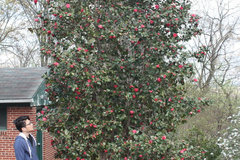
    Pictued below is C. japonica 'Variety Z' The Z is for a researcher named Zimmerman from the Boyce Thompson Institute in Yonkers.

    In your zone site it in a well protected courtyard or something similar. Perhaps a church, hospital, campus or something similar protected from winter exposure.

  • 7 years ago

    I've had so-so experience with camellias in my zone 6/7 environment. Keeping them alive is one thing but seeing them flower is another. I've had lots of flower buds killed from a cold snap. Fall and spring. Be prepared to have your heart broken!

  • 7 years ago


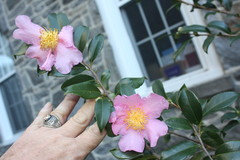
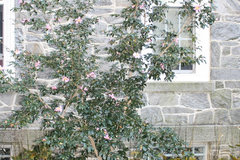
    Camellia 'Winter's Star' pic taken around Thanksgiving in a protected courtyard of Swarthmore College (south of Phila) Many flowers already on the ground.

  • 7 years ago

    Does anyone know about camellia hiemalis 'kanjiro'. I see some websites state this as zone 6. Is this cultivar worth trying? Keep in mind I only want a camellia that is strictly C. japonica x C. sasanqua=camella hiemalis.

  • 7 years ago
    last modified: 7 years ago

    Kanjiro is not hardy enough for you and it just does not bloom early enough for zone 7a or colder. It tends to want to start blooming in January in my region. Best where winter lows never go below 5ºF (= zone 7B and warmer). I have Kanjiro and I rarely see it bloom.

    Why are you limiting yourself with 'strictly C. japonica x C. sasanqua=camella hiemalis.?'

    For hardier fall bloomers, please consider C. oleifera hybrids. Dr. Ackerman made a whole series of hybrids.

    My best fall bloomers are 'Ashton's Supreme', 'Winter's Rose', 'Winter's Fire', 'Ashton's Ballet', 'Snow Flurry' (highly recommended!), as well as just pure C. oleifera. Also consider 'Winter's Star', and 'Long Island Pink'.


    https://www.washingtonpost.com/lifestyle/home/fall-blooming-camellias-bring-down-the-curtain-on-the-growing-season/2015/11/17/3e61f87c-88b7-11e5-9a07-453018f9a0ec_story.html?utm_term=.04d8d1c6ea1c