Software
Houzz Logo Print
webuser_125126325

Old clock need help identifying

6 years ago

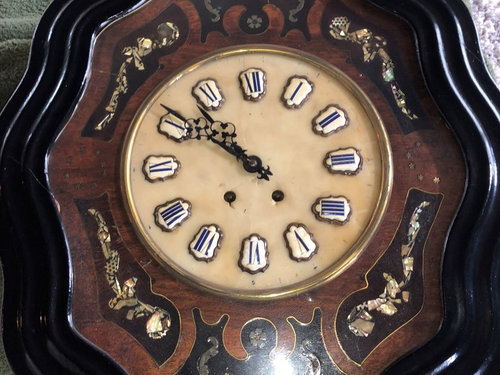
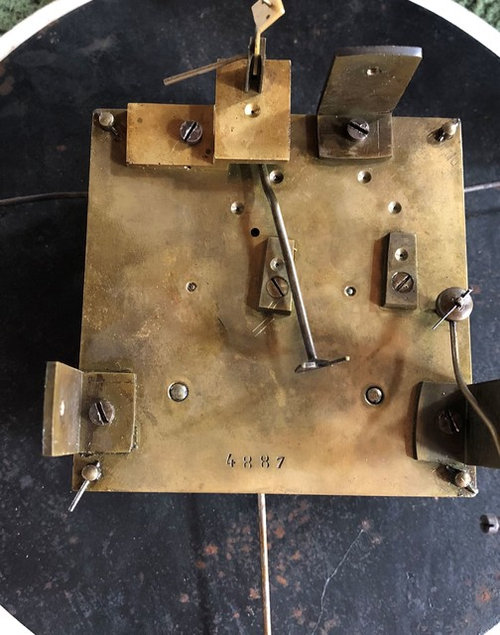
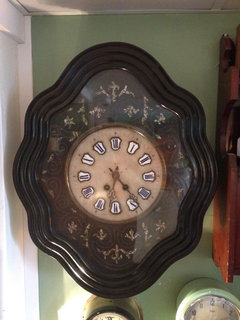
This old-looking clock was found in a recently purchased house. I am not sure how old it is or where it originated from but it looks like its been through a lot! I have attached some photos. I am no clock expert so any feedback on age/origin or value would be a great help. Based on some internet searching it looks similar to images of a "French Baker's Clock" but that's all I've been able to find so far. I believe all parts are present/functional but it appears to need some attention from an expert. Any feedback is greatly appreciated!


Comments (10)

  • 6 years ago

    I forgot one picture


  • 6 years ago

    Hmmmm? How big? does it sit or hang? Chime? what chime? What's the case made from?


  • 6 years ago

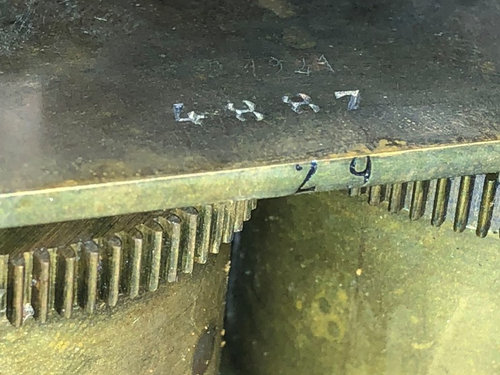
    I did wonder at the odd reflection on what would be the sixth picture. Under the 29 on the rollers there appears to be a slightly elongated round object with darker circles side by side in it. My first thought was someone had put a skull on one then decided it was a reflection of something.

  • 6 years ago

    This one appears quite similar:

    This is a quality French wall clock with mother of pearl inlay
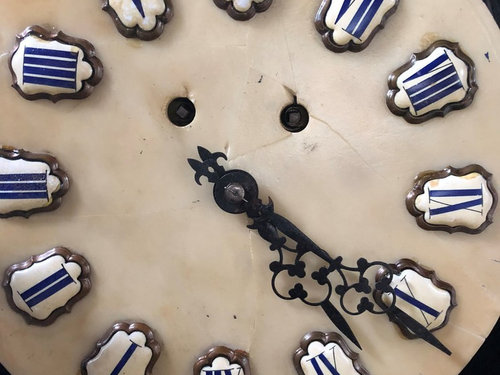
    decoration. The face is alabaster with porcelain roman numerals. Steel
    hands and an 8 day comtoise striking movement. With original glass and
    bezel. Striking the 1/2 hours and hours on a gong.


    This piece is in good working order striking on the hour and the half.

    https://www.loveantiques.com/antique-clocks/french/french-oval-comtoise-wall-clock-c1850-104704

    HU-125126325 thanked Olychick
  • 6 years ago

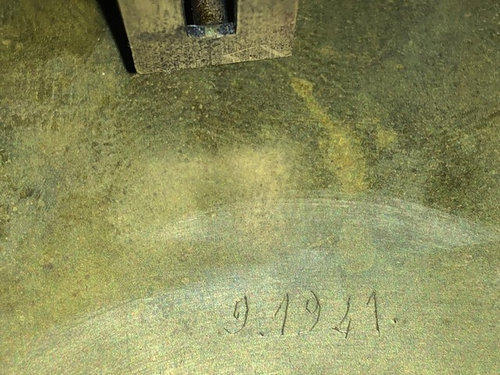
    Your last picture shows what is apparently a date: 2.1941. This would be February 1941. This could be the date it was assembled, or it could be a repairman's date. From this, I'd say that it was as old as 1941 and could be earlier.

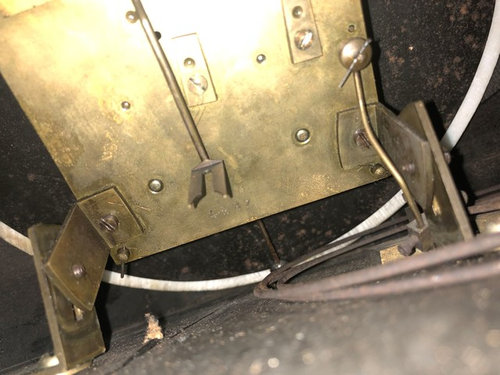
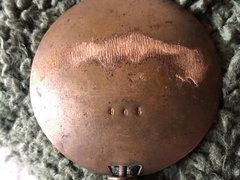
    The pendulum weight is stamped with the number: 906. This could be a part number or pendulum style.

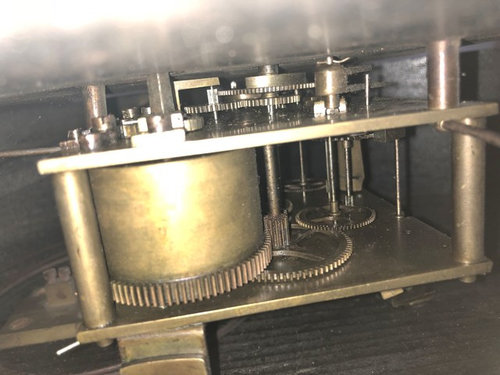
    That item that someone called a roller is not a roller. It is a drum that contains a power spring.

    The Roman numerals on the clock face all point to the center of the face, thus numerals 4 through 8 are upside down. This was the style of early clocks and at some point, clock makers turned over numerals 4 through 8 so that the '6' was right-side-up. I have forgotten at what date this occurred; I believe it was in the 1800s. However, this was not a hard rule that everyone adhered to; It was more of a style change. Since your clock has a rather compact spring driven mechanism, I do not think is was built in the 1800s. Yet today, some clocks are made with all numerals pointing toward the center simulating an old clock.

    Many early clocks ca 1830 were weight driven. A number of spring contraptions were tried before the introduction of the power spring, but it was difficult to build a clock that could run for 8 days with these primitive devices, The introduction of the power spring made it possible to shrink the clockworks and have a run time of 8 days. Early power springs had a habit of breaking until better technology and stress analysis improved this spring.

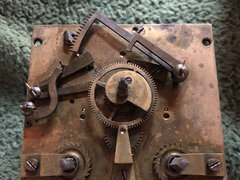
    The construction of your clockworks does have design elements that were in use during the 1830s. Its frame is two flat plates. The base plate has 4 pins riveted to it and the top plate slides onto these pins. The pins have a reduced diameter on their upper ends making shoulder pins. The top plate rests on these shoulders. That top plate is fastened by tapered pins inserted through holes in the frame pins. I do not know how long this type of construction was used. I do know that it was common in the 1830s for weight driven shelf clocks. The other element is the beveled holes for the shafts of the final gears in the gear train. This little recess is a oil reservoir for lubricating the shafts. Oil will stay in this bevel by surface tension if it is not flooded. Unfortunately, these details do not pin down a date for this clock.

    Look over the interior of this clock case. Was there a label? A Maker's label was often put in quality clocks and these labels can be very helpful in determining a date. The label may have the date of invention or patent. This label may be on the inside of the case back. If it is there, use care to preserve it.

    There can be up to 3 identities in a clock: The manufacturer of the clockworks, the case maker, and the business establishment who distributed and marketed the clock. Often, a clock maker buys the clockworks and installs it in his case. In another example, a jeweler may specify the clockworks, its pendulum and contract with a clock-maker to make the case and assemble the clock. The Jeweler's name may appear on the clock label. Hopefully, he credits the others involved.

    HU-125126325 thanked jemdandy
  • 6 years ago

    Thanks for giving the proper name for what I mentioned as a roller as I did not know what the proper name was. I only knew that it moved as part of the clock mechanism.

  • 6 years ago

    Thank you for all of the additional information and detail. So far I have not been able to locate any more identifying information so far. Here is a photo of underneath the face. I am hesitant to disassemble it any further.


  • 6 years ago

    Go to the site below and scroll down to the 6th photo to find your striker mechanism. It is French made.


    http://www.abbeyclock.com/japy.html

  • 6 years ago

    Since the clock runs well, do not disassemble the clockworks. There are several adjustable pieces present, and some may require bending to adjust. The main reason for taking it apart is repair or total cleaning.