Software
Houzz Logo Print
paola_b

Rose Mosaic or deficiency?

7 years ago
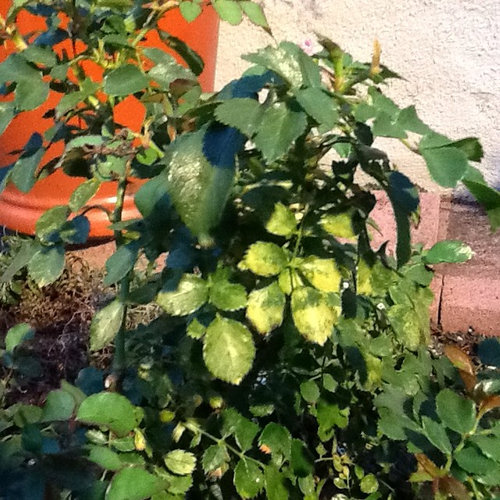
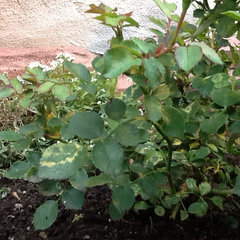
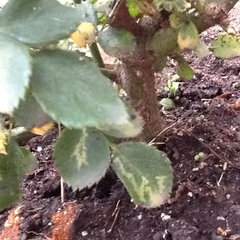
I have a two-year old Bonica, own root. This summer it started to show the yellowish pattern on its leaves. Does it look like some sort of deficiency or rather RMV and if this is Rose Mosaic what shall I do?

Thank you so much,

Paola

RoseCare · More Info


RoseCare · More Info


Comments (35)

  • 7 years ago

    I would like to see some crisp detail of affected leaflets, if possible.

    paola_b thanked rifis (zone 6b-7a NJ)
  • 7 years ago

    Agreed. But, based upon how that appears to be older foliage, therefore potentially yellowed because of other issues and not new foliage, which is where the mosaic patterns appear and remain until the foliage falls, my preliminary vote is not viral and potentially too much water or fungal issue.

    paola_b thanked roseseek
  • 7 years ago
    last modified: 7 years ago

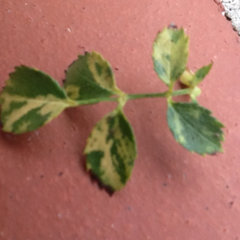
    Thank you both. The plant is almost three years old and barely one foot. Green all around and producing some blooms. I do fertilize and water regularly. The adjacent Iceberg, about three feet away, is not affected. Here are some more pics.

    RoseCare · More Info


    RoseCare · More Info


  • 7 years ago


    RoseCare · More Info


  • 7 years ago

    Thank you. This clears it up. These appear very distinctly to me to be RMV infected. Just because this plant is infected, does not mean the Iceberg a few feet away is or will be.

    paola_b thanked roseseek
  • 7 years ago

    Thank you. Should I discard the plant and the soil?

  • 7 years ago

    It is planted in garden bed.

  • 7 years ago

    Holy scintillating scotomata, Batman!

    paola_b thanked rifis (zone 6b-7a NJ)
  • 7 years ago

    It is virus, for certain.

    What should you do? Well, possibly nothing. The virus is not in the soil, and its unlikely to spread to other roses (its not spread by casual handling of your roses) so unless you find the mosaic pattern on the leaves objectionable, or if the plant doesn't perform well ('Bonica' is a workhorse of a rose and will likely do just fine in spite of virus) then there's no real need to dispose of it. Its all about how you FEEL about the plant, knowing it has a virus.

    Many mass-propagated (grafted) roses have virus in them, they just don't show it.

    paola_b thanked User
  • 7 years ago

    In zone 10, if you are observing symptoms now, it is probably not PNRSV (a common temperature dependent virus). I would not make any statements about how it (they) is (are) spread until the virus (es) is (are) identified (I use is/are because it could be infected by several viruses).

    https://sites.google.com/site/rosevirusindexpage/

    paola_b thanked henry_kuska
  • 7 years ago
    last modified: 7 years ago

    I would be far more concerned with crown gall on Bonica in that zone than virus. I have encountered many Bonica plants over the years and, like Ballerina, The Fairy, all Flower Carpets and Francine Austin plants with which I have dealt, they have all succumbed to gall. I agree with Paul. If it offends you, pluck it out. If you like the rose and it's performing well for you, ignore it. When it begins to decline, look for gall.

    paola_b thanked roseseek
  • 7 years ago

    Contrast the excellent advice Paola has received here, from heavy hitters, with

    https://chaseagri.com/ask-ann/

    She (Paola) and we are fortunate indeed.

    paola_b thanked rifis (zone 6b-7a NJ)
  • 7 years ago

    Thank you for useful information and advice, for sharing your knowledge... very helpful and wise! I really appreciate-:)

  • 7 years ago

    It is great to have real experts on the forum! We are so fortunate and I am really appreciative too.

    paola_b thanked Sheila z8a Rogue Valley OR
  • 7 years ago

    Paola, I think those first pictures look more like the old leaves that roseseek mentioned. The second set of pictures is indeed RMV. RMV usually only shows up when the rose is stressed for some other reason. In your case probably the heat. Otherwise you may never see it again. In your climate it will probably never affect the growth or vigor of the rose. It can have a weakening affect in cold climates. However, if I got rid of every RMV infected rose from my garden I wouldn't have any left since they're all grafted and probably all in Dr. Huey, the worst offender for spreading it. I have roses here that I know have it and they have been here for 60+ years and are still growing and blooming. Even though I know they are infected I RARELY ever see the symptoms. If you keep your roses healthy and happy you probably won't either, weather not withstanding. .

    paola_b thanked seil zone 6b MI
  • 7 years ago

    What Seil said.

    And she's right. You could dig those plants out. Go out and buy new ones. And have a whole bunch of the identically-infected roses you had to begin with.

    I had a Reine des Violettes that we KNEW had to be infected with RMV. It grew here for 20 years before we saw a sign of it. I have other roses that I know to be virused. Some, I've NEVER seen it. Some, I've seen it once in 30 years.

    So, don't worry about it.

    paola_b thanked jerijen
  • 7 years ago

    Jeri,

    You just described my 30 year old plant of 'Rose de Rescht'!

    paola_b thanked User
  • 7 years ago

    All of the above is true and I, too, have experienced very similar occurrences. If it becomes an issue or if it already bothers you, rip it out.

    paola_b thanked roseseek
  • 7 years ago

    Paul Barden -- I've got a Sombreuil, Cl., planted in 1988. I've seen it on ONE leaf, ONE time. :-)

    paola_b thanked jerijen
  • 7 years ago

    Jeri and Paul, did both of those plants come from Roses of Yesterday and Today? They had a particular strain of PNRSV in them that was reluctant to show symptoms in some varieties. I think that may be where the mistaken idea came from that symptoms never show up in warm weather. In some varieties they very much do, and with some strains of the virus, they can and do on many varieties. I don't think our RoYaT 'Sombreuil' ever showed symptoms, when infected. Still, it was one of the first varieties we cleaned up in our program

    paola_b thanked malcolm_manners
  • 7 years ago
    last modified: 7 years ago

    Malcolm . . . BINGO!

    Of course they did! Back then (heck, increasingly like now) vendor choices were limited.

    So our first few roses came from -- YUP -- ROY&T. That was in 1987.

    (It wasn't until quite some time later that we discovered ARE, and Vintage -- and learned that Sequoia had more than Miniatures.

    I have a distinct and clear memory of Clay, and I, and Syl Arena, standing in my front yard looking at those roses, and discussing the fact that we KNEW them to be virused . . . but but but . . . we had never (yet) seen it.

    These days, there are relatively few probably-virused plants here, because so much of what we have, now, came from very old cemetery plants. (Some of them, you have tested, and found "clean".)

    Back then, beggars couldn't afford to be choosers. :-)

    paola_b thanked jerijen
  • 7 years ago

    I wonder where Sheridan got it?

    paola_b thanked roseseek
  • 7 years ago

    It'd be interesting to know, wouldn't it?


    paola_b thanked jerijen
  • 7 years ago

    The following was stated earlier in this thread: " I think that may be where the mistaken idea came from that symptoms never show up in warm weather. In some varieties they very much do, and with some strains of the virus, they can and do on many varieties."

    H.Kuska comment: is the above consistent with any documentation? If so please give the citations.

    Also, the above appears to be inconsistent with the following: "Mosaic disease causes swirly yellow or white "mosaic" symptoms on leaves of the spring growth flush. Most other times of the year, the leaves do not show symptoms."

    http://www.gpbrs.org/articles/mosaicvirs.htm

    Apparently the non temperature dependent rose spring dwarf virus has symptoms similar to some of the temperature dependent viruses that infect roses (see earlier link that I posted in this thread). It is possible that observations of symptoms of mosaic virus in the heat of summer are actually due to the rose spring dwarf or other non temperature dependent viruses. I specifically mention rose spring dwarf because the Texas testing of the roses supplied by Florida Southern reported that the most common virus found was rose spring dwarf (again, see my earlier link).

    To make it easier to look at, here is the actual rose spring dwarf link:

    https://sites.google.com/site/rosespringdwarf/home


  • 7 years ago

    Henry -- no one was discussing Spring Dwarf Virus -- so that just confuses the issue.

    You might want to open a discussion of Spring Dwarf Virus in another thread, to avoid needlessly confusing folks.

    paola_b thanked jerijen
  • 7 years ago

    I think it very important to recognize that the Texas testing results of our roses is UTTERLY irrelevant to this discussion, and really to ANY discussion of rose viruses here, in general. The population sent to them for testing was NOT typical! Remember, we are a rose virus treatment facility. OF COURSE we sent them infected roses -- we knew that and it was on purpose. We send known positives and negatives, as well as roses received from others, that we want to know what's in them. The concept that that population in ANY way represents roses in Florida or the US or really any population OTHER than that of a testing and therapy facility is ludicrous. If you wanted to find out the percentage of the population of Chicago who have some disease, would you do your polling ONLY in its local hospitals, assuming that population represented the entire city's population? I'll stop now. Appalled as always.

    paola_b thanked malcolm_manners
  • 7 years ago

    You know, once Henry chimes in with his "material", I unsubscribe from the thread because it KNOW where it is headed and I've watched that rerun twice too often. Thankfully, I waited just long enough for Jeri's and Malcolm's contributions and for them I only have to say, BRAVO! Thank you! So, NOW I shall unsubscribe as there is surely nothing more of any value left to come of this.

    paola_b thanked roseseek
  • 7 years ago

    "I wonder where Sheridan got it?"


    That would be interesting data, since it seems very unlikely that RoYaT was the source for Sheridan 25 years ago. That suggests that this cultivar may have been virused before RoYaT got ahold of it, although without knowing if the virus(es) infecting samples from each source is/are the same, one can only speculate. More unanswered/unanswerable questions.

    paola_b thanked User
  • 7 years ago

    I think I'll follow Kim's example, and follow this thread no longer.


  • 7 years ago

    This information is contained in the slides presented at

    https://ucanr.edu/sites/ncpnrose/files/292256.pptx


    As can be seen this is represented as the Fl Southern College OGR collection. If that is not what Malcolm Manners intended, I suggest that he request that the minutes be changed.

    This does not change the intent of my post. It is to show that rose spring dwarf virus is not just a west coast virus. As pointed out this is a aphid spread virus that shows mosaic type symptoms in hot weather. If a poster has mosaic virus symptoms in hot weather, I strongly suggest that advice such as "it won't spread" be considered possibly incorrect.

    :

    Test/Screen
    FL Southern College OGR collection

    ◉150
    plants

    ------------------------------------------

    ¤2017-2018:
    Upgrade lab capabilities, test/screen Florida Southern College (Manners) OGR
    collection, test/screen Moore & TAMU collection.

    ---------------------------------------

    ¤Continued
    testing of the FL Southern College OGR collection

  • 7 years ago

    I think Kim and Jeri are correct, so I intend for this to be my last comment here, for the "innocent bystanders" who may still be reading. For the record -- we have never seen summer symptoms on a rose with rose spring dwarf (which of course is not mosaic and is therefore not the subject of this discussion thread -- the photos above do not resemble in any way what rose spring dwarf does). Indeed, those roses in our collection that show warm-weather symptims have PNRSV or ApMV, or mixtures of PNRSV and ApMV (that combo is always strongly symptomatic, in my experience). But then, ApMV is exceedingly rare in US-grown roses, and almost unknown in the commercial trade, so again, it is an academic interest at a virus testing and therapy facility where it would even be seen. The probability of the photos above being ApMV or a mix of ApMV and PNRSV is so small that it can and should be ignored. As I've said before, if you feel like you're catching a cold, you should probably not immediately assume it's ebola and that you'll be dead in a week, just because their beginning symptoms may be similar.


    A rose that I can virtually always find symptoms on is one that we know (and the Texas A&M agrees with) has RoYaT's "mild" strain of PNRSV in it and nothing else. It's just a reaction in that particular rose. That doesn't change the concept that for MOST roses, they will be symptomless in hot weather, and so it's interesting when one sees the exception. The fact that exceptions exist (in this or any other area of life) does not mean the generalizations are not true or wise or useful.


    I'm assuming the concept that rose spring dwarf is a "west coast" virus likely comes from the now-very-old Compendium of Rose Diseases. They, like most books, tend to repeat material from older editions in new editions, unless some point has been challenged, and since rose spring dwarf is not a particular problem, likely no one challenged it -- for the average grower, it's of no concern. But it should be totally obvious to anyone who has thought about it that since there is free movement of OGRs between the coasts, it would have moved east decades ago. So nothing new here, nothing particularly interesting, and certainly nothing vaguely relevant to this discussion thread. From the standpoint of our program, obviously we wanted to know which of our roses might be infected, and until now had had no good method of testing for it. No, there is no need to go and changes anyone's minutes -- TAMU did, indeed, test a selection (MY selection) of roses from our "collection." It is only by gross misinterpretation and extrapolation that ANYONE could think that meant all of our roses, or that such numbers would, in ANY way, represent the "typical" virus infection status of the rest of the rose-growing world. Sheesh!


    So it's the usual, way-too-many-times-repeated problem here -- someone asks about mosaic, and knowledgeable people give knowledgeable, wise answers about mosaic. And then all hell breaks loose, as it is suggested that other, unrelated viruses are involved, that there is rampant contagion of all of those, and that no one knows what they're talking about. One would hope it obvious that the folks actually working with virus diseases are not all incompetent idiots, nor are all people living in warm climates incompetent idiots. Yet that always appears to be the suggestion in these discussions. It becomes necessary to be lectured by someone who, so far as anyone knows, is not a virologist and has never done any plant virology research of any kind.


    So consider your sources of information, folks, and continue to grow healthy roses! The sky is not falling. You don't have ebola. The rose pictured above probably has a 99.99% probability of being PNRSV (no I'm not going to back that statement up with hard data, but that doesn't change the truth or the wisdom of it). Happy rose growing!

  • 7 years ago

    @malcolm_manners


    "It is only by gross misinterpretation and extrapolation that ANYONE could think that meant all of our roses, or that such numbers would, in ANY way, represent the "typical" virus infection status of the rest of the rose-growing world."


    And with that, I think we are done comparing Apples to Tardigrades. Thank you, Dr. Manners.

  • 7 years ago
    last modified: 7 years ago

    " "It is only by gross misinterpretation and extrapolation that ANYONE could think that meant all of our roses, or that such numbers would, in ANY way, represent the "typical" virus infection status of the rest of the rose-growing world."


    The above statement appears to be Malcolm Manners interpretation of what I have presented not what I have actually presented.


    I gave actual links to what has been reported. Regarding the rest of the world the following is the actual statement that was made by me:

    " January 2018 general article about rose viruses from National Clean Plant Network adds rose spring dwarf virus to those listed as found world wide.

    http://nationalcleanplantnetwork.org/files/276825.pdf

    The main difference between it and earlier articles (to me) is that it states: " Several viruses are found worldwide, including Prunus necrotic ringspot virus (PNRSV), Apple Mosaic Virus (ApMV), and Rose spring dwarf-associated virus (RSDaV."

  • 7 years ago
    last modified: 7 years ago

    The following was stated: "But then, ApMV is exceedingly rare in US-grown roses, and almost unknown in the commercial trade, so again, it is an academic interest at a virus testing and therapy facility where it would even be seen."

    ------------------------------------------------------------------

    H.Kuska comment. See:

    https://www.ars.usda.gov/research/publications/publication/?seqNo115=339038

    Please note that this manuscript is listed as last modified 8/23/2019.

    -----------------------------------------------------------------------------------

    Also, see the version at:

    https://ucanr.edu/sites/ncpnrose/files/285803.pdf

    The roses checked are described:

    "Rose virus collection (RVC)
    • Over 18 years, we identified 600 roses to maintain a
    collection for further evaluation
    • None of these roses qualify as foundation material"

    ---------------------------------------------

    Used: "Up to 254 samples tested as individuals or composite
    samples of up to 20 bushes of the same genotype"

    -----------------------------------------------------

    Viruses found :

    ===============================

    Apple mosaic virus (ApMV) -

    Season - Fall 2016

    Total #samples - 243

    Single test - (31/92) 33.7%

    Composite test - (24/151) 15.9%

    -------------------------------------------------------------

    Season - Spring 2017

    Total # samples - 254

    Single test - (40/103) 38.8%

    Composite test - (23/151) 15.2%

    ====================================================

    Prunus necrotic ringspot virus (PNRSV)

    Season - Fall 2016

    Total # samples - 243

    Single test - (45/92) 48.9%

    Composite test - (44/151) 29.1%

    ----------------------------------------------------

    Season - Spring 2017

    Total # samples - 254

    Single test - (63/103) 61.1%

    Composite test - (47/151) 31.1%

    ===================================================

    Rose spring dwarf-associated virus (RSDaV)

    Season - Fall 2016

    Total # samples - 243

    Single test - (27/92) 29.3%

    Composite test - (36/151) 23.8%

    --------------------------------------------------------------

    Season - Spring 2017

    Total # samples - 254

    Single test - (40/103) 38.8%

    Composite test - (52/151) 34.4%

    =======================================

    For Rose rosette virus (RRV), Rose yellow vein virus (RYVV), and Blackberry chlorotic ringspot virus (BCRV), please see the link above.

    ==================================================

    This table from a New Zealand publication gives the symptoms observed for their infected roses. I would like to especially point out the symptoms when rose spring dwarf is the only infection.

    https://static-content.springer.com/esm/art%3A10.1007%2Fs13313-012-0191-x/MediaObjects/13313_2012_191_MOESM1_ESM.docx

    =================================================

    I feel that the data support the idea that these three virus all have to be considered when looking at a U.S. rose with a mosaic leaf pattern.