Software
Houzz Logo Print
xtremeski2001

Logan Labs Soil Test (Zone 7a)

7 years ago
last modified: 7 years ago
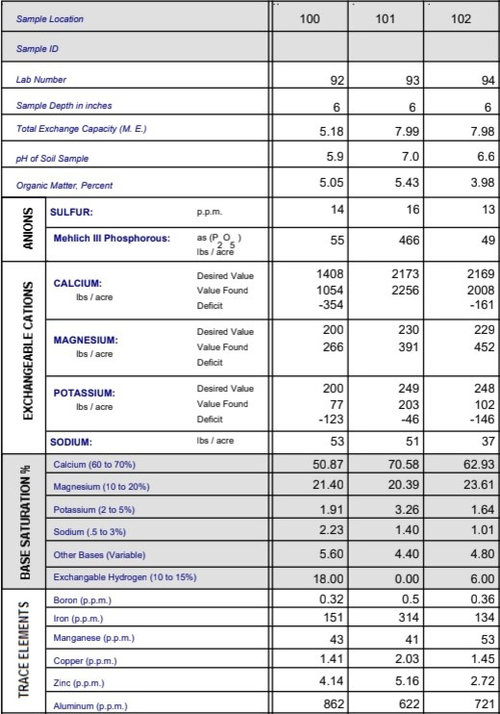
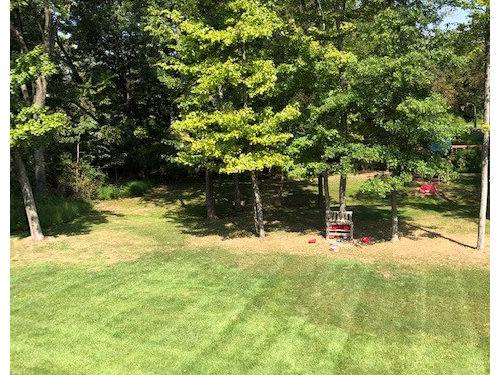
Hi All - Have received great input from here over the years and, despite dragging my feet, I've finally listened to morpheuspa and got a soil test! Input is appreciated. I've also included some sample location details below for reference as well as a photo of my backyard (taken today). Thank you!

Sample 100 - Way back in my yard. Has not received much fertilizer. Was aerated and seeded two years ago.

Sample 101 - Middle of back yard. New sod/soil. ~20 dead ash trees were downed, stumps grinded, new soil brought in, and seeded two years ago. Area has seen some high-nitrogen fertilizer on expected schedule for zone 7.

Sample 102 - Front yard. Established grass. Regularly fertilized, never seeded, aerated 5 years ago.


Comments (23)

  • 7 years ago

    One thing I can pick out is that 100 is both acidic and low on available Ca. That means it would benefit from some lime.


    Definitely a noticeable difference in 101, the area that was redone and soil brought in. P is quite a bit higher, pH is neutral, no Ca deficit and the K deficit is the lowest of the three (hardly worth worrying about I should think).


    What are your plans for these areas, are you changing anything like adding gardens or just wanting to maintain a healthy lawn?

  • 7 years ago

    Thank you for your input. We'd just like to maintain a healthy lawn at this time.

  • 7 years ago

    I don't know if you fertilize but the info is here for adding P and K as appropriate next spring. It looks like the deficits are in lb/acre and it would be nicer in lb/1000 sf. An acre is 43,500 sq ft. Let's say one of your lawn patches (101) is 2000 sq ft. and needs 123 lb/ac. 123 lb/ac x 1 ac/43500 sf x 2000 sf = 5.6 lb K. If you were using a balanced fertilizer like 12-12-12, that comes out to 47 lb of fertilizer (5.6 x 100/12) which seems quite excessive for one application on 2000 sf. Either my math is wrong or they're saying the deficiency is massive. Since the grass is growing it can't be THAT bad. You might fertilize with a reasonable amount of balanced fert next spring and let it come up more slowly. Also, adding organic matter helps everything, but 5% is pretty good. If you use a mulching mower or just let the clippings fly, it might maintain all by itself.

  • 7 years ago

    Thank you so much for the detailed and easy to follow response! I'm just NW of Philly in central bucks area. Two questions:


    1 - Is there any downside to applying lime across sample areas at the same rate? Asking because it's difficult to tell where 100 and 101 begin/end.


    2 - Does Winterize as normal mean to apply a high nitrogen fertilizer like I would any other year?

  • 7 years ago

    1) A little. The pH in 101 is already 7.0, which is borderline high. More calcium would kick it higher, which we don't want. It's not a gigantic issue--grasses do just fine right up to 8, which you wouldn't approach, and which will, in our (I'm in the Lehigh Valley) area rapidly re-acidify--but it's still going to knock things out of whack. Which I try to avoid doing.

    I'd suggest simply making your best guess as to where 100 ends and 101 begins, and 101 ends and 102 begins and go with that. The gypsum won't adjust pH (well...the situation is more complex than a simple will not),

    But if you find you think you overlapped, then no problem.


    2) Exactly! No changes there and it won't interact with anything done, so no matter what the date, you're good to go just as long as it's not too near the the October 1 feeding.

    Given that today's temperatures were 90 degrees, I have the distinct feeling that winterization might be Thanksgiving week this year. If we're lucky. :-)

  • 7 years ago

    Thanks again, Morpheuspa! Two more questions I came across when out trying to buy the shopping list :)

    1 - My local lawn depot does not carry gypsum. His suggestion, in its place, was to lay down an Organic Soil Amendment (4-3-1). What are your thoughts?

    2 - I can’t find Potassium Sulfate around here except via Amazon. Prices are $2/lb and given the size of my yard this would carry a nearly $200 price tag. This is pretty rich for my blood ... any other options? Will the grass get enough P from the other treatments you recommended?

  • 7 years ago

    I'm not going to disagree with anything proposed by the far more learned comments above. But: I'd also consider approaching from a different perspective: what is it you're trying to fix? Not in the numbers, but in terms of what you actually see in your yard/lawn and what you want. Also, can you make adjustments slowly over a few seasons, or do you really need to fix something quickly? Finally, if you're cheap (like me), can you approach the changes bit by bit - and especially by addressing the most obvious and cheapest problems and checking in a year or three later?

    This is most relevant to your question about buying the most expensive item on your list above - I'd say it's basically okay to delay and try other approaches and see how how they work (and put off buying a lot of potassium sulfate, as in this particularly case).

    I don't see a whole lot in that photograph that looks wrong - a pretty normal, nice lawn. Gets a bit thinner and drier around the trees - that's normal, less sun and some competition from the trees there. There don't look to be any catastrophic shortage/excess issues with the soil analysis overall.

    So some overall thoughts:

    -you have good organic content, but nothing excessive. Consider just applying more in whatever form (compost, mulched clippings, etc).

    -some mix of other grass types and some clover and other plants with different preferences/tolerances for conditions (eg. sun needed, but also nutrient needs and water demands) may be helpful overall. If you already seed from time to time, mixing things up a bit won't hurt. Some of these like clover are quite cheap to broadcast and let grow in.

    -some mix of ground cover around trees - i.e. other plants - may do well there. Doesn't need to be dig up and replace, just let stuff that does well there grow on its own.

    On potassium in particular - you could try some wood ash if you have access to any. Just don't overdo it all at once. (The word potassium is from potash, originally obtained from wood and vegatble ashes). To some degree, other basic NPK fertilizers you may already be using will help here too, just choose ones with a bit more K.

    Again, great precise input from others above (with far more knowledge). Some like adding lime are pretty simple and rarely harmful or expensive.

    I'm just saying that unless you're running a golf course (or some commercial agri operation that needs optimal results in near term), you can take your time and work with what you have and check the results periodically to see if you're moving in the right direction. If the slow approach doesn't work or you're not happy with the results, you can still do the heavier applications of whatever's needed next season.

    Personally i'd probably do the liming, more compost and a bit of wood ash where indicated as well as some seeding and see how things go (but I'm not too picky about lawns). But a yard and a lawn's a personal thing, whatever works for you.

  • 7 years ago

    You can do whatever pleases you, actually. I'm not hovering over your shoulder watching you and judging your actions. Budget, energy levels, and available time change.

    But I always figure you paid for the test and therefore wish to correct your soil.

    If a fix is too expensive or difficult, tell me and I'll prioritize things so you can put less important stuff.


    Let me go off on a rant here. The above posting gently intimates that doing some of the things I've suggested might (and then carefully will not) cause harm for the convenience of plausible deniability. And that they're difficult and, as the trend has repeatedly been over the last few days, for "golf course lawns."

    Let's just say I see an interesting trend here and leave it at that. If you're detecting my own not so gentle intimation, that's good. Because that's what I'm saying.

    Nothing I'm suggesting is going to be harsh, kick anything along in any great amount, do any harm, or do anything other than enhance your soil and the look of your lawn.


    Nobody said I set those corrections at one year, either. I didn't. You'll be fixing that potassium for quite a while in all likelihood. :-)


    Again, you paid for the test. I presume you want to fix the errors. My apologies if I was wrong about that.


    And then we have the suggestion to use wood ash. Let's just say "don't do that," and I'll lead you to look at why wood ash is used by soap makers...because of its pH. Here, I think, we have somebody who keeps very little eye on the pH except through a useless home kit.


    Quite bluntly, if somebody wants to take over the Logan Labs reads for all the thank you's you get (few) and the ever so common posts you get like the above (common) and crap you get thrown at you from other people, please feel free.


    I have a damn life, family, time-consuming hobbies, just made 17 pounds of soap for Christmas with plenty more to go, and can fill tons of time without spending hours balancing chemistry in my head.

  • 7 years ago
    last modified: 7 years ago
    OK, xtremeski2001, now back to you. And I don't want you to think I was yelling at you, I wasn't, but we do have our set of Holier Than Thou posters who seem to think that exacting answers are somehow worth criticism. Quite probably because they're incapable of generating them and feel threatened by those who can. But I'm quite used to that.

    You paid for your test. They provide us with some very good numbers. I happen to understand those numbers (which said posters admit that they don't and usually have no interest in doing, and frankly, often any ability to do). I am happy to read them for the appreciative. Which you are. And I'm going to give you the best answer using every single number and fixing everything on the fastest timeline possible.

    You can certainly choose a slower one if you want.

    1) Check your local landscape and garden supply stores. Most will be happy to order gypsum for you, and it shouldn't be expensive. We synthesize the stuff wholesale by the gigaton for wallboard!

    2) That's ridiculous, but Amazon often is. Just off the top of my Google, Seed Barn https://seedbarn.com/products/sulfate-of-potash-0-0-52-granular-fertilizer-50-lbs has it at fifty for $78 with free shipping.

    But price this out. Go to your local Big Box Store. Check their price on 20-20-20 fertilizer, they should have it. Compare that to starter. Instead of feeding with starter, we could just feed with that in May and September and October. Application rates would be 5 pounds per thousand square feet instead of "bag rate" for the starter, and apply the same amount of phosphorus.

    It's only 1 pound of potassium, but it'd get something down. You could do the rest at the recommended dates using potassium sulfate (edited to add: using 1 or 1.5 pounds per thousand, or whatever your budget will bear) to cut down the cost, or stretch the timing out past the next soil test if you want. The potassium isn't critical.

    We can use any balanced fertilizer, really, so 10-10-10 would work as well but tends to be more expensive per unit. Application rates will be 10 pounds per thousand square feet.

  • 7 years ago

    2) Another thought; ask the same landscape/garden stores you order the gypsum from. They can probably beat the Seed Barn price as SB is still charging you shipping, it's just built into the price.

    I use a different source, but need something with absolutely no insoluble matter. You don't require that.

  • 7 years ago

    Thanks for all the input and feedback ... I know we're talking grass, but really curious about the 17lbs of xmas soap :-)


    I'll look at a few other places for the gypsum. The 50lbs for $78 for potassium I could live with.


    As for what I'm trying to fix ... I'm not entirely sure. I feel like a lawn is built through the process of elimination. Once the soil is right it's one thing I can rule out. I've been in this house 6 years and the established grass has improved significantly, but now I've introduced new areas of grass that are just getting started ... so right now it's a big question of why grass isn't growing, growing poorly, thriving, etc.

  • 7 years ago

    23 pounds now (oil weight; figure 32 pounds total weight). What can I say, the store had a massive sale on decent olive oil, and my winter soap uses that as a base. Since everybody at work loves the stuff, I give away tons. And stockpile tons. And with olive oil, made a lot of (strictest definition) Castile, which only allows olive oil. And has to age 2 years before I consider it acceptable.


    Lawns are built via sweat, frustration, and elimination. :-) But seriously, build the soil first, and the lawn naturally follows. At this point, I pay very little attention to mine.

    This irks some posters to no end, but it's true. The occasional weed, feed it five times a year (four organic, one synthetic, and I skipped a feeding this year because I was lazy and busy). Spray the weed with Tenacity and move on with life.

    A properly built lawn, simply put, maintains itself. It's not magic. It's good, tuned soil with good resources and proper amounts of nitrogen supplied by feeding at the correct times.

    That's all. It's not "anecdotal," it's not "unscientific," and it's not "impossible."

    It just takes some time to balance things in the soil without knocking anything out of balance at the same time

  • 7 years ago

    OT a bit but I pay even less attention to mine - in fact I believe I must be lawn-lazy because feeding it 5 times is, well, more than I do in about 5 years. :-D But it shows too. If only I had the time. I'd like to (and this may be relevant to the thread) have a perforated drum compost spreader to make addition of organic matter feasible. They cost too darn much if you buy one.

  • 7 years ago

    You can actually do in situ composting by feeding with organics instead. Hence the five times a year for me.

    Many only do it once or twice and stick with synthetics otherwise. And this year I was lazy and fed in May, September, and now will do so around October first. The winterizer will be synthetic. I was busy.

    Count on approximately ten percent of your mass sticking around as "compost" when all is said and done; the other 90% is lost immediately as it decays off, but releases nitrogen that the lawn can use. Or gardens, I feed those organically as well. Although it does vary by what you use, it's a good general guide.

  • 7 years ago

    morpheus - on behalf of all lawn lifers coast to coast I would like to formally and officially thank you for the meritorious service you so selflessly provide on this forum! :o) All joking aside, it's great to have people like you who know what they are talking about helping others out in these forums.


    Dan

  • 7 years ago

    Wag. :-)

  • 7 years ago

    What do you use for 'organics' then? Something like pelletized alfalfa?


    I recently came across several bags of spoiled grain - cracked corn, etc. Most of it was not spoiled, just a corner of the bag got wet in most cases. I fear if I put that on the lawn, as soon as the birds find out it will look like the set from The Birds out there.

  • 7 years ago

    You will probably get tons of birds with cracked corn (I did) but there will still be plenty left in the lawn. I prefer cornmeal as the birds don't even know that is there.

  • 7 years ago

    Or, let's face it, the stuff goes through birds like....well, corn through a goose. And that's organic matter as well.


    Corn and any other item does not become OM via some pristine process. It becomes OM by passing through the digestive tracts of birds, rabbits, shredding insects, smaller shredding insects, worms, small larvae of various species, bacteria, deeper bacteria, and so on.

  • 6 years ago

    Thanks all for the input, especially @User. I put down the lime, starter fertilizer, and high nitrogen fertilizer as you outlined. One question:


    1 - 2019 lawn budget is exhausted so I'll need to postpone the Potassium Sulfate and gypsum applications. Since these applications are also present in the plan for spring, my assumption is I proceed as outlined in spring and then do the treatments I couldn't do in fall/2019 in fall/2020. If correct, I would then retest the lawn in spring/2021?

  • 6 years ago

    Exactly. Delay anything you need to and put it off if you want. If it drifts much further than that, retest in spring 2021 anyway and we'll re-evaluate where we are.


    About the only thing I wouldn't do is put anything down in the heat of summer, or too close to ground freeze.

  • 6 years ago
    <?xml version="1.0" encoding="UTF-8"?><md>Morpheus - Thank you! Will post back in a year or so