Software
Houzz Logo Print
samnsarah

Tree Bark Issues

7 years ago

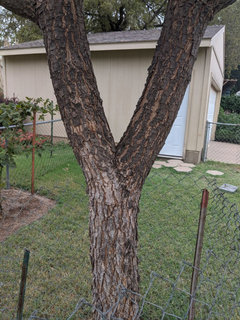
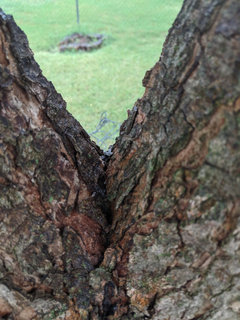
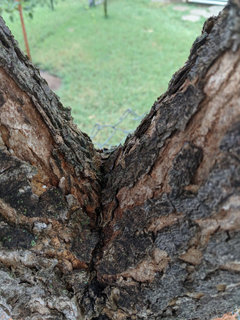
Below are a couple of photos of the bark of my Chinese Pistache tree. The first photo are some cracks on the bark. I asked my county extension rep. what they were, and he said frost cracks. Apparently, I'm at the very edge of the hardiness zone for Chinese Pistache trees. However, they are still on the tree throughout the summer, so are the really frost cracks? The second photo is some sort of white blotches on the bark on the underside of the branch I thought perhaps sun scald, but I don't

know. Does anyone know what these are? My main concern is are either of these issues anything I should be concerned about? Other than these two issues, the tree is very healthy. Leaves look great, no diseases, no borer beetles or caterpillars. Tell me what you think. Thanks.


Frost Cracks?


What are these blotches?


Comments (29)

  • 7 years ago

    Frost cracks are permanent. The white spots look like the early stages of a type of crustose lichen. It is very common on smooth barked or young trees, in particular. Lichens are absolutely harmless and add to the natural beauty of tree bark.


  • 7 years ago

    it appears smooth bark is a juvenile trait .... as such.. anything that happens from here on forward might be considered part of the normal maturation process ...


    i dont grow these in my MI ... but here is what is claimed to be mature bark ... https://duckduckgo.com/?q=Pistacia+chinensis+bark&t=ffcm&iax=images&ia=images


    did the extension guy say anything about crotch angle???


    ken

  • 7 years ago

    Looks like the way the bark on my Amur maple does as it is getting bigger.

  • 7 years ago

    btw .. lichens are said to be an indication of good air quality ... fwiw ...


    i have them growing on my plastic mailbox .. whats that all about ... lol ...


    ken


    and...they are pretty cool: https://duckduckgo.com/?q=lichens&t=ffcm&ia=images&iax=images

  • 7 years ago

    The extension guy said nothing about crotch angle. I was told by a horticulturalist from Arizona State University that if the angle is too wide or there is included bark, the tree may split at the angle when older. I sent him a photo, and he said the crotch angle in my Chinese Pistache tree looked good and that he couldn't see any included bark. So, it sounds like the consensus is that the cracks in the bark of my tree aren't frost cracks but part of the normal growth process. And the white blotches are the beginning stages of lichens. Good to know. Thanks!

  • 7 years ago

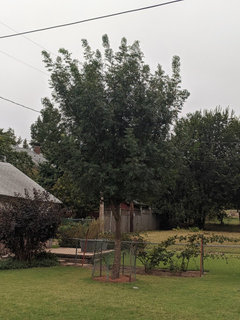
    Out of curiosity, I'd like to see a full frontal image of the tree. In my world, co-dominant leaders can mean trouble as a tree matures.

  • 7 years ago

    We can't comment on the crotch here without seeing pictures that show the entire interface between the two branches. "Included bark" is where the crotch appears as though the involved branches or trunks are disappearing beneath one another where they meet, hence "included". The problem with this is that it carries an implication of the two stems having not formed a secure connection with one another below the level of the crotch. So that they may pull apart later, once there is enough weight to each (and the right weather conditions occur).

  • 7 years ago

    i brought up the crotch angle ... and i presume.. if he saw a problem... he would have mentioned it ... good enough for me ... kinda the whole point of have an on site inspection ...


    ken


  • 7 years ago

    Except he went by a photo only, which may or may not have been more illustrative than the one posted here.

  • 7 years ago

    Actually, it's the narrowness of the crotch angle that can cause problems. Pistache is a tree that benefits enormously from straightforward corrective pruning when very young. I'm a firm believer that great tree growers should spend a few minutes on their young nursery crop to improve the quality of the trees.

    A young tree with co-dominant leaders can be transformed swiftly as a youngster or culled as it gets older.

  • 7 years ago

    Yes, I read that Chinese Pistache trees do need some pruning early on to develop proper growth, such as eliminating branches from growing into the tree. So I did some corrective pruning early on during the first three years of when I planted it.

  • 7 years ago

    Here are those photos from both sides.


  • 7 years ago

    Apparently Flickr only allows me to download one or two photos at a time. Here are a few more.


  • 7 years ago

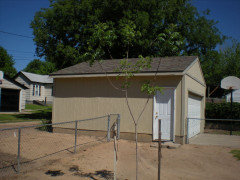
    Finally, for what it's worth, here is a photo of this same tree when I planted it five years ago.


  • 7 years ago

    That looks like a giant divining rod.

  • 7 years ago

    I remember when you posted that last picture smsnsarah.

    Unusual that it came from the nursery with a double trunk like that but maybe that's right for that particular species of tree. It looks beautiful.

    Anyways, not anything can be done now and nothing also can be done if the tree decides to split someday. Not that it will necessarily, some trees can have the worst structure and never have problems. I think a lot has to do what kind of storms they are exposed to. Some areas don't nave to worry about that.

    The bark issue appears to me to be normal splitting of the outer bark as the new inner bark expands from the inside. Many young trees with smooth bark, end up with mature bark having fissures.

    :-)

  • 7 years ago

    These shots don't get close enough to form a reliable determination. And whether or not the two halves have formed a good union where they meet is quite significant, with numerous examples of split apart trees clearly showing this happened due to a lack of fusion where involved parts met.

    Forking trees can be cabled together by tree services to prevent breakage.


  • 7 years ago

    Or bolted.

  • 7 years ago

    Okay, I'll have to get some crotch shots of the tree once it stops raining. If after seeing the photos you think it may be prone to splitting, I'll have to have a tree expert come out in person and look at it before I start wrapping cables around it or screwing bolts through it.

  • 7 years ago

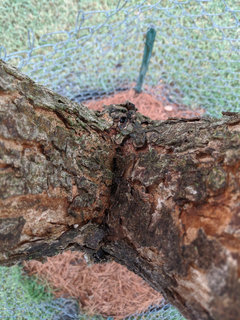
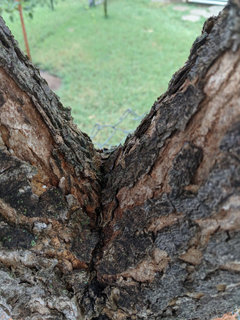
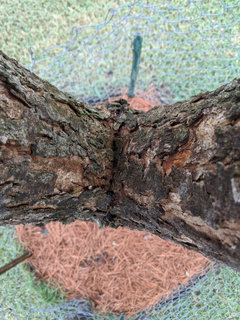
    Here are some photos of that crotch angle. It looks good to me. but then again, I'm no tree expert.


  • 7 years ago

    Just in case those three aren't enough, here a re a couple more.


  • 7 years ago

    Branch "A" is the main trunk. When I planted this tree the extension guy from Arizona State said that the Chinese Pistache trees with the best form and least likely to split are trees that have a main trunk and one branch like the one in these photos. When Chinese Pistache trees have that "included bark" that's when splitting is most likely to occur. Earlier Embothrium said of included bark, "Included bark is where the crotch appears as though the involved branches or trunks are disappearing beneath one another where they meet, hence included." Does it look like the branch and trunk are "disappearing beneath one another"?

  • 7 years ago

    I have no experience with Chinese pistache so can't comment on how prone they are to splitting. I'm sure your extension guy knows his stuff and if he says it looks good, it looks good. :-)

    Included bark interferes with branches bonding securely but someone else will have to comment on what they see on your tree.


  • 7 years ago

    Thanks for all the advice and help.

  • 7 years ago

    You're welcome.

    Just out of curiosity,

    why the fence and posts around that tree?

  • 7 years ago

    To keep my puppy from chewing the bark off and to keep the neighborhood cats from using as a community scratching post.

  • 7 years ago
    last modified: 7 years ago

    At expected maximum size is this tree going to be big enough to damage anything in its fall zone?

  • 7 years ago

    A Chinese Pistache tree doesn't get any larger than 40' wide and tall. Nothing except a chain link fence is close enough for it to fall on at it's maximum size of 40'. I suppose it could get larger than that after a hundred years, but I don't think I will be concerned about it by then. ;-)