Software
Houzz Logo Print
meyermike_1

Please help. Suggested light use for my plants.

6 years ago
last modified: 6 years ago

I am going to post this on the citrus forums and orchids because I know many that have been so helpful with this and very experienced at using lights, so here it goes.

I have an option to buy

T12 or T8 L.E.D 48" bulbs that are either 'full spectrum' or 'daylight' for my orchids and citrus trees and I am very confused.

I just want to add some extra light over my orchids and citrus trees and I already have the flourescent fixtures I got at Lowe's. It's the bulbs I am confused about.

Would it be just as beneficial for my plants to use daylight or full spectrum? Does it make any difference for these plants?

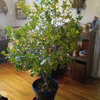
I used L.E.D single clip daylight bulbs last year for my phals and they seemed to love them. In fact, too close like a foot away they seemed to be turning to yellow like it was too much light. I have also used the same for my citrus as it seemed to work for them too.

So would it make sense to get full spectrum or stay with daylight bulbs. I am looking for cost savings and something my plants will respond well to with a fixture I already have.

Thanks in advance!

Mike

Comments (9)

  • 6 years ago

    Still researching myself,

    this probably won’t work for you but for my one plant and not wanting to figure out where I can hang a light from,

    this may be a good option.


    Might be good for you if you are looking for extra supplemental light.


    https://www.gardeners.com/buy/cfl-full-spectrum-floor-lamp-plant-light/8592053.html?utm_campaign=PLA&utm_medium=googleshopping&utm_source=google&SC=XNET0146&gclid=EAIaIQobChMIxM2x3-e15QIVU5JbCh05Ag1wEAkYByABEgJ3y_D_BwE


    any more experienced people out there have any thoughts?


    Meyermike(Zone 6a Ma.) thanked Grace Romito
  • 6 years ago

    Mike, I used to put my phragmipedium in a terrarium with a metal halide in top. I think it’s a 6500k.

    Meyermike(Zone 6a Ma.) thanked Amy (montreal, canada)
  • 6 years ago
    last modified: 6 years ago

    Mike, what illsstep is correct. Go with regular flourescent tubes. Manufacturers are not quite specific as to what can be labelled as daylight - it seems to me they are all over of the place. Anything 4000K and above is considered daylight. Paying extra for full spectrum is not really worth it. Instead you may consider a mix of 3000K and 6500K (or even 5000K if 6500K is not available) bulbs and you would effectively achieve pretty close to what the plants needs.

    Full spectrum, in lighting world, actually refers to something called color rendition index (CRI). Usually for cheap ones the value is around 80 and for really good ones you may get 93. Sun is considered 100. What it means is how closely the color looks to human eyes to the real color of the object. Real color being what it would look like in Sunlight conditions. So it matters to artists, photographers etc. In home lighting it matters if you care about how your decor looks like. It may matter to you if care about how true to color your orchids look like under the lights.

    Full spectrum, in horticulture, is mostly a marketing gimmick meant to wow the consumer as if you are getting something more - so must be good.

    For tall plants you have to think a bit differently. If you are using tubes you will have to use several of them to produce enough light to reach lower parts of the plant. Even then it is not easy with just over-head lighting. You may want to consider using several "spotlights" pointing at the plant at various levels (using a floor stand makes this easier). Remember that spot light produces approximately the same amount of light as one tube produces but concentrated on a smaller area. So the light "reaches" a bit farther although it can be shaded by leaves that are closer.

    The reach of a light depends on the intensity of the light source. The intensity of a light drops off pretty dramatically as distance increases. With Sun it does not matter because it is already 93 million miles away. A single tube may have an effective reach of 6 inches spread across 4ft of the tube. Whereas a CFL spot will have say 12 inches but concentrate in a much smaller area (about a sq ft or so).

    To put things in perspective: At noon Sun delivers approx 40W of raw light energy per square foot and about 60W of thermal energy per square foot. To match just the light intensity you would need about 8 100W equivalent CFLs per square foot - (rough ballpark calculation) and consume about 180W of energy. That will be one very hot light indeed and a lot of wasted energy. Unless, of course, you also need to heat the area. But 180W per square foot will be way over the top.

    When you need a lot of light running for 12+hrs every day the energy used and thermal management becomes a factor. So this is where LEDs become more useful.

    In reality though, you do not need that much of light as Sun delivers.
    For most sun loving plants you can get away with half as much. Remember
    that the intensity of the Sun varies through the day. In fact, photosynthetic efficiency is higher in the morning when the light is less intense and air is cooler. Most sun loving plant will need about 6-8 hrs of sunlight. You will never hear that a plant needs more than that.

    You can use less light but run it longer for plants that need the light. This is called daylight integral (DLI). What it means that plants care about the "accumulated" light received per day as long as the light is intense enough for photosynthesis to occur. So you could run at 1/4 of Sun's strength for 16 hrs and it would be quite OK. You can dial it down further if you are not looking into growth like the tropics.

    Meyermike(Zone 6a Ma.) thanked tropicofcancer (6b SW-PA)
  • 6 years ago

    Mike,

    Only orchids for me, so no idea about the citrus, but I try to keep it simple: I mix the colors (I use 2-3000Ks and 2-6500Ks in my 4 bulb fixtures) and purchase bulbs that generate the most lumens. For a simple man like me, I use the lumens as a representation of intensity/brightness of the light. As far as T12 or T8's, I'd go with the one that will hold bulbs with the highest lumens. With using the LED bulbs your electric usage/cost difference will be minimal between the two.

    I don't use my lights as supplements to sunlight, so I go for the strongest light possible within reasonable $ range and run them from 14-16 hours per day.

    I'm also a very big fan of LED 150+ watt equivalent flood lights (20-27 watts actual), very adjustable as far as heights and they penetrate very well. I run 5-6 of these over a 5' x 5' growing area and get good results, pretty ugly set-up though as I use brooder lamps to hold the floods.


    Bob

    Meyermike(Zone 6a Ma.) thanked westoh Z6
  • 6 years ago
    last modified: 6 years ago

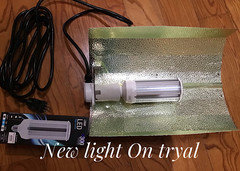
    Mike, wrote on this before, here is a new set up I am trying out Soon, just got it

    Bought two set up,s.

    looks like these are used for the long run. This one need some mod’s, plugs are made for M/H,s.

    Had to change plug and screw in a special adapter for 110 v. Adapter cost $ 6.00.

    Should last for umteen thousand years.

    Mike, did you check how Brian is doing?. kind of strange not hearing from him by now.


    Meyermike(Zone 6a Ma.) thanked Monyet
  • 6 years ago

    daylights should work, fine 5000k and up

    Meyermike(Zone 6a Ma.) thanked bklyn citrus (zone 7B)
  • 6 years ago

    Thanks everyone. I went for the cheapest and brightest route. So far so good.

    48 inch lon L.E.D daylight bulbs. Very bright and I love them so far!!!

    Thank you!

    Mike

  • 6 years ago

    So far, I am finding out that the LED bulbs are costing me a lot less to use than the growlight I used in the past and the CFL ones and my plants are thriving, flowering and growing very well.