Software
Houzz Logo Print
krisbry

Does anyone know much about birch bark cherry trees?

6 years ago
last modified: 6 years ago

Our landscape architect spec’ed birch bark cherry trees for a front tree garden along our walk. She chose them because of the bark color, the vase shape, and the suitability for our climate and the location.

Our one concern about them is the possibility of them bearing fruit, even small fruit, which would them drop on the walkway and make a huge springtime mess And then attract yellow jackets, to which my husband is seriously allergic. She said she didn’t think they should do that, but wasn’t sure (she just knew they didn’t have harvestable fruit).

One of the landscapeDa that quoted the install recommended using paper bark maples instead. They don’t flower, but that’s a worthwhile trade off for us if there is a real concern of fruit from the cherry trees.

I’d love to hear more from anyone with experience with these trees!

Comments (34)

  • 6 years ago

    im also wondering about how much future space is being given these TREES ..


    if flora is correct... here is the potential future of the trees: https://duckduckgo.com/?q=Prunus+serrula&t=ffcm&ia=images&iax=images


    i would probably be giving these trees ... at least 10 feet of space ... and maybe even 20 feet ... yet you are talking about them being next to a walk ...


    all trees can be pruned into whatever shape you want .. but it can become a yearly.. or twice a year event ... which you either learn to do ... or pay to have it done ...


    you are focusing on one variable in the landscape equation ... perhaps if you give us much more info ... we could help you define/discuss the whole project ...


    ken


    Kristin S thanked ken_adrian Adrian MI cold Z5
  • 6 years ago

    It would be a crime to plant this lovely thing anywhere it had to be pruned to fit the space. You're talking about a gorgeous tree which wants ultimately to be thirty feet tall. If you don't have the space for it to express its nature unmolested I wouldn't plant it.

    Kristin S thanked floral_uk z.8/9 SW UK
  • 6 years ago
    last modified: 6 years ago

    Our landscaper did indeed put the botanical name, prunus serralus, on her spec sheet. I am not a plant person (nor a latin person), so she's kind enough to also use common names, which is usually what I remember.

    I'm glad to hear that the fruit isn't a concern with these trees. When we moved to our current house it had some old apple trees that proved to be a major yellow jacket problem. We removed the few nearest the house (which were also in pretty bad shape, as the previous owner hadn't done much to care for them), and we kept and have had an arborist maintain the ones a bit farther away. I wanted to make sure I wasn't recreating the same problems again.

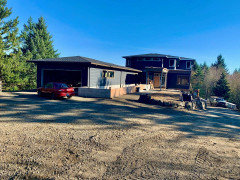
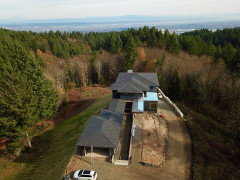
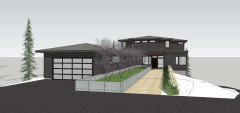
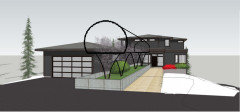
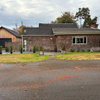
    I'm happy to share more information. Our (traditional) architect included in our house design a slightly elevated tree garden between the house and front walk. The planting area within it is 11'x72', within which the landscape architect spec'ed seven trees. There is a 8' path next to the tree garden, and beyond that the hillside falls away; her designs show them planted closer to the walkway side to take advantage of the space, so they'll have more than 11' width at foliage height. She includes a variety of grasses and low shrubs to be planted as ground cover beneath the trees.

    I'm not finding a great picture of the area right now, but here are a couple that show the general idea, as well as the architect's (traditional, not landscape) initial renderings.


    (note - no trees in the area at the back between the two roofs, just Soft Caress Mahonia.


    Other trees we discussed for this space include Serviceberry (difficult to find), Coral Bark Maple, and Paper Bark Maple. We want a multi-trunk tree to help provide visual interest year round. We considered and rejected evergreen magnolia, as while they technically can survive in Portland, this house is at 1100', and according to the landscape architect they often struggle with the wind and colder temperatures in our particular location.

    Oh, and this spot has southern exposure so full sun (or as close to that as Portland gets, which doesn't feel very close this time of year).

  • 6 years ago
    last modified: 6 years ago

    Serviceberry would be like the representations in the drawing, the others would not be. With 'Autumn Brilliance' currently being listed by a large number of wholesale production operations in western Oregon. All kinds listed by you in this discussion will grow much larger than in the drawing over time. With recurring heading back in order to restrain growth eventually having a spoiling effect. Even in the rendering the appearance created is of the trees conflicting with the garage overhang. I am sure many would prefer smaller growing plants that did not reach up to that level anytime soon - having the planter butt up against the house wall, resulting in the overhang poking out into the space that would be occupied by the crowns of the trees is a somewhat curious arrangement.

    Also I wouldn't trust a mass planting of that particular mahonia to come through every winter on a hill near Portland without noticeable damage.


    Kristin S thanked Embothrium
  • 6 years ago

    the best info on the web.. relies on latin names ... if a website doesnt include such .... i find little faith in the info provided ... there are too many common names that represent different trees ...


    i dont hink 30 foot trees... belong next to the garage .... key word: trees ...


    at best.. shrubs woulld be the better choice .. imo ...


    as to the PNW and OR ... i will defer on plant recommendations to gal .. or embo ... as they are IN SITU ... hey.. more latin ... lol ... sorry.. being a bit evil ... lol


    https://duckduckgo.com/?q=IN+SITU&t=ffcm&ia=definition


    what i wonder about.. is why jam them in there.. when there appears to be a great place to put them.. on the other side of the walkway ...


    whats the plan ... with the grass on the left side of the garage ... thats some steep slope ... nightmare to mow ...


    great looking place...


    ken


    ps: take any plant name.. to a search engine... find the latin.. if you dont have it.. then flip to IMAGES .... that is how you see the future ... do understand ... none of this stuff... shrubs and trees.. magically stop growing at some given height .... many size estimates are at ten years... and and the years go by.. they just keep going .... too many peeps its like interior decorating.. and that they are just what they buy.. and dont change size.. as the years roll by ... here is an example: https://duckduckgo.com/?q=Mahonia+eurybracteata+%27Soft+Caress&t=ffcm&iax=images&ia=images

    Kristin S thanked ken_adrian Adrian MI cold Z5
  • 6 years ago

    The Autumn Brilliance Serviceberry looks wonderful, but will we have fruit mess problems from it? Are there other trees that you would recommend we consider for this purpose/climate/location? Our goals are low maintenance, multi-trunk, happy in this location/climate/spot, and year-round visual interest. Beautiful fall color is a bonus, and actually more important to me than spring flowering, though that's nice too, just not a big driver.

    Because of the quirks of our site and building on a hill, we ended up with a long run of siding. The tree garden was the architect's solution to have something fun/pretty there to provide something other than siding to draw the eye. Whatever it is needs to have some height, hence the trees. We're open to suggestions for different trees to suit our purposes, but hard to imagine the space without something tree-like.

  • 6 years ago
    last modified: 6 years ago

    Very cool property. I would also consider large shrubs, like tree form hydrangea or japanese tree lilac. Hoping more of the PNW folks will chime in on your thread, but I agree the cherry tree will likely be too large for the space.


    edit to add: birds will likely not allow service berries to become an issue as they love it

    Kristin S thanked indianagardengirl
  • 6 years ago

    What can I say - my high school only taught greek, not Latin. And biblical greek, not ancient, so pretty much all I can read is the new testament, nothing fun like the Odyssey. (Though as a fun trick I can recite the Lord's Prayer in greek. Ah, the joys of a Catholic education). It doesn't help me much with my landscaping, though.

    The grass on the steep slope to the left is there for slope stability and erosion control, required by the city. It was jute-matted and hydroseeded with a mixed native grass blend that they assure us is low growing. We'll see. We had to get it done, and get it done fast to meet a seasonal erosion control deadline, so we didn't get a lot of choices. Our excavator tells us he has some home-built steep slope robot lawnmower he'll loan us in a pinch :-).

    To the right of the walkway is a whole additional multi-terraced planting area. I have another whole list of latin names that go there, including some juniper, various dogwoods (the shrub kinds), some ground cover like kinnikkinnick, some heather. and variety of others. The landscape architect initially proposed a beautiful wildflower garden concept that would undoubtedly have looked amazing the day it was installed, and have looked like a total mess after six months unless we devoted a LOT of time to it.

  • 6 years ago

    As a designer, I'd have to question the practicality of this elevated tree planting garden myself. I have seen

    allées or matched tree plantings similar to this but they were always in much larger spaces or at the very least, created with very fastigiate trees. In this case, this elevated garden would make much more sense on the right or down sloping hillside part of the walkway. Not along the garage.

    I'd also have issues with the tree choices provided. As noted, all will eventually exceed a reasonable width for that area (and 7 trees within 72' is overkill! You can accommodate 5 at most and even that is pushing it) even if single trunked, which most of them will be. If you leave the 'tree garden' in that position you will only be able to accommodate narrow or fastigiate selections.....and darn few of them will fit either!

    And neither the cherry - excessively disease prone in PNW wet spring weather - nor the coral bark maple - also highly prone to bacterial infection from wet springs and winter cold - are likely to be good, longlived or healthy choices for a high, wind exposed bluff above Portland.

    Kristin S thanked gardengal48 (PNW Z8/9)
  • 6 years ago

    Ken likes to talk about 'Latin' names but in fact botanical nomenclature is a mixture of Latin, Greek and other languages. Rhododendron, for example is entirely Greek. So whether or not one studied Latin doesn't matter. I know more Latin from gardening than I ever learned in school. It really is important to use the botanical names if you want accurate information and to ensure you get the correct plant when you buy.

  • 6 years ago

    This is all helpful information. Given that at this point we’re locked in to the concept of the tree garden (as you can see, it exists already) what would be some good options to put there?

  • 6 years ago

    Shrubs.

    Kristin S thanked Embothrium
  • 6 years ago

    Ivory Spear or Raspberry Spear crabapple, Carpinus betulus 'Frans Fontaine', various columnar oaks (Crimson Spire, Streetspire, Kindred Spirit, Skinny Genes), 'Persian Spire' Parrotia, 'Slender Silhouette' sweetgum, Acer palmatum 'Twombley's Red Sentinel', Styrax japonicus 'Evening Light'.

    Kristin S thanked gardengal48 (PNW Z8/9)
  • 6 years ago

    ps: i would love to see a home built robot hillside lawn mower ... that said.. i would just let it go free range ... whatever may grow there ... think about it.. do you really need mowed lawn on that hillside ...?? ... nobody who comes up the drive is going to focus on the grass anyway ...


    we are talking about plant choice... not removal of the tree garden space ... i agree you need something there to break the siding view ....


    think of it as a SHRUB garden space ... as we have said... its not a TREE garden space.. as currently configured .. many shrubs can be trained to look like trees [and thats not a big deal] .... without the vast tree potential ...


    i wish you luck ...


    ken


    ps: i would love to see a home built robot hillside lawn mower ... that siad.. i would just let it go free range ... whatever may grow there ... think about it.. do you really need mowed lawn on that hillside ...?? ... nobody who comes up the drive is going to focus on the grass anyway ...

    Kristin S thanked ken_adrian Adrian MI cold Z5
  • 6 years ago

    You can certainly grow trees in that location!! Just not as many as spec'd, not multi-trunked and with careful consideration given to form and spread.

    You do not need to be limited to shrubs. Or even shrubs pruned into a tree form.

    Kristin S thanked gardengal48 (PNW Z8/9)
  • 6 years ago

    Your list of suggestions is peppered with kinds that will grow to overwhelm the space same as others previously discussed. Both visually and physically.

  • 6 years ago
    last modified: 6 years ago

    Kristin have I got the perfect solution for you. No fruit for yellow jackets. Late winter bloom, good fall color, will fit the space better and easy enough to train into multi-trunk small trees. Witch Hazels. The Hamamelis x intermedia group has a number of cultivars with different colors and fragrance.

    Witch Hazels

  • 6 years ago

    How about red twig dogwoods? Varied with yellow twig and variegated? They would give you the architectural element the full length, especially when leafless, and not be difficult to maintain at the size desired. I’m from the east coast so have no idea if they’d thrive there, but just thinking from the design perspective.

  • 6 years ago

    Embothrum, that is just a matter of a difference of opinion. You don't happen to like the idea of trees in that location and I think they will be fine provided the OP recognizes what restraints and time frame might be involved . Not all landscapes are designed or planted with the idea that they will never be amended or altered over the course of time. In fact, very few are left unchanged for long, even with longterm ownership.

    The only concerns with my list is a few - but by no means all - of the selections may get taller than desired. But virtually everyone will fit within the width, so just how "visually and physically overwhelming" is that going to be?

  • 6 years ago

    Is it very windswept? Plant a small oregon white oak seedling or even an acorn somewhere in the southwest half of the bed closer the driveway. Trees in windy exposed sites can develop interesting growth habits like a bonsai. It will take a lifetime for the tree to really grow up but you can kind of view it like a perennial or shrub for that time, while keeping it spaced from other trees and structures based on its mature size.

    https://landscapeplants.oregonstate.edu/plants/quercus-garryana

  • 6 years ago

    You've all given me so many ideas. I think we're going to talk more with the person who will actually be sourcing and installing the plants and see about making changes in this area. We have bids but haven't made a final choice yet, but a couple proposed that the number of plants recommended by the landscape architect was overkill (or perhaps overfill is more accurate); it sounds like that's a good sign that they recognized and were willing to bring that up.

    kitasei - lots of dogwoods out here - I drive by lots and lots every day all along our road, and the landscape architect spec'ed quite a few for other locations, with varied twig colors. Most seem to be more the shrub variety, at least that I see. I know my mom has a couple of dogwood trees at her house and they've struggled, but she had one at her old house that thrived, so not sure what the difference is.

    Skip1909 - the property in general gets a lot of wind, but the tree garden location is pretty sheltered. Our worst winds come down the Columbia River Gorge and hit us from the east, which is the back of the house. The L shape of this area means that it's actually pretty protected. We do have a bit of a bluff that we're not doing anything with now but likely will later, however, and this is an intriguing idea for that spot, as it does get quite a bit of wind.

  • 6 years ago

    I think the fastigiate Parrotia mentioned by gardengal would be stunning in that area. Narrow, tall with great fall color.

  • PRO
    6 years ago

    Structurally speaking, I would not want a row of large plants forming a "wall" of sorts in the planter that separates the walk from the garage. Doing that would make the walk seem much less spacious. If those plants were tree FORM, with their canopies raised, and their trunk structures clear of foliage, then the space between walk and garage wall could be retained, and the walk seem more spacious.

    As others have said, plants considered to be actual trees are going to get too large. Large shrubs that are pruned into the tree form would be a much better fit. (Many such plants can approach 15, 20, or more feet in height.) Since the planter seems about 10' wide, I don't see a problem with multi-trunks, so long as the V-shape is controlled by you, and not let be too wide. (I have multi-trunk tree forms in much tighter spaces. They work because they are make to fit, and not allowed to be wide ranging. Sometimes this only requires pruning and sometimes it requires pruning, staking, and tying. I resort to whatever works because this is a temporary training process that need be in place only while the plant is young.)

    I'd vote against a straight run of "trees" when there are architectural features at the garage wall that need acknowledgement and attention. This, too, would limit the number of "trees" that can be used.

    I don't know if the hedge at the right side of the walk is still in play, but I'd be strongly recommend against this feature. It makes the walk to the entrance seem even more like a stockyard feature, where animals must be guided along a very specific path.


  • 6 years ago
    last modified: 6 years ago

    You have all been tremendously helpful, and I really can't thank you enough. I probably shouldn't admit this to plant lovers but this is one area of the new house build that I had really hoped I could just turn over to the landscape architect and not delve into too deeply myself. Clearly I do need to dig in and learn more about my plants, especially for this area, and I really appreciate the help in getting me started.

    I've gone down the internet rabbit hole on what exactly is the difference between a tree and shrub. Before this I probably would have said shrub = shorter than me, tree = taller than me, and that's why we've always said trees for that spot. In reality, I think want things that are in the gray area between tree and shrub height. I'm going to do some measuring and looking at roof heights on the plans for a sense of scale and go from there. We want a tree "look," but definitely not 30'. I plan to make a spreadsheet of the options suggested here and see what works best. I may have more questions.

    Again, thank you!

  • 6 years ago

    Neither 'tree' nor 'shrub' are precise botanical terms so not surprising that you are confused :-) Typically, a tree is defined as a perennial woody plant of at least 3 meters with a single, elongated stem or trunk from which multiple branches evolve, generally at a specified height above the ground. A shrub is defined as a perennial woody plant smaller than a tree and with one or more stems (no clear elongated trunk) originating from the root crown and often with branching starting at or near ground level.

    There are many woody plants that can be both trees or shrubs depending on how they are grown, trained and their ultimate size.

  • 6 years ago

    What about crepe myrtle (Lagerstroemia)?

  • 6 years ago

    Crape myrtles would certainly work size and shape wise. But they are not the best plants for the PNW. While perfectly hardy here, they need a much hotter summer than we usually generate to bloom well. Or a lot of reflected heat from paving or a west or south facing wall. They rarely flower here and what's the point of planting crapes if not for the flowers??

  • 6 years ago

    What about Heptacodium miconioides? The size seems right and it has great winter interest (actually 4-season!) with no fruit to worry about.

    https://www.missouribotanicalgarden.org/PlantFinder/PlantFinderDetails.aspx?kempercode=k450

  • 6 years ago

    That's beautiful. I wonder how hard they are to find? I'll definitely add them to my list to discuss with my landscaper.

  • PRO
    6 years ago
    last modified: 6 years ago

    One heads-up ... plant heights and spreads are listed in books, plant tags and all over the Internet, but these are snapshots in time. In my experience, the true mature plant size is somewhere between 1 1/2 to double the listed size. Obviously, there's going to be no precise, universal correlation, so take the listed sizes with a big grain of salt.

  • 6 years ago

    Thanks again, all. I met the contractor we chose for landscape install and he recommends going with either paperbark maples (because of their exceptionally slow growth, among other reasons) or crepe myrtles, as he thinks there are some varieties that would flower in our spot, given the combination of south facing, reflected heat from the wall and pavement, and newer varieties that do better here. Any thoughts on our final choice?

  • 6 years ago
    last modified: 6 years ago

    Paperbark Maple is a much more attractive tree in leaf, form and bark. I think it would make a better visual impact as a focal point along the entry walk. You will never see any Crepe Myrtle blooms if they manage it because they will be over your head. I have been watching two Paperbark Maple for a decade plus and they remain at two story building height. In a zone 6.

    Find a place in the garden for some Witch Hazels. They are truly fab.

  • 6 years ago
    last modified: 6 years ago

    I really love the witch hazels. We're eventually going to be adding trees along our quarter mile driveway. Well, more manicured trees - it's very forested already. I think witch hazel could be perfect along there.

    Thanks for the information about your experience with Paperbark Maples. I love maples, so that's the direction I was leaning, but I found a couple of articles about Crepe Myrtles in the PNW, which had me wondering if I should try them.

Sponsored
J.Holderby - Renovations
Average rating: 5 out of 5 stars4 Reviews
Franklin County's Leading General Contractors - 2X Best of Houzz!