Software
Houzz Logo Print
hennen

Landscape design "Rules" for grouping trees?

6 years ago

I'm in charge of planting around 5-6 medium to large trees along the street at our church building. The spot is 287 feet long and 18 feet wide. I plan to plant two species so we don't have a monoculture.


The question I have from a design perspective: Is it better to plant the same species together, is it better to alternate between the two species, or does it just not matter?

Comments (29)

  • 6 years ago

    i dont think there is any 'rule'....per se ...


    it is mostly about your vision ... your goal ... and how you want to see the future ...


    but you might focus on certain seasonal 'shows' ... e.g. is they were crabapples .. two pink.. two white... they might look best ... every other.. during bloom time ... and the rest of the year... you might not tell them apart ... so.. in our MI ... with 4 distinct seasons .... think about each individual tree ... and its seasonal changes ....


    same logic with any fall color options ....


    in the general garden.. say my 5 acres.. imo.. it would not really matter .. because they would be all over the garden ..


    your base issue is the regimental straight line you are working with .. and its good you are thinking about it ... but the decision will be left to your goal/vision ....


    ken

  • PRO
    6 years ago
    last modified: 6 years ago

    With a total quantity of 5 or 6 trees, the term "monoculture" does not really apply. IMO, it's a vastly overused and wrongly used term insofar as much of landscaping is concerned. It applies better to agriculture and forestry where the plants are in the hundreds of thousands or millions & upward.

    Given that you are planting in a situation that warrants a certain dressiness, I'd opt for a single, stately species ... and pick one that has a history of being without disease issues. Is that an iron clad guaranty? No. But almost nothing that is alive can offer that. However, the chances of success would be overwhelmingly in your favor.

    For a few street/drive trees, planting a uniform species at a uniform spacing would be the obvious, easy way out. No one could make an argument that there is something wrong with that scheme, as it has demonstrated its worth through the eons. If you mix species, I would avoid an alternating pattern. While it's sometimes possible, it usually strikes me as someone didn't know what to do, so chose what appeared to be "safe," whereas the end result reads as unprofessional ... or that someone didn't know what else to do! A better possibility if using two species, would be to begin the run with one, change to the other, and finish up the run with the starting species, where each species is somewhat grouped. In that scheme, it would make more sense if the two groups were of radically different form. But with only a half dozen trees, that scheme has not got the greatest potential here either.

    If you live in an area where trees produce fall color, that's a characteristic that would be good to have as a priority for street trees. It's another reason to have all be a single species ... so the annual show is even better.

  • 6 years ago

    Thanks for the input.


    My thought on “monoculture” was If a disease or pest takes all of one species, the property wont be devoid of trees there.

  • 6 years ago

    I second all of Yard's comments. And a good choice of tree species can eliminate your concerns about some 'plague' coming along and wiping them all out. That is not a very common situation to encounter.....consider city street tree plantings. They are almost always of a single species and cultivar in a particular area or neighborhood.

  • 6 years ago

    5 or 6 trees, the term "monoculture" does not really apply.


    ===>>> well.. if the prior person didnt plant a monoculture of those horrible pears... he might only be planting one or two replacements .. so there are two sides to that coin ...


    it also shows... its not just a disease or bug issue... in this case.. the trees are falling apart ... which isnt all that uncommon with the 'fast growing' group of trees ... of which.. i dont think you are considering any of those ... willow and poplar come to mind... if you are wondering ...


    ken


  • 6 years ago

    "And a good choice of tree species can eliminate your concerns about some 'plague' coming along and wiping them all out"

    • Dutch Elm Disease
    • Ash Borer Beetle

    My previous city had overplanted Ash. Now there are much fewer street trees there.


    In our city, Silver Maples were planted en masse 60 to 70 years ago and we spend significant resources each year taking down the dangerous and rotting ones, and it has been a struggle for us to replace trees as fast as they are coming down. I know Silver Maple has a lot of problems, but any tree eventually ages out and I don't want my successors to have to replace all of these trees all at once again.


    Anyway, this is a side issue as their will be at least two species. I'm looking for design considerations here.

  • PRO
    6 years ago

    "... well.. if the prior person didn't plant a monoculture of those horrible pears ..." If we never misread the crystal ball, things would surely have better outcomes! In answer to that, though, I suggest that the better course of action is not to miscalculate known design factors, but instead avoid falling prey to the sway of fads too early in the game. Every decade or generation seems to have popular trends that are later looked on as sorry mistakes or some form of bad taste. In this instance of needing only a few trees, it's hard to conceive that one cannot choose a species that will prevail with near certainty over the long haul. And there's barely any difference a mistake would mean, between planting 3 or 6 trees when measured out over the span of 30 or 40 years before the mistake became evident. A bug or disease problem that will not exist for a number of decades hence will be next to impossible to predict, but bad habits in middle or old age of a tree's life are much more predictable. What we've found with the pear in many cases is a lot of people saying that they've heard of the problem, but choose to ignore it because they just love the form, flowering, and fall color of the youthful or teenage pear. They are paying their money and taking their chances. Of course, the outcome is predictable.

    "My thought on “monoculture” was If a disease or pest takes all of one species, the property wont be devoid of trees there." I totally get that. What I'm saying is that it barely, if at all, applies in a genuine commonsense way with so few trees involved. You are making a [design] sacrifice up front in order to avoid a potential, not certain, need to sacrifice later. This is sometimes called jumping from the frying pan into the fire. (That usually happen with conditions that are outside of one's control. Here, the conditions are in the process of being created, so not quite as drastic.)

  • 6 years ago

    So don't pick any ashes or elms!! Very few other species of trees have similar issues that can wipe out an entire planting in just a couple of seasons.

    The 'design consideration' you asked for has been provided, For that number of trees along that short of a length, either plant just a single species or 5-6 different ones. That will provide the best design aesthetic. If you want to stick to two species, then place them any way you like. Alternating is going to provide the strongest statement if not necessarily the best one.

  • 6 years ago

    How does the planting space relate to the building? Is it an avenue leading up to it? Or just the length of street outside? Can you show a plan?


  • 6 years ago

    If 6 I’d go 2, 3, 1. The 2 and 1 would be the same species but 3 would be a different genus.


    For example 3 White Fir with 2 and 1 Korean Pine or 2 and 1 Serbian Spruce with 3 Macedonia Pine.


    If 5 all the same


    That is just my opinion but a good one in my opinion.

  • 6 years ago
    last modified: 6 years ago

    I would not alternate. I just think that looks dumb. I would rather have all of the same than alternate one then the other.

  • 6 years ago
    last modified: 6 years ago

    I agree if alternating is 1, 1, 1 Etc


    I see it quite often and I don’t quite get it

  • 6 years ago

    This is quite impossible to visualize without having an idea of the streetscape and context, OR the species. If you are talking about tall canopy trees and understory trees, the intermixing could be the right formula. I want to know what views OF the building and FROM the building should be framed or concealed. Churches generally have significant architectural features - steeples, towers, entrances, etc. These can be highlighted by the trees you select.

  • 6 years ago
    last modified: 6 years ago

    Here is a link to Google Maps with a pin dropped where we are replacing the trees.

    We have removed the three failing pears in the southwest corner and are going to plant new trees there. This is a 18 foot wide, 287 foot long strip of land between the sidewalk and parking lot. The church itself is not an architecturally significant building, and the views are views of the parking lot.

    If you want background on my criteria for tree selection, see this earlier thread.

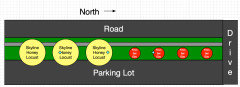
    Below is a scale drawing of what I'm currently considering based on the suggestions here. The teal dots are the locations of the pears to make sure I don't plant over the ground out stumps. The spread I used is based on what the nursery I will be buying from reports, but I know they could be bigger or smaller.

    Thanks everyone for your input so far. It is appreciated.


  • 6 years ago
    last modified: 6 years ago

    For some reason I was thinking evergreens originally.

    With this set up I would do them all the same otherwise 1,5,1.


    Are there other tree selections you are considering? I am a fan of frontier elm however not so much the honey locust.

    Its late to leaf out late, have aggressive roots, typically lose their leaves early and is over planted. It’s otherwise a tough and fast growing tree

  • 6 years ago

    I’m not a huge fan of the honeylocust either. the shorter leaf out and that it is over planted here too. I’be gotten conflicting info on surface roots from reputable sources.


    The soil test shows high salt content, which makes sense being between the road and a huge parking lot, so that and the desire of church leadership to have very low maintenance and low to no litter has limited my choices.


    Other considerations have included


    - Homestead Elm (potential seed litter)

    - Presidential Gold Ginkgo (slow in this zone)

    - Espresso Kentucky Coffee Tree (I think slow growing in this zone)

    - Green Vase Zelkova (susceptible to winter ice damage)

    - maybe Autumn Blaze Maple (not salt tolerant, maples here are overplanted)

  • 6 years ago

    The KCT isn’t slow growing but also has a short growing season. Makes up for it with its elegant silhouette.


    Consider acer miyabei with frontier elm.. Although short lived will get yellow fall color and has course texture compared to the elm.


    Yellowwood and Amur Cork tree (male like Eyestopper) are ones to consider as well


    hennen thanked whaas_5a
  • PRO
    6 years ago

    Honey locust too sparse for me.

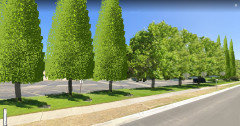
    Consider an arrangement that includes bald cypress groups at each end for high form contrast.


    hennen thanked Yardvaark
  • 6 years ago

    I love bald cypress -- such pretty fall color. I like the design also, three groups of three trees. "Trinity" has meaning for a church ... so plant a trini-trees!

    hennen thanked User
  • 6 years ago

    I like groups of 3. Reinforces the color/form, especially from a distance. Use it mainly with conifers.

    hennen thanked scotjute Z8
  • 6 years ago

    this might be the street view ....: https://www.google.com/maps/@42.4888218,-83.1243454,3a,75y,90t/data=!3m7!1e1!3m5!1s4Ln8A1WPDwQC-hVAalFjWA!2e0!6s%2F%2Fgeo2.ggpht.com%2Fcbk%3Fpanoid%3D4Ln8A1WPDwQC-hVAalFjWA%26output%3Dthumbnail%26cb_client%3Dmaps_sv.tactile.gps%26thumb%3D2%26w%3D203%26h%3D100%26yaw%3D211.6361%26pitch%3D0%26thumbfov%3D100!7i16384!8i8192


    you can rotate 90 degrees right... or click up the road and repeat rotate ...


    or it wont work.. lol ...


    that hell strip between the road and sidewalk.. is dead.. dead.. dead.. lol ... gotta love mid to late summer in metro detroit ...


    but is does look like you have a much wider planting area.. than i was conceptualizing ... which is good in the sense.. that the retained sun and heat on all the surrounding pavements... deep into the night ... will be buffered somewhat by the lawn .... night should be a time of reduced heat [and obviously sun].. a cooler recovery period from the onslaught of the day ... if you were planting in the small hell strip ... this could be a watering issue ... a new transplant with impacted roots might have a hard time coping


    ken

  • 6 years ago

    That is indeed the street view.


    When Google took that photo the city had just recently finished road work there. The dead grass you're seeing is actually mostly the grass matt they put down. It grew in pretty well. I was waiting for the road work to finish to make sure they didn't disturb our new trees.


    I'll be able to drag a hose across that huge parking lot to keep things watered until established.

  • PRO
    6 years ago


  • 6 years ago

    @Yardvaark that is very neat. Is that Bald Cyprus + Some shade tree?


    What program do you use for that? Is it freely available for Mac? (I doubt it, that looks too good)

  • 6 years ago

    ive spent 20 years dragging hoses around 5 acres .. BUT ... i could leave them were they lay.. at the end of the watering ... you are going to have to drag them back... and store them every time ... which of course.. done right... is no more than once a week..or longer.. if you water properly deep ...water slowly and deeply.. and then let them near dry before the next deep watering ... dig a couple 3 to 6 inch holes around every tree.. with a hand trowel... until you figure it out .. we can not tell you a schedule ...


    a good layer of mulch will retard drying in the high heat of summer... but again.. its moisture at depth.. where the roots are ... not the surface ...


    but i think you ought to consider these: https://duckduckgo.com/?q=tree+gators&t=ffsb&iax=images&ia=images


    when i plant in early april in MI .. if i water them in deeply .. so the whole root mass is moist.. plus the mulch ... in my MI ... it might not be until the heat starts to build in july.. that they need watering again ... subject to ma natures rains .. or an early heat wave.. but i learned all that.. by digging the small holes ...


    also ... keep them moist deep into fall.. to they dont go into winter dry ... its usually not an issue as the temps start dropping .. but there have been some very dry falls ... its just best to keep checking late into october ...


    by the year after planting.. they should only need water in high heat or drought ... and by the 3rd year.. be free range .... which cracks me up in royal oak ... lol ...


    ken

  • PRO
    6 years ago
    last modified: 6 years ago

    That is the basic bald cypress look. It has a striking profile from a distance. It is not evergreen and many, including myself, think its ghost shadow winter look is almost better. And the other trees ... generic shade tree.

    I use MS Paint (which comes with every Windows computer) to draw over the photo. I imagine Mac has some equivalent painting program. And there must be similar programs online. With only a computer and mouse/trackpad, one is relegated to line and shape tools. With a touchscreen and stylus, all the painting tools work well.

  • 6 years ago
    last modified: 6 years ago

    Yellow-wood is prone to significant future breakage - as in entire major limbs or trunks tearing off - if not carefully and knowledgably trained to prevent this in the early years. And it of course generates spent leaves of large size, spent flowers and spent fruits.

    If the church leadership dreams of the maintenance equivalent of artificial trees - as so many non-gardeners do these days - then the choices for the new planting are in fact going to need to be seedless cultivars of species with small (preferably tiny) leaves or leaflets. Even the pollen of some kinds of trees - pines are a common example - can form drifts on the edges of parking lots, bother those allergic to it when blowing about.

    hennen thanked Embothrium
  • 6 years ago

    The fall color of bald cypress is a soft russet brown, it would be stunning with the golden leaves of ginko for a few weeks each fall. What a nice picture that would be.

    hennen thanked User