Software
Houzz Logo Print
hennen

Help narrowing down street tree selection

6 years ago
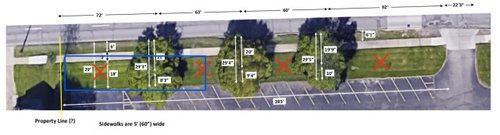
I am tasked with selecting new trees to plant at our church building and am seeking advice. See the attached picture.


We're in suburban Detroit, zone 6a.

The existing trees there are pears that are in rapidly declining health and have in recent years started splitting under ice damage. There used to be 4 of them. They will be removed before the new trees are planted.


The red X's are the proposed location for new trees. I have already had the utilities marked and there are no above ground or underground utilities.


This is along a somewhat busy suburban road. It is possible some salt spray may make it on the trees in the winter, but reviewing the site after a recent heavy snowfall it didn't look like much splashed across the sidewalk. The soil test shows the sodium is 242 ppm and chloride is 267 ppm (which they said is high). The rest of the test results are here http://homesoiltest.msu.edu/your-results/code/P9WH5K (loam, nearly neutral pH, low on potassium).


The blue box shows where there is sometimes standing water for a day or two. The rest of the site drains remarkably well.


Tree requirements:

  • Deciduous.
  • I can care for them the first few years, but they must be tolerant of benign neglect after that.
  • No significant litter. Leaves, flower petals, and small seed pods are okay, but e.g. no oaks, sweet gums, catalpa, or sycamores.
  • Won't drop messy stuff on cars parked below.
  • Parking clearance for cars and the sidewalk.
  • Roots typically deep enough to not cause difficulty mowing or heaving the sidewalk and parking lot.
  • At least two species to avoid monoculture.


Desirable traits, if possible:

  • Multiple season interest
  • At least one species tolerates wet feet (though we can probably adjust the grade if absolutely necessary)
  • Long lived (60+ years)
  • Large mature size


Based on all this, I have narrowed it down to these four species that I'm able to acquire from a local, reputable nursery

  • Ginkgo, Presidential Gold
  • Hackberry
  • Linden, Americana ‘Boulevard’
  • Honey Locust, Skyline

I have read a lot of conflicting information from reputable sources (e.g. extension sites) about salt tolerance, surface roots, tolerance of standing water, etc, so am looking for thoughts on if any of these are a better choice than others.


Thanks!


Comments (14)

  • 6 years ago

    I helped get it narrowed down to this list with the help of the local extension office. I have also reached back out to them for final confirmation, but am looking for a few opinions since reputable folks do give conflicting information.


    I also consulted the city's approved tree list. I have a little more flexibility since we are actually planting on private property, but I'm calling them street trees since they are very close to the road.


    If I get a consensus among two or three different groups then I think I have a set of winners.

  • 6 years ago
    last modified: 6 years ago

    If you are within the city limits Detroit may have a list of both approved and prohibited street trees, if you haven't looked for that it was the first thing to do.

    hennen thanked Embothrium
  • 6 years ago
    last modified: 6 years ago

    The ginkgo would satisfy all your criteria (except wet feet). The Hackberry and Locust have salt tolerance, but they would also have potential surface root issues, as well as potential pest issues. Linden is nice for form and summer foliage, but not very good for fall color, and doesn't have very good salt tolerance. You could think about adding Green Vase Zelkova to your list of options. For the wetter spot(s) possibly Baldcypress or Blackgum, although if the standing water only lasts a day or two that may not be a problem.

    Are you looking to alternate 2 different species, or have all 4 different?

    hennen thanked arbordave (SE MI)
  • 6 years ago

    Total of two species. Because the wet spot is together probably two and two instead of alternating, unless all can tolerate some wetness.

  • 6 years ago

    Green Vase Zelkova is not a tree I was familiar with and it looks very promising. It probably didn't make my list as it is a little on the large side as I was trying to avoid the mature plant from overhanging the road (>40' spread has that risk) but with a "vase" shape that may be a non-issue.

  • 6 years ago

    i have a real hate for maples ... because i grow hosta under them.. but this might be a perfect spot for a seedless maple ... anything in the freeman or norway families ... key word: seedless ... much faith in the z6.. but it might make a small difference ...


    anything sold by the extension office will be tiny ... under a foot or two .. probably not the way to go ...


    ginko in my local experience.. is extremely slow in MI ... i think its the long cold season ... as compared to further south where they might have an extra month on each side of winter ... i would skip that ...


    im wondering.. what you budget is ... you really probably should be looking at 4 to 6 footers at a min ... so you can get them above peeps on the sidewalk and the street faster ... the first few years after transplant usually are very slo motion


    i have a real hate for maples ... because i grow hosta under them.. but this might be a perfect spot for a seedless maple ... anything in the freeman or norway families ... key word: seedless ...


    some maples.. like silver maple.. night cause the root issues you speak of.. in 50 to 80 years ... but i dont think they all do ...


    when we talk of wet feet ... in the tree world ... we are talking fen... or near year long bog type issues ... i frankly dont see that being an issue in the pic provided above ... lets not go too far on this topic .. imo ...


    have you ever dug a hole there.. any idea what the soil structure is ... all of detroit was a flood palin after the glaciers.... i would suspect... if there is anywhere near native soil.. drainage should not be a year round issue.. and a week or two of lots of water in late winter is not a big deal.. if it otherwise drain ... any issue would be when all the pavement was made.. and what they did to the soil ...


    even if you have the stumps ground out.. plant on planting at least a few feet away from the precise locations of the prior trees ..


    and 3 thumbs up.. for getting rid of the invasive pears ...


    they should be planted starting around 4/1 ... when the soil thaws ... thru about mid may.. in a perfect world.. dormant.. leafless but when they could grow some roots before they actually have leaves ... here is a decent primer on such .. note timing


    https://sites.google.com/site/tnarboretum/Home/planting-a-tree-or-shrub


    if you cant get them in on that schedule .... you might want to wait until next fall ... unless you use some of those tree irrigators.. to provide some proper moisture during the near 100 degree heat of july and august in detroit ,... not to mention all that pavement is going to be a nightmare as far as retaining sun deep into the night .. and reflecting sun onto the leaves... which loosely translated means.. watering issues ...


    with trees.. we talk in tree time... which is counted in decades .... so dont get tied up in instant gratification.. unless you are going to spend a thousand dollars a tree ...


    but that said ... for the most part ... you are responsible for all water the first year or two ....


    but the 2nd or 3 rd year.. only in drought ... depending on what ma nature provides ... and then should be more or less free range after that ... except for pruning... due to the height issues mentioned above ...


    to properly water.. you will probably be using a hand trowel.. and digging a few 3 to 6 inch holes around each tree... TO FIND OUT about moisture in the soil .we cant tell you about that.. and it really isnt a schedule thing ... and this is why the tree gators might be well worth the investment ...


    ok.. coffee buzz just set in ... i will have to review this later.. when i quit sweating ... and the screen quits jumping around.. lol ..


    oh... there is a spectacular tree farm a few miles north of jackson off I94 .. gee tree farm ... it would be worth contacting them .. maybe they have a church discount.. who knows... but its worth a shot ... they might even beat out the local nurseries on price .. since.. as noted above.. you really do need some size to start with ...


    ken


    ps: if done in early april... there is no reason this couldnt all be done bare root ... rather than trying to move huge potted plants ...


    hennen thanked ken_adrian Adrian MI cold Z5
  • 6 years ago

    New root growth starts when winter stem buds open, send hormones to the existing root ends - there will be no spring root growth before foliage starts to appear.

    hennen thanked Embothrium
  • 6 years ago

    The above is not precisely true.....it will depend on the species and growing conditions. Most arboriculture authorities and websites state that soil temps are the overriding factor as to whether or not you will see root growth in winter. Depending on species, root growth will be active if soil temps remain above 32-41F. Not as active as they would be in spring or fall or but still active.

    hennen thanked gardengal48 (PNW Z8/9)
  • 6 years ago

    6ft tall trees are probably the minimum we'd use and we have budgeted accordingly.


    The soil there is good loam.


    The trees will be planted in between where the existing pears are to avoid any issues as the old ground out stumps decay.


    I'll personally be watering them the first 2-3 years as needed, understanding less water will be needed as they mature. I'm at the building three times a week anyway.

  • 6 years ago

    after ground freeze and total dormancy .... when do the roots that are there.. START PUMPING WATER ... to form the new leaves ...


    i would presume.. we dont have to wait for new root growth.. before the plant starts sucking up vital life fluids [was that dr stangelove?] ....???


    ken


    ps: no it wasnt.. those were precious bodily fluids ....


  • 6 years ago

    Accolade elm

  • 6 years ago

    Consider Frontier Elm or Kentucky Coffee Tree (male upright form) - I believe there are three of them.


    If you have high populations of Japanese Beatles I’d stay away from Elm and Linden


  • 6 years ago
    last modified: 6 years ago

    When the topic is a new planting chances are pretty good there has been prior cutting of existing roots involved, with when new roots will come out of those cut root ends being of interest.

    Presumably the commercial practice of warehousing bare-rooted trees and shrubs dug in fall, shipping them end of winter (for early spring planting) developed because of the fact that specimens that have lost their feeder roots during bare-rooting will not have any significant root activity until spring bud break. And will instead be almost as vulnerable as rootless cuttings if re-planted in open ground in fall.