

You Were Warned
I told one of my sink replacement customers that her tile man was installing her tile incorrectly. Here in Florida, it is unfortunately common practice to not pull the baseboard, tile to within 1/2" of the drywall, grout, and reinstall the baseboard to cover the gap. Instead, her tile is being laid directly on concrete, no uncoupling membrane, and directly adjacent the baseboard:
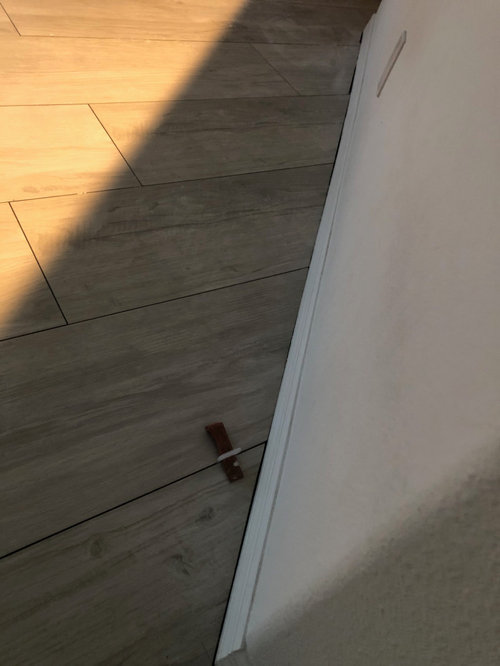
I'm betting that gap won't be filled with flexible silicone, but with inflexible grout. Either way, it's going to look terrible compared to having the baseboard cover. When the concrete moves, as it inevitably will, the tile will "tent". I'm told when tile let go, it sounds like a gunshot. I hope it happens in the middle of the night.
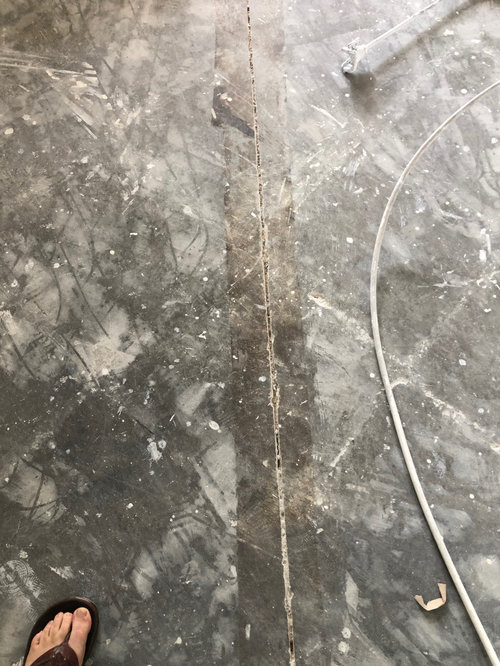
No, you can't membrane over control joints as illustrated here and as her tile installer has done. This picture was taken at my next sales call. The guy had the tile removed from his whole house. The tile in the dining room was split continuously along this membraned control joint.
You will accommodate movement, no matter what look you or your designer desire. The laws of physics will delay themselves just long enough for your tile man's check to clear. You deserve what you get since I told you so and you didn't listen.
Comments (30)
 6 years ago
Thank You! Excellent explanation of the 'gunshots at night' phenomenon, which generally happens during the evening cooling cycle here in the Caribbean, where contractors have recently begun to use thinset directly on slab. They employ the same technique we traditionally bedded tiles using mortar. Mortar and thinset are not the same thing!
Related Professionals
Emporia Design-Build Firms · Merced Design-Build Firms · Owensboro Home Builders · Concord Home Builders · Hempstead Home Builders · Clarksburg Kitchen Remodelers · Saginaw Kitchen Remodelers · Altoona Kitchen Remodelers · Ashland Bathroom Remodelers · Harrisonburg Bathroom Remodelers · Billings Bathroom Remodelers · Magnolia Flooring Contractors · Tupelo Tile and Stone Contractors · San Angelo Tile and Stone Contractors · Atlantic City Kitchen Remodelers 6 years ago
Joseph knows! I am in Sarasota an we bought an older home. It has wall to wall carpets but there is tile underneath! This tile was installed by god knows who! We have experienced what is also known down here as “ heaving” ! Yup! Sounds like a gunshot! Scared the $&@$ out of me. The tile is now piping up everywhere and we will be taking up about 2500 sq. Ft of it!
Joseph Corlett, LLC thanked Business_Name_Placeholder 6 years agolast modified: 6 years ago
I'm stunned that people still ignore Joseph's recommendations. And no I'm not trying to be funny. I'm always impressed with Joseph's stone and tile knowledge.
Don't we all feel the same way? Seriously, Joseph constantly shows us real-world issues, and he explains them simply. Anyone who isn't listening (well, that's most of the world), is asking for trouble.
Joseph Corlett, LLC thanked Mrs Pete 6 years ago
Okay, so as a homeowner who lacks comprehensive knowledge of construction and the trades, how do I know that my Sink Guy knows more than my Tile Guy when it comes to floors? :-O
I mean, yes, if Mr. Joseph came to my house in Texas and told me what was wrong, I'd believe him, because I know him here on GardenWeb.
But out in the wild, when a consumer pays a professional to do something, we're crossing our fingers that the pro will do things correctly. And if my Cabinet Guy says, "Hey, your Plumber is an idiot," and my Plumber Guy says, "Your Electrician was high when he did this...." And my Electrician says, "You know your Cabinet Guy is taking shortcuts...?" Who the heck am I supposed to believe???
Yes, I can do a bit of homework/research ahead of time, on how to "properly" do this-that-and-the-other, but who do I trust even then? Because googling something simple like, "How to properly paint a room," yields more than one opinion/technique, and several different YouTube videos from folks no one knows....?
- 6 years agolast modified: 6 years ago
Interesting, Mexico (assume you are referring to our southern border) has a lot of great tile labor. My only tile disaster was done by someone clearly not from Mexico. I personally see no correlation between skill of a person and location of birth. Especially not Mexico and tile/stone work.
- PRO
Joseph Corlett, LLC
Original Author6 years agoDavid:
Don't even begin to insinuate that I correlate ethnicity with quality of work. I've done no such thing and never have. - 6 years ago
Everyone wants the lowest price, but licensing, insurance, and making a decent living cost money.
This, I can totally see. Too many folks chase after the cheapest price, which obviously carries a greater risk for poor craftsmanship.
- 6 years ago
Everyone wants the lowest price, but licensing, insurance, and making a decent living cost money.
This, I can totally see. Too many folks chase after the cheapest price, which obviously carries a greater risk for poor craftsmanship.
I am not sure it does. One of the major problems with the construction industry is that price is not a very good indicator of quality. More to the point, higher prices may be necessary for good craftsmanship but it is far from sufficient. There is arguably substantially more risk in paying premium prices than there is paying low prices as risk tends to increase as investment does.
This is the problem with the construction industry in general. Too often bad contractors and good contractors look too much alike, in fact, bad contractors may even look better and charge more. Consumers are simply too ignorant of quality and the construction industry knows it. It is sad but in my experience too true.
- 6 years ago
[...] higher prices may be necessary for good craftsmanship but it is far from sufficient.
^ This is along the lines of what I was thinking... "You get what you pay for," isn't necessarily the case, but "You don't get what you don't pay for," more likely is. :-)
 6 years ago
Why would you hope something makes a gunshot noise in the middle of the night? I always wish people good luck, even if I don’t agree with them, or with what is being done.
- 6 years ago
The closer to the southern US boarder, the lower the labor costs. The low cost of labour drives many PROFESSIONALS out of the business. Those professionals who are good at what they do but already live off of marginalized income. As soon as labour costs drop below their mortgage costs, they quit the industry.
The VERY GOOD contractors - those who have a high level of quality - are those who can continue. They service the 1%-10%. The rest of us cannot afford them. Which is fine. They don't need the other 90%. They have a tremendous following that continue to pay for their high quality work.
The 90% of the population who have to be cost conscious are the one's who are left scrambling for "good". Those "good" contractors have quit. They have been replaced by lower priced people. Many of those people are average - good. But many more are not. The scammers come in all colours and creeds. Which means they cannot be 'filtered' out just by looking at them.
The way to battle this: MANDATORY enrollment in professional Guilds. Yep. Guilds. With 7 years of training to reach Master/Meister status. If someone wants to 'teach' others, they MUST hold a Meister/Master level certificate. How do you get that? You take 7 years of education and training AND a 3 day final exam. Just. Like. Germany.
So if you want "new" guys to be equal to the old guys, you need to have the oversight of a Guild system. The very system the Europeans LEFT in the 1700's, 1800's and 1900's.
The Wild Wild West is a horrible place to be if you are looking for quality building professionals.
A word to the Wise Homeowner: General Contractors are LEGALLY responsible for the quality of the work done by THEIR subcontractors. Subcontractors are never contractors. If you are the GC (you hire your own plumber, electrician, drywaller, painter, tile setter, etc) YOU become the General Contractor. - 6 years agolast modified: 6 years ago
A word to the Wise Homeowner: General Contractors are LEGALLY responsible for the quality of the work done by THEIR subcontractors. Subcontractors are never contractors. If you are the GC (you hire your own plumber, electrician, drywaller, painter, tile setter, etc) YOU become the General Contractor.
I have no idea what you are saying here, so if I am misunderstanding I apologize. A subcontractor will owe the homeowner the same duty as they would a contractor. This is a standard third party legal scenario and possibly a disclosed agent.
As for subcontractors there is actually no change in legal liability for their own work, there is a change in general legal liability for the job.
Here is an illustration to understand the difference.
- Suppose your flooring contractor was hired by you to work on your house. If the install is faulty the subcontractor is legally required to make you whole.
- Suppose your flooring contractor was hired by your General Contractor to work on your house. If the install is faulty the subcontractor is legally required to make you whole, whether or not that action goes through the general contractor.
- Suppose your flooring contractor was hired by you to work on your house. The install was done properly, but the floor was subsequently damaged by other work and the source of that damage is unknown. The flooring contractor is not required to make you legally whole as he is not the source of the damage.
- Suppose your flooring contractor was hired by your General Contractor to work on your house. The install was done properly, but the floor was subsequently damaged by other work and the source of that damage is unknown. The flooring contractor is not required to make you legally whole as he is not the source of the damage, however, the General Contractor is required to make you whole as overseeing all subs is his responsibility.
- 6 years ago
A homeowner becomes liable for the work done by the subcontractors when the HOMEOWNER (who is now the GC) asks for a result (ie. form of install) that goes against the manufacturer's recommendations or goes against Best Practices.
The subcontractor has a duty to object or argue the case for the appropriate form of installation - this is the same duty they have to a professional GC. As soon as the GC (homeowner in this scenario) IGNORES the advice of the subcontractor, the GC now OWNS any issues arising from that decision to ignore professional advice.
The two larger issues become:1. Homeowners don't know what they don't know
2. Subcontractors find it easier to do as they are told instead of risk being fired for objecting to the Homeowner's requests.
And therein lies the heart of the issue. Homeowners as GCs own the quality of their workers. And because a homeowner doesn't know what they don't know, they make requests that run contrary to Best Practices. This issue compounds when the subcontractors do not object to the homeowners' requests.
So we have a chicken and egg scenario running without end. Homeowners don't know enough to know how to evaluate subcontractors (because they don't know what they don't know) and the non-professional (guys with hammers) subcontractors will not object to a directive given by a homeowner-GC. - 6 years ago
The real problem is lack of vocational education. Our schools have focused effort on getting every student into college because college placements have become the gold standard for “we have really great schools”. To educators, administrators, and parents, working with your hands has become low class. Over the years, I stopped testing applicants on such simple tasks as addition and subtraction and no longer asked them to read a tape measure. These skills were no longer taught in school, so I, as an employer, had to decide if this applicant was teachable. I had people with two years of college who couldn’t figure the square footage of material even with my printed instructions of the math. We had people who couldn’t drill holes 18” apart, drilling instead holes at random spacing. Schools focus on diversity, trophies for trying, no rules for classroom behavior under the guise of creativity. We need vocational education returned to schools so people can learn to work with their hands. Several years ago the statistics showed the average age of a tradesman in America was 57. Who is going to fix the plumbing, rewire your house, tile the restaurant floor, fix the engine of your car, frame the new construction?
- 6 years agolast modified: 6 years ago
A homeowner becomes liable for the work done by the subcontractors when the HOMEOWNER (who is now the GC) asks for a result (ie. form of install) that goes against the manufacturer's recommendations or goes against Best Practices.
The subcontractor has a duty to object or argue the case for the appropriate form of installation - this is the same duty they have to a professional GC.
Your second sentence stands in opposition of your first. There is simply no additional exposure for a homeowner for work outside of due care for being there own G.C. and they realistically have more legal protection.
Poor workmanship or improper installation is actually a negligence case. It is a series of reasonableness tests. A request from homeowner to G.C. to subcontractor might pass a reasonableness test when the same request from homeowner to subcontractor would not. The difference has to do with asymmetry of the information, as a person becomes less experienced/informed their known and expected reliance on hired expertise increases. This means a subcontractor may have a duty to object to instructions from a homeowner that they would not from a G.C.
I am a fan of G.C.'s for practical reasons, but they don't add any legal protection against poor workmanship. Having said that, they should add some practical protections, as they have a more developed relationship with the homeowner so might get a sense of what homeowners want. However, they also do add communication friction. As you add links in the communication chain, the communication degrades. Anyone remember the thread about the homeowner agreeing they wanted the wood look tile laid straight so they ended up with a running bond install? I have to believe that wouldn't have happened had the homeowner discussed the pattern with the installer instead.
- PRO
Joseph Corlett, LLC
Original Author6 years ago" To educators, administrators, and parents, working with your hands has become low class."
There's your problem. You can build all the vocational schools you please, but until parents stop thinking only a doctor or lawyer is good enough for their little Janie, nothing will change. Maybe when Janie's lawyer husband can't get his tile installed it might. - 6 years ago
Mike Rowe (Dirty Jobs) speaks about this. He tells a story that In High School, he was called into a meeting with his guidance counselor with a poster with two men side by side mounted behind his desk. On one side was a smiling dapper man in a business suit holding a briefcase. On the other was a greasy, sweaty frowning guy in a hard hat. The caption was 'work smart, not hard".
How did we forget that hard work, physical labor, physical support of others and/or the creation and building of things can be far more rewarding than work behind a desk?Rowe has some good ideas:
- 6 years ago
Our schools have focused effort on getting every student into college because college placements have become the gold standard for “we have really great schools”.
I think you have the right symptoms, but I think you have the wrong disease. First, let's realize that kids are less prepared for college than they were 20 years ago and have been declining every year. It only appears a focus on college prep from your perspective, from my perspective it is a far more pervasive problem. Which isn't simply a disrespect of certain careers but a disrespect of any education that doesn't seem directly correlated with an employment outcome.-------
The college prep vs. vocational education thing is largely a myth. In the 70's and 80's there was a call for research to improve the vocational system. What the research found is that vocational/trade educations were inversely related to vocational/trade success. In other words, when we analyzed the number of people achieving a mastery of the trade or successful ownership of a trade business, they were much less likely to have vocational or trade educations than they were to have broad "college prep" educations. Those who dropped out of college in less than one year were still exponentially more likely to achieve vocational success than people who completed vocational school.
This isn't a surprise to anyone in education. It turns out that those who have critical thinking skills are better prepared for all types of work than those without. In fact, the only group that vocational education outperformed were those who dropped out of high school before their Junior year. So we largely adopted the stance that vocational education was the best path for only a few select students who were unsuited for broad general education...aka college prep.
At some point though, everyone became a bit too enamored with outcome based education. Too many people believe that education is job prep and now students shun anything they see as purely educational and not related to their selected outcome. Parents have contributed greatly to that and now few actually get the broad education that was the original goal.
- 6 years ago
In Canada, the homeowner GC is FULLY LIABLE for the people they hire. They do NOT have more protection. They have LESS protection, legally, from subcontractors ineptitude than if they were GCs.
In Canada the courts recognise the professionality of a GC. As soon as the homeowner chooses to side step the professional GC (to save money) the courts look upon the homeowner as the one responsible for their own demise should things go south.
In Canada, subcontractors are just that...subs. They sit BELOW the GC. The subs are employees of the GC and therefore *should do what they are told. The courts recognise the GC as the ULTIMATE decision maker. If the GC says hang the ceiling light on the floor, the electrician is supposed to do it. It is understood the GC knows MORE than the subs and therefore is making decisions for the homeowner. It is the GCs JOB to inform the homeowner that something 'isn't right', not the subcontractor.
Therefore the Homeowner is SUPPOSED to become the "Know-it-All" decision maker of a GC. And the subs are to do as they are told. It is the HIGHER END professionals (the Red Seal plumbers, electricians, etc) who are required by their PROFESSION (not necessarily the courts) to bring forth concerns to the GC....but they are not legally required to do so.
The courts recognise the vulnerability of the tile setter trying to make a decision. If the homeowner purchases wall tile and says, "Use it on the floor as well" who is the tile setter to say anything different? The GC (aka homeowner) obviously knows something they DON'T, so they do as they are told. The vulnerability of the employee is well documented in Canada. Whereas the USA has a different approach (legally) than Canada.  6 years ago
Am I the only one that didn't understand this sentence in regards to the baseboard?
" it is unfortunately common practice to not pull the baseboard, tile to within 1/2" of the drywall, grout, and reinstall the baseboard to cover the gap"
They are laying the tile w/o pulling the baseboard and then pulling the baseboard and reinstalling it after the fact? If that is the case, what's the point of not pulling it in the first place?- 6 years ago
30 percent of the job applicants, after reading the drug free policy and signing two consent forms, FAILED the pre-employment drug test. We didn’t track the number of people who walked out when they heard of the drug test.
- 6 years agolast modified: 6 years ago
In Canada, the homeowner GC is FULLY LIABLE for the people they hire.
You can yell every other word all day long but this is a massive oversimplification, if I am being generous. I haven't practiced in Canada but 8 seconds on Westlaw disproved your assertion.
Canada is not that different from the U.S., you have a duty of due care, that due care changes with the experience of the person the due care is owed to. If a homeowner is acting as their own G.C. there is a higher duty than if an experienced G.C. is acting as the G.C. Furthermore, the G.C.'s liability doesn't limit a subcontractor's liability in Canada. A G.C.'s expertise is a defense against negligence but not a limit on it. I assure you that an electrician who installs a chandelier on the floor will have liability unless he has significant evidence that he questioned the action. Even then it may not be sufficient.
Again, most of what you wrote is unnuanced understanding of Canadian contracting law if I am being kind.
The courts recognise the vulnerability of the tile setter trying to make a decision.
Here is a simple test, when negligence is involved, U.S., U.K., Australia, and Canada courts almost always hold the party in the best place to prevent the damage responsible. It is almost always the person who should have said no, and when everyone should have said no, it goes to the person who most understood it was wrong.
I will give some free legal advice here. If you are doing or overseeing something that you know to be incorrect and are wondering if you should say something... you should. If you know it is wrong and you are directly or indirectly responsible for doing it, then you may well be liable for the damages. I assure you, the law is not going to protect you when you should have said no, but didn't. You can march around all day believing you are in the clear, but I warn you that is a risky assumption at best.
- PRO
Joseph Corlett, LLC
Original Author6 years ago"They are laying the tile w/o pulling the baseboard and then pulling the baseboard and reinstalling it after the fact?"
No.
" If that is the case, what's the point of not pulling it in the first place?"
Laura:
No baseboard is being pulled; that's the problem. The baseboard should be pulled, the tile laid, and the baseboard reinstalled on top of the tile to cover the expansion gap between the tile and the drywall.
I hope that is more clear. - 6 years ago
Since we have delved into it. You can work at a desk until you are pretty old. Try laying tile when you are 50. My knees hurt just thinking about tile as a career.
I did agree that the baseboard pulling comment was confusing to me. Of course it should be - even I know that. - 6 years agolast modified: 6 years ago
Yes, that is quite clear, but not what is in your initial post:
" it is unfortunately common practice to not pull the baseboard, tile to within 1/2" of the drywall, grout, and reinstall the baseboard to cover the gap"
Not sure what happened there ^^^^
Thank you for clarifying.
 6 years ago
Since we have delved into it. You can work at a desk until you are pretty old. Try laying tile when you are 50. My knees hurt just thinking about tile as a career.
The man who did my specialized stone work around the base of my house and pool is 63 years old and probably in better shape than you or me. He was a true artisan too. Something to be said for doing physical labor.
- 6 years ago
@ bry911 - Now imagine the money-saving homeowner just discovered their subcontractor doesn't know a d@mn thing about tile setting. What's the likelihood the same money-saving homeowner is going to take said subcontractor to court?
In Canada: highly unlikely. Which brings us back to the reality the homeowner is fully responsible for the quality of the work done by their subs. If a GC is involved, the homeowner has some protection. If there is no GC involved the homeowner has no protection. That is the reality of it. - 6 years agolast modified: 6 years ago
What's the likelihood the same money-saving homeowner is going to take said subcontractor to court?
That is a valid point, but that was not your original point. I am not arguing against hiring a General Contractor, only against misstatements about the legal liability. But to respond specifically to that point, in the U.S. it is often much easier to seek legal recompense from a subcontractor than a G.C. In the U.S. small claims actions typically have much lower limits and so a bad contractor will quickly rack up damages in excess of those limits.
Which brings us back to the reality the homeowner is fully responsible for the quality of the work done by their subs. If a GC is involved, the homeowner has some protection.
A homeowner is not fully responsible for the quality of work done by their subs when they don't hire a G.C. Period! Do you actually know what the words "fully" and "responsible" mean? If you have a recognized legal duty to someone, which subcontractors certainly do, then by very definition you bear some responsibility. A subcontractor can't bear some responsibility while simultaneously bearing no responsibility. This isn't quantum mechanics, you can't occupy two mutually exclusive positions at the same time.
Furthermore, while I generally support the value of G.C.'s let's not pretend that they are altruistic. They can provide a layer of protection for homeowners, but sometimes they add a layer of damage to homeowners. For G.C.'s to always provide the benefit you are claiming they must always be more altruistic than the subcontractors, and that isn't the case. Anyone who has any significant experience in construction has seen G.C.'s cut corners when they got upside down on a project. Corners that a homeowner wouldn't have cut, and that only existed because the G.C. needed his margin on the project. It may not even be the homeowner's project the G.C. is upside down on that creates the problem.
Anytime you add an arm's length party in an intermediary role, there is an additional risk that their pursuit of profit will be detrimental to your project. I often use construction managers in lieu of G.C.'s so I can eliminate their profit motive and create a true fiduciary duty rather than a due care duty. Do you want to explain to me what I am doing wrong?
ETA: If we look back at the original post, I have seen G.C.'s do this exact thing to protect their margin. Tile to the baseboard and use quarter round to bridge the gap because it was more profitable.
















SJ McCarthy