Software
Houzz Logo Print
mike_54321

What did you pay for exterior insulation?

6 years ago

Hello all,


As I plan my house, I'm trying to decide whether to pay extra for exterior insulation, but I don't have a clear idea of what it would cost. Has anyone recently installed exterior rigid foam, or even better, rockwool panels, on their new build and could share the costs with me?


I'd also be interested in hearing closed cell spray foam costs, if you went that route instead / as well.


I'm in the PNW of the US, but interested in hearing from anywhere.


Many thanks!

Mike.


Comments (25)

  • PRO
    6 years ago

    Keep in mind construction costs are regional, and those regions can be small. You will receive the best information for your project from local people. Talk to a few local insulation companies and share your concerns, it will be very informative and the best chance for accuracy. Good insulation is a good investment.

  • 6 years ago

    Thanks Mark! I know it varies a lot; I'm still interested in ballpark figures from anyone who wouldn't mind sharing. If it appears to be within my budget, I'll start asking around locally for quotes.

  • 6 years ago

    Thank you Seabornman! You're right, we're specifying a rain screen anyway. Nice job doing the work yourself! That was my original plan, but my wife wanted the house finished in a reasonable amount of time :)

  • 6 years ago
    last modified: 6 years ago

    Costs are not only local, but can be very particular.

    For instance, when as a licensed builder I bought lumber and insulation through a wholesale lumberyard, XPS boards were 40% cheaper than at the Big Boxes.

    As well, all inputs and benefits have to be compared in any project.


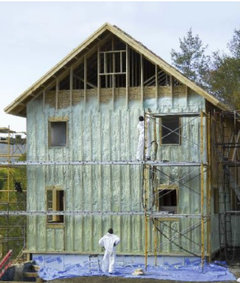
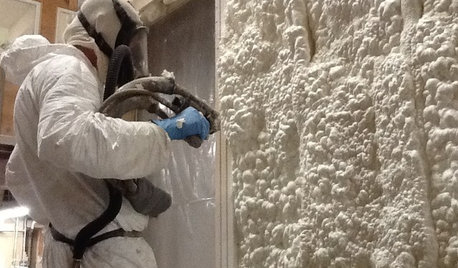
    Exterior spray foam insulation. Photo:JLC on line

    In one build, I had 1" XPS (extruded polystyrene) installed as sheathing. So it was actually lots less costly than OSB or ply sheathing.

    On a possibly upcoming project, I may spray foam the exterior over OSB. That's much more expensive than applying foamboard if you don't count the ease, speed and effectiveness of spraying vs. cutting, fitting, nailing and taping dozens of XPS boards. Only when I get the actual quotes will we decide.

  • 6 years ago

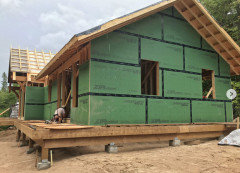
    I'm nearing completion of my house I sheathed with Zip-R9 (1.5" polyiso) and the increased material cost was almost exactly $3,000, or an extra $30 for the 100 sheets I purchased. (Compared to Zip with no exterior insulation at all)

    Incidental labor costs increased roughly equal to that amount.

    So I figure I spent about $6,000 for continuous insulation.

    When I do this again, I can cut the incidental cost likely in half.


    Closed cell will perform worse and cost more than continuous exterior.

    Opposite side of the country, but I pay $2 a sq.ft. for 2" closed cell.


    I like the idea of rockwool exterior panels, but the extra labor is considerable.

    I think any house built as such is likely to last life times.


    So, based on a house requiring 100 sheets of 4x8 Zip sheathing - The cost of upgrading to zip-R with someone who knows how to use it should add roughly $5000.

    Exterior rigid, I figure would double that cost to $10,000.

  • 6 years ago
    last modified: 6 years ago

    Closed cell will perform worse and cost more than continuous exterior.

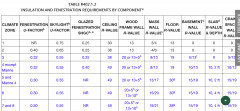
    Continuous exterior insulation has been offered as an alternative since 2012 by the IECC. So in many cases the ccspf would still be combined with exterior insulation.


    IECC 2018

    Not to mention cost comparisons between hybrid approaches such as flash and batt to the interior plus exterior foamboard. Or variations involving oc spray and/or polyiso and EPS boards.

  • 6 years ago

    Thank you! Matt M, that's super helpful info, thanks so much. You think exterior rigid foam would cost twice as much due to labor?

    I really appreciate the dollar figures!

  • 6 years ago

    I would think the simplest approach is to install the code minimum exterior insulation (probably 1"XPS R-5 in zone 5) which simplifies windows, doors and furring installation. When I put up XPS, I temporarily attached each piece with a couple of deck screws and a plastic washer, then applied furring on top. I used 2 layers for 3" but 1" would be one layer. Foam is quick to cut with a toolbox saw and/or a utility knife.

  • 6 years ago
    last modified: 6 years ago

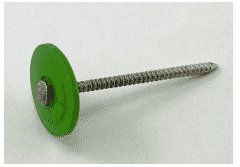
    Best to use tongue and groove XPS, the bigger the sheets the better. XPS is attached with cap nails.

    See Building Science Corp. guidance on taped sheathing drainage planes.


    Cap nail

    Tape the joints with XPS sheathing tape. You don't even need to cut the boards. Just score them and they break cleanly over dimensional lumber. And follow best practices with window installation as per BSC document linked above.

    ******

    I used 2 layers for 3" but 1" would be one layer. Interesting math!

  • 6 years ago

    The $10,000 figure is a bit muddy, because there's many factors that will effect the cost.

    I break this down as $6,000 labor and $4,000 materials(3,000 for 2" insulation board, 1,000 for "extras", furring, hardware, tapes).

    If the insulation increases in thickness, obviously the insulation cost increases, but the hardware costs only slightly increase. Ex, lets say $6,000 for 4" insul. board, and now $1,300 for extras. The labor is essentially the same.

    This makes it possible to maybe save money by framing with only 2x4s (about $1,000 less). Your sheathing doesn't need to be anything fancy like Zip and instead use an osb or 1/2" plywood sheathing (save another $1,000 or so. +/-)


    So now we have a 2x4 wall with 4" exterior insulation for about $12,000 (6,000 labor, 8,000 materials, -2,000 in potential material savings.)

    This wall will inherently have a rain screen, the sheathing will be warm, the walls will have no less than R-20 at their weakest and R-32 at their best. It doesn't get much better than that. The question is if it's worth it.


    I personally chose the Zip-R system instead on my house for a bunch of reasons, but ultimately - cost. The R-9 version hits the sweet spot of cost to savings. The energy savings by going further couldn't be justified, around $100 a year in my case if I doubled the exterior insul. level.

    Air tightness is decidedly more important, after which Windows and doors will be the biggest energy losses, and domestic hot water will be the biggest energy user. It makes more sense to focus spending in these areas.

    I spec'd all casement windows, with triple glazing that added 30% to the window cost ($5,000) and chose Therma-tru doors which aren't anything special.


    At this point, you can and should use air source heat pumps for HVAC and save yourself a considerable amount versus a typical gas fired forced hot air system.


    There's so many factors. These prices are also only what I would charge since I'm familiar with these systems already. You may find resistance from builders in your area.

    If it's not just about the economics, then I would encourage you to put as much insulation on the house as you can.


  • 6 years ago

    A few other advantages of exterior insulation in zone 5: insulation can be continuous from top plate to top of footing so no need for interior basement insulation and rim joist is taken care of, there's no issues of plumbing or electrical in exterior walls, it's easy to add ledgers for decks and porches, 2x4 walls ok (can meet code with no insulation in wall cavity), and air infiltration reduction comes with the system.

  • 6 years ago
    last modified: 6 years ago

    I paid $3000 or so for R3 - upcharge from regular zip. My house is 3800 sqft and a bit complicated so not very efficient for materials. A house could easily be 1/3 of mine (in my area) so a ballpark is tough without knowing details of your house.

    You have to wonder if exterior insulation makes sense anywhere in the PNW.

    I can tell you my R3 in NC (a much colder area than most of the PNW - ie winter lows) probably saves me $100 a year. You pay less than me for electricity (a generalization for the PNW). My cost benefit became worth it to me because my utility paid me 9 years or so upfront for any avoided KWHs. Also, we rely on solar and winter is the biggest issue so saving a Dec/Jan KWH is much more important than a June KWH from a carbon/environmental standpoint.

    Are you looking for other reasons than financial or environmental? Because financial isn't likely to cut it (maybe at elevation?) and environmental is tough when your electricity is hydro. Those foam panels are not free from environmental injury and in a mild climate may never pay back in the life of the house. Resources need to be used where they are beneficial - like in a cold area (or a coal area I suppose but those will be gone by 2030).

  • 6 years ago

    Thank you @David Cary! Good questions and helpful info.


    My house will be 1600 sqft, Eastern Washington. In January, average high/low is 35F/20F. In summer, average high is 88F. Our electricity is very cheap: 2.7c per kWh.


    My reasons are mainly comfort and build quality. Without external insulation, we can only stuff enough insulation into the 2x6 stud bays to meet code minimum (R-20). Will there be cold spots in the house as a result? Will I wish I had spent the extra money? It's a mid-budget build, so I have to make compromises where it makes sense.


    The architect is suggesting closed-cell foam on the inside as a mid-budget option, but I have reservations (and have also heard, including on this thread, that it might cost more than, say, rockwool batts + external rigid). If I don't do exterior insulation I'll likely choose rockwool batts and a good peel-and-stick WRB to help with air sealing.


    I feel good about all of the other decisions I've had to make so far, but this insulation question has me going back and forth!


    Thanks again!


  • 6 years ago

    With exterior insulation and 2x6 walls, I have calculated R36 (standard 2x6 framing would be R16) walls, added to R60 ceiling, and my addition is extremely comfortable. It's also very quiet. I was able to extend ductwork from existing system, so very efficient.

    Good luck with your project!

    mike_54321 thanked Seabornman
  • 6 years ago

    Will there be cold spots in the house as a result?


    We are currently in a 3,770sf 1964 home in Climate Zone 5 with no wall insulation whatsover and there are no noticeable cold spots. But it ain't cheap to heat and cool!


    R20 in the stud bays is not the effective wall R value when you count the up to 27% of wall space occupied by the studs. Thermal bridging is the enemy.


    All costs are local. But if you can diy external insulation, obviously a big savings.

  • 6 years ago

    We are currently in a 3,770sf 1964 home in Climate Zone 5 with no wall insulation whatsover and there are no noticeable cold spots. But it ain't cheap to heat and cool!


    Haha! I bet :) Good to know, though - I can handle the extra heating/cooling load, but would be disappointed to build a new house and have it be uncomfortable.


    I definitely see the advantages in exterior insulation (many hours of watching Matt Risinger et al!) but perhaps I can live without it on this particular house.


    Thanks!

  • 6 years ago

    For comfort, if you have anywhere you should first spend money, it is on air tightness.


    An air tight cardboard box would hold heat longer than a yeti cooler with the top open.


    If budget constraints preclude exterior insulation, you won't be uncomfortable in a code-minimum insulated, but well air sealed house.


    I would still push you to spring for the exterior insul., if you can find a builder familiar with higher performance homes. I understand this is not a simple task.

  • 6 years ago
    last modified: 6 years ago

    Agree with Matt. Air tight first.

    My house is cold in one area. The living room with 14 foot ceilings (and no one overhead unlike the rest of the house). It also has a wall of windows that have no real window covering. That to me is more of an issue than just R20 walls. It isn't a really big issue for us. That is where the direct vent gas fireplace is so it gives us an excuse to run it. Used probably 6 therms this year.

    Compare to our bedroom which has 2 exposed walls with decent glazing per size (4 large windows). Has insulated attic above. Floor to ceiling curtains. We don't run the heat in there and it gets to 62 when it was 15 out (below our design temp).

    In a tight house (and 2x6 with something better than batts), windows dominate the cold spots.

    There isn't anyway we have a 27% framing fraction. We have 24 O.C., but even still I don't see 27% floated around much. 20% sure.

    At 2.7 cents, no exterior insulation is by far the best financial decision.

  • 6 years ago
    last modified: 6 years ago

    There isn't anyway we have a 27% framing fraction. We have 24 O.C., but even still I don't see 27% floated around much.

    Advanced framing ( including 24" centres) will greatly reduce the framing fraction. However, 14%-27% is the figure studies have shown is typical of existing homes, according to Martin Holladay. He then cites a national 2003 ASHRAE study that says 25% is typical!


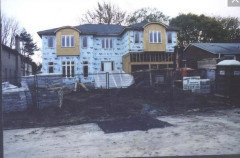
    worthy built 2004 XPS exterior insulation as sheathing

    In our parts, it has been 20 years since exterior insulation has been considered a novelty for eco/energy geeks.

  • 6 years ago
    last modified: 6 years ago

    In that link, Martin said 14-27%. Or about 20%.

    One would hope at least some components of "advanced framing" would be used on modern builds - these are framing techniques around since the 1970s (source being my father who worked on studies in the 70s about this stuff).

    My builder (who didn't exactly sell himself as a green builder), always uses at least some techniques even if building with 2x4s.

    That thread was about retrofits - so Martin was discussing old (presumably at least 30 years) construction techniques.

    OP is in a much colder area than I was thinking. But typically on the warmer side of the border, exterior insulation is not routine and thus overpriced. And then with 2.7 cents a kwh - that is really hard to justify. I use about 500 kwh a month to heat my 3800 sqft house in a similar climate. That is $13 for OP. It might be $15 with no exterior insulation. So even giving 5 months of heating, we might be talking about $10 a year.

    And XPS has highest GHG per r value of all conventional insulation techniques. Not the full story because exterior is better than stud based but still a significant consideration when your energy source is hydro.

  • 6 years ago

    These numbers help a lot - thank you all!


    Also a good point about the environmental impact... the materials used would likely outweigh the energy generation's impact.


    I think you've all helped me to decide to concentrate on good air sealing, and not do the external insulation. If my builder was gung-ho on it, I'd be more likely, but he's reticent, which means extra cost in money and relationship.


    Many thanks for taking the time to help and educate me! This has been very helpful.

  • 6 years ago
    last modified: 6 years ago

    One would hope at least some components of "advanced framing" would be used on modern builds.

    Not a novelty. But still not standard. For example, most high end custom builds in our neighbourhood (C$5m+) are still studs @ 16" o.c. with batts between. Our latest architect's plan was the same till we insisted on exterior insulation.


    In my last build for clients, in 2012, the architectural technologist wanted nothing to do with exterior insulation.


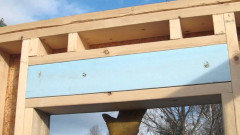
    Insulated window header. (Double top plate is not advanced framing.)


    About the best I could do was move window headers to the exterior and use XPS to the inside.

    (Thanks for the correction, though then Holladay cites a completely contradictory study!)

  • 3 years ago

    @mike_54321


    I know this thread is incredibly old, but in case anyone else finds it:


    My reasons are mainly comfort and build quality. Without external insulation, we can only stuff enough insulation into the 2x6 stud bays to meet code minimum (R-20). Will there be cold spots in the house as a result? Will I wish I had spent the extra money? It's a mid-budget build, so I have to make compromises where it makes sense.


    Another very important consideration is the greatly reduced risk of condensation and resulting moisture damage that exterior insulation provides by keeping any surfaces inside the wall warm enough to prevent condensation. This of course depends on your climate and ratio of exterior to cavity insulation values.

  • 3 years ago
    last modified: 3 years ago

    And here I am again, 3 months into another build with exterior insulation--ZIPR 6.6 from Huber, to be combined with fg between the studs on the interior.

    ZIP R sheathing combines exterior insulation and air.moisture barrier with exterior OSB.

    I's still rare here. But I've long had it with flapping-in-the-wind TYVEK rarely detailed properly.

    Of course, the framing contractor may say "no, never heard of that," so I'll go back to XPS. Or, if he says "no" to that too, maybe just cc spray the entire exterior. The world of building scientists is unknown to most of the trades.