Software
Houzz Logo Print
danielj_2009

Continued fungus problems

6 years ago
Just thought I'd start a new thread on fungus as several of us have been dealing with this in recent years. I'm frustrated because I had no issues for a good 5 years and now every year I get hammered even with fungal treatments. Three years ago I had it so bad I brought in some sections of sod and cut and pasted it in. Two years ago I used Headway G which is a mix of azoxy and propi and I got through most of the summer before again getting a pretty bad outbreak. Last year I used Clearys thio to try and avoid azoxy resistance. Same thing. Got into mid July and lawn near the street broke out, although several people in the area had fungus this year. I spent a lot of money on the Clearys and got a breakout anyway. So this year I'm thinking of going back to Headway G and try to be more consistent with applications over a longer period, starting in May instead of June 1.


Before you ask, no it isn't grubs.


I mow at 3.5" now because I'm worried that 4" was trapping moisture. Maybe I should go down to 3" this year? It's disappointing because my neighbors frequently say I have the nicest lawn in the area, but I seem to get fungus more than anybody else. Maybe I'm killing my lawn with kindness?


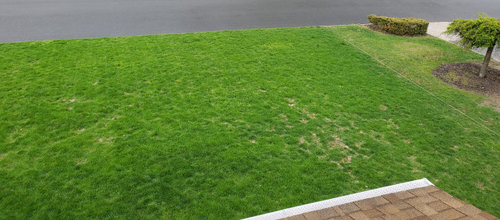
See photo. I've transplanted a few patches of KBG from curb edging so several of the dead areas are not as apparent. Also, you can't see all the small dead spots near the street. This is left over damage from last year, of course. My property ends at the white string my neighbor put up for when he does whatever he is going to do over there. I planted the sod for him and he does nothing with it. He's full of weeds and the grass is not healthy, but no fungus! Admittedly it is a small patch of grass.


I've even considered aerating the lawn (gasp!) to see if that helps, but I don't want to risk holding off on fungicide and find out aerating did nothing... just trying to figure out what the neighbors are doing or aren't doing compared to me. I know few of them fertilize enough or at the right time of year.


Anybody have similar issues? I'm in north NJ. I mowed twice so far but it has been cold here and the whole lawn has not waken up yet.


Comments (17)

  • 6 years ago

    To me, repeated fungus is mother nature's way of saying that lawn (be it cultivars or type) shouldn't be there. Also, what is your spring fertilizer routine? The further south you go with cool season grasses, the earlier you want your only application of spring fertilizer and then NOTHING until fall. If you have KBG, maybe consider a TTTF lawn? Or if you have older KBG cultivars, maybe it's time to renovate with newer types more suitable for your area.

  • 6 years ago

    Yeah, that's something I was mulling over last year. Thanks for the reminder. I only use OceanGro (like milorganite) in May and then into fall. I never knew what cultivar the landscaper used and I'm sure he has no idea, either. The other side of my front lawn gets a lot less fungus but still a little. The back yard is a contractor's tri mix and has never had fungus, so there's that.


    The last thing I want is to replace the whole lawn and then continue to have the same problem! Too bad these things take years to resolve, if ever.

  • 6 years ago

    Well if you are using OceanGro spring and fall, I would for sure say you don't need core aeration. Maybe the spring application earlier?


    Regardless, if it were me and you have a sprinkler system, I'd probably redo the front. If northern NJ is KBG friendly, try elite cultivars. Otherwise, TTTF with a little KBG is nice.

  • 6 years ago

    Fortunately, lawns never really need core aeration and it won't ever help with a fungal issue anyway. And to confound fungi, you'd actually want to apply the feeding further out from the spring flush of growth when it's not going to have a nice, juicy rich grass growth to set into even more rich juicy grass growth for the fungi to attack. Like very, very late May or early June.

    I might actually try something folks say doesn't work because hey, what the heck, it's cheap. It's nice and early. Get a nice, cheap bag (some bags) of cracked corn and spread it at 20 pounds per thousand. See if it helps. This can take a year or two to get going. Theory here being the corn favors fungal growth to begin with...just not disease fungi. Other fungi compete for resources and space, and frankly don't favor having the disease fungi around.

    Even in my supposedly susceptible lawn, after years, I'm the one in the neighborhood without any fungal issues.

    Even if it fails, at worst you just slightly conditioned the soil a bit and made the local birds happy.


    The second option is to change the cultivar in that one problem spot to something resistant to fungal infections. By preference, a KBG cultivar that will spread with good treatment (not a problem in your lawn) but that matches the current color and blade well enough not to be terribly obvious.


    Option three, zone treat with an anti-fungal tuned to kill that particular disease, which I can't ID from that distance.


  • 6 years ago

    Thanks mish and morph. I've used corn in the past and didn't notice anything obvious. If I find some cheap maybe I'll throw some down. Weird thing is I have about 1500 sf of the same KBG on the other side of the driveway and I don't have anywhere near the same problem.


    I could imagine nuking the whole 2200 sf pictured above if I could figure out a cultivar that would guarantee no fungus problems. Does the TTTF not have these issues?


    If I redid the lawn I know there will be a mountain of dead grass to deal with after scalping. My biggest issue then is thinking about seeding new KBG into existing but dead KBG roots. Can KBG be reseeded without having to do much with the existing substrate of soil and roots, other than simply rolling it?

  • 6 years ago

    You'd have to know what disease you have to figure out what (if any) cultivar or species is going to be resistant or immune. And sometimes...well... Mine is supposed to be resistant to red thread. And it is. But in years like the one we're having, I still get it, it's just that my lawn doesn't turn red like others.

    Really, every grass, cultivar, or other plant will suffer from some fungus. It's an eternal war between the two. QED. It's a matter of what you can handle, the grass can handle, and what happens to flourish in that particular area.

    For re-establishment post-kill, you don't have to do anything. For my old lawn, I scalped it and that was all. No rolling. Nada. Threw down seed, tossed down some covering peat, and had done with it (it was a full 10,000 square foot reno, so the covering was a make-sure).

  • 6 years ago

    Thanks, morph. Starting over might not be so bad then, but if I can't really expect better performance out of another cultivar then I dunno.. I have to think the one I have is already compatible with my region, yet I have these problems. I wanted to rule out other possible causes, like too much organics or wood pellets from a few years ago, or something I'm doing that the neighbors aren't. The only thing obvious is that most lawns are starved for N around here, except in the spring when everybody fertilizes.

  • 6 years ago

    Too much OM from years ago isn't going to do that, it's already later-stage. Plus decaying OM doesn't attract disease fungi anyway--it's getting decay fungi. They're not usually the same species, for obvious reasons. :-)

    A healthier, well-fed lawn is going to be less susceptible to diseases due to being...well, healthier. Conditions have to be right, or the cultivar in question has to be susceptible to the disease at hand. I can't remember which cultivars you have offhand, it's been far too long?

  • 6 years ago

    " What do you think of the idea that mowing high might trap moisture and make the problem worse, compared to all the lawns cut at 2.5 and 3 inches? "

    Probably not significant in terms of cutting 2.5 to 4 inches. It's just not going to impact the dry time of the blade--where fungus tends to strike--all that significantly.

    In fact, it's probably inversely proportional. Long-cut grass tends to be healthy grass (when talking about most northern lawns). It encourages deeper, healthier root systems that can tap deeper resources and store more carbohydrates. Grasses grow more slowly when cut longer and don't produce the weak, juicy growth that encourages fungal infections.


    " The landscaper put down KBG sod. "

    Yep. You got the cheap crap, and probably an old cultivar that has few resistances. *cough* Abbey *cough*.

    Try this. This fall, in that one bad spot, try upgrading just there to modern KBG cultivars. Say...Midnight II and two others from other families. I'm thinking something like Moonlight and the like, whatever the modern ones are (remind me in July, I'll look it up for you). You'll need a pound.

    Ride it for two years and see how it goes (that first year, it's going to get diseased, it's a baby, they get colds). If that works, think about a reno in pieces.

  • 6 years ago

    @morph: Interesting idea. Part of me just wants to replace it rather than diddle around for another year testing cultivars. The other part of me thinks it will be interesting to try. Maybe do a 5x5 or 5x10 foot plot of each. The key thing you just said is that I got crap sod from the landscaper. Is it pretty much a guarantee that I got a Yugo because you can't buy Ferrari sod? In other words, the new cultivars don't come in sod form? This kind of thing would give me the confidence to make a move to change out the lawn.


    I've noted before that I had no fungal issues until year 4. I found somewhere online that KBG sod tends to be rather immune from fungus for its first 3 years. This matched my situation exactly.


    I really appreciate you sharing your knowledge on this. You're a great resource!

  • 6 years ago

    was searching through posts about fungus to see if anyone is posting about similar issues. I'm in central jersey with a fescue lawn and I'm seeing some spots and yellowing which, if it truly is fungi, it's early this year for me. 2018 was the first time I dealt with fungal problems and it usually doesn't happen until late June. wondering if it's the more humid and rainy seasons we've been getting here past few years?

  • 6 years ago
    last modified: 6 years ago

    I seem to be having the same problem as danielj and I am in North Jersey also. My KBG lawn has been here for 45 years and I kept it 100% KBG meaning if I ever found a different looking grass finding it's way in, I would kill it. If the patch of foreign grass was large enough I would dig it out and replace the sod, Not a weed to be seen, I can honestly say it's the best lawn in town and beyond.

    Fungus was never an issue until suddenly and unexpectedly it began around 5 years ago. The 3rd year has been the worst so far and it took until that 3rd year to realize that this is now a persistent problem that is most likely overwintering, and applying a fungicide the way I was, was not helping much if at all. I describe the 3rd year as being the worst because like daniel I had many patches that completely died down to the bare ground. It took until the following year for the lawn to repair itself. So realizing that I had a serious problem I tried to research and find out what exact fungus I was getting. It was difficult to diagnose and I never really did because some areas were evenly browning out, some areas had the spots and some areas had the half circles with green grass in the middle, etc... so I probably get a combination of fungus diseases. It doesn't show up in my lawn until we get sustained 90 degree + days with humidity, usually beginning of July, and then calming down in August when temps seem to drop a few degrees. Up to the 3rd year I was only treating the fungus once. Not enough obviously. Last year I treated twice with Jonathan Green and was able to keep another disaster at bay, but maybe the weather was on my side too (I wasn't keeping records). This year I realized that I should be applying a fungicide at 14 day intervals when conditions are favorable, but I realized it a bit late and had spaced the first 2 applications of Bayer Advanced a month apart. Then 14 days later applied Scotts around August 1st. Again, this year I avoided complete disaster but still had the worst fungus on the block (however, all the other lawns are weedy and many different grasses). I have to say in August the lawn started to heal up nicely. Not sure if it had more to do with Scotts or because the weather broke a bit but I did see improvement the first week of August when the weather was still over 90 and highly humid

    So I'm still in the process of trial and error in getting back to a point before this started happening. Next year I will try Headway G at the end of June, then a Lesco product mid July and finally Heritage G beginning of August. I could back off on my feedings too and I may get some backlash on what I am about to say, but I fertilize once a month April to November. It wasn't a problem for 40 years and has kept the lawn A1 all that time.

    If next year's plan doesn't work out well, what am I considering? Switching the lawn over to a hot weather grass like Zoysia? A bold move. I'm not a big believer in climate change but can our lawns be telling us maybe it's really happening? Also, if this fungus is in the soil year over year and nothing is working to kill it, I read that if you cover the ground with clear poly sheeting for a year, it sterilizes the soil. That ain't happening on my front lawn of 5,000 square feet.

    Let me know how you make out. I'll do the same.

  • 6 years ago

    Any updates Daniel? It was a rough summer here in NJ....

  • 6 years ago

    @Thomas and @Joe: Call me Dan, please!


    I threw all kinds of fungicides, including Headway G, at my lawn for the last two seasons. Results were still disappointing so I gave up and did nothing this year. Well, I threatened to kill off the lawn this year and the lawn must have gotten wind of it because it pretty much behaved this year. I did find it interesting that Thomas had problems like mine in recent years. I just don't want to have to deal with fungicides every year so I'd like to try a better KBG variety.


    So I'm in a quandry. I really didn't get hit hard by the same fungus this year. I have a few small dead spots but that might also be some of the grass near my big hickory tree going dormant from little watering. I did not redo the lawn mostly because it wasn't a priority. If covid goes away and things are more normal business wise next year then I might redo the lawn just to get a better cultivar.


    What's your story, Joe? How is the new lawn holding up? I'd probably be getting the same one as you so I'm interested in what's happening. Same with you, Thomas.

  • 5 years ago

    Dan, my grass looks great this fall. I'm giving it one more season with the fungicides I mentioned. If the disease continues I'll go the route of a better KBG variety as you are considering.

  • 5 years ago

    Glad to hear that, Thomas. I had some problems again this year but it was mostly only around my large hickory tree. The tree line extends pretty far so a good 25% of the lawn is technically "under" the tree even though the branches are so high up that I still get lots of sun there. I just didn't have the time to do much with the lawn this year. I think next year I am going to irrigate this particular area a lot more than I normally do, which is deep and infrequent. Maybe the lawn is drought stressed and is ripe for infection.