Software
Houzz Logo Print
prairiemoon2

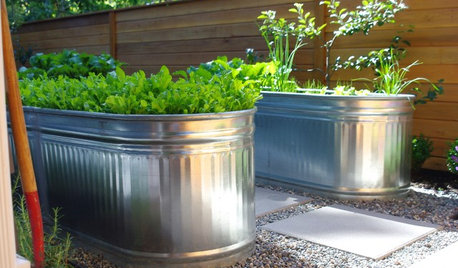
How about a metal trough as a vegetable planter?

6 years ago
last modified: 6 years ago

I have wooden raised beds at the moment, and I am finding that from one spring to the next, the multiple silver maples in my neighbor's yard on one side, and spruce, sycamore, and pine on the other, are invading my vegetable beds with roots.

I dig it all out in the spring and the next spring I have to do it again. I expected to have to deal with roots, but, never thought a bed would fill up in one season. I'm considering ending my vegetable gardening. Then the other day, I saw a photo of someone who had large metal planters for vegetable growing. I thought, maybe I could do that. I do wonder though - you have to put drainage holes in them and if they are sitting on the ground, is that going to still make it possible for maple roots to creep into my beds?

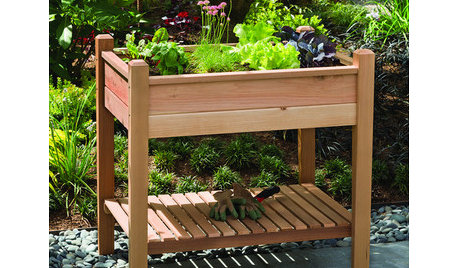
Then I thought maybe I could raise them off the ground somehow.

Anyone had any similar experience with tree roots? Have any thoughts on these metal containers? What about heat in the sun? Here's a link to what I am talking about....


Metal Troughs


And actually, the more I think about it, I garden organically, and that requires an ecological system with the soil, which is eliminated in a container. So, maybe that is a deal breaker. I've grown for example tomatoes and peppers in containers and it's just not the same as growing them in the ground. I'd assume organic growers would agree with me?

Comments (20)

  • 6 years ago

    Metal stock tanks are very popular for raised bed veggie gardens in my area. But as they have a base, they are really containers as opposed to just a raised bed and so are best when following all the protocols for container gardening......proper potting soil (not just dirt or enriched topsoil) and avoidance of organically derived ferts.

    I grow some stuff in the ground and some in containers, primarily tomatoes. And while I follow organic practices for inground gardening, they just do not work efficiently for containers. To be perfectly honest, I have not found any difference in taste, productivity or growth habit between the two systems.

    prairiemoon2 z6b MA thanked gardengal48 (PNW Z8/9)
  • 6 years ago
    last modified: 6 years ago

    Well, with a large container you could probably maintain some sort of biological system in the soil. Of course, we're talking real topsoil and compost (and a lot of perlite or vermiculite to allow it to breathe better). Certainly with sterile soilless potting mix, you wouldn't have a chance. As far as soil bacteria is concerned, such system would look pretty much like the ground. Might be worth a try doing that with organic ferts. In principle, there's nothing about a wall and a floor that prevents soil bacteria from populating a mix.

    prairiemoon2 z6b MA thanked daninthedirt (USDA 9a, HZ9, CentTX, Sunset z30, Cfa)
  • 6 years ago

    Unfortunately, you cannot just a fill a container - regardless of size - with regular topsoil and compost and expect it to work like a raised bed or an inground planting situation. Compared to a raised bed or the ground, a metal trough is a closed system. It will have solid sides and a solid bottom and even with a good number of drain holes drilled into it, fast drainage is compromised unless you use a container specific potting medium. And those will just not support a healthy microbial population.

    It's not the "wall and floor" that prevents microbial activity.......it is the media you need to use with the "wall and a floor" that will restrict its development.

    That is just the nature of container gardening. It is what it is and organic gardening methods are not easy to superimpose on this very situation specific activity.

    prairiemoon2 z6b MA thanked gardengal48 (PNW Z8/9)
  • 6 years ago

    Thanks for that perspective GardenGal. I don't use any fertilizer that is not organic and very little of that. I use cover crops and compost. I wouldn't want to grow vegetables with non organic fertilizers.


    Dan - It is a pretty large container. I think it was about 160 gallon size. I was thinking I could simply transfer the soil in my raised beds over to these containers. But you're saying I would need to add perlite? I guess I don't know enough about the biological system. In my imagination, I think the residents of the soil are always moving up and down deeper in the soil than just a foot of soil. It's probably time for me to learn a little more about the biological system in the soil too.


    I'm thinking that it might be worth my while to try one container and see how it works out, simply because the other choice is to stop growing vegetables. What would I have to lose and it's not much of an investment.


    Any thoughts on whether drainage holes would give the roots an opportunity to infiltrate the containers? Or if it would be possible to raise the beds about 6" off the ground to prevent it? I'd imagine full of soil, they would be pretty heavy.


  • 6 years ago

    If you can find a fully liquid or water soluble organic fert, that could work. There are some but they tend to be few and far between. Even compost tea would be better than compost for the trough planting.

    btw, you would need to add about 50% total volume of perlite if you use regular raised bed soil to get the trough to drain well. That is the ongoing issue with any container gardening system....the soil mix and how it affects drainage governs everything that happens.

    You do have choices....inground or regular raised bed practices will not limit organic methodology. If you go with a container, organic options are extremely limited.

    prairiemoon2 z6b MA thanked gardengal48 (PNW Z8/9)
  • 6 years ago
    last modified: 6 years ago

    I was suggesting adding a lot of perlite and vermiculite *specifically* to increase porosity. But from a biological perspective, there is no reason that a container can't have active soil microbia. Gardengal is suggesting that the issue is drainage. I'm not convinced that a container with bacterially active soil can't be made to drain properly. I do very little container gardening, but it would be good to see some careful explanation about this. In fact, I do houseplants in pots that are filled with garden soil (with some peat moss and compost), and it works fine. I have actually never ever used soil-less mix. I do add MiracleGro to these pots, but the fact that I need to keep adding soil specifically means that the compost is degrading, and that little beasties in the mix are doing it. So I KNOW I have active bacteria in my containers.


    To keep roots out of containers, it may be as simply as putting a plastic shield underneath the tank. But yes, to keep that plastic from plugging up the drain holes, might be smart to raise the tank and inch or so.

    prairiemoon2 z6b MA thanked daninthedirt (USDA 9a, HZ9, CentTX, Sunset z30, Cfa)
  • 6 years ago
    last modified: 6 years ago

    Great information GardenGal, and I did notice that Dan had suggested perlite or vermiculite. If I understand GardenGal, she is saying that if the soil in the container does not drain as well as it needs to, that biological activity will be negatively impacted.

    I think Dan has a point as well, how can it be that a container that is bacterially active can't be made to drain properly? Doesn't the amount of drainage holes add to the discussion, too?

    I'm also fascinated to hear that you use garden soil in pots for houseplants, Dan.

    Yes, raising the trough might be worthwhile, just like putting a plant pot on a patio on little feet, but of course, something that heavy would need a lot more than that. Maybe 2"wood the length of the trough with a couple of crossbars for one idea. I just read an article suggesting you could sit the trough on gravel. I wonder if sitting on gravel would still allow tree roots to grow up through drainage holes. Especially if I were going to add a lot of drainage holes. I was also reading that sometimes these tanks leak and if using them for gardening, that could work out as a good thing. Someone in this article reports that he uses 80% manure in his tanks. ?? I didn't think growing anything in that amount of manure was a good thing, is it?

  • 6 years ago

    dan, just visit the Container Gardening forum. This topic has been discussed endlessly there. And there is very clear science behind it. Any one of the Container Soils - Water Movement and Retention threads will explain it in detail. Plants will grow in just about anything. But for them to thrive, and in the cases of vegetables, be properly productive does require a lot more finesse than tossing them into a pot with garden soil and some compost.

    btw, vermiculite's contribution to any porosity is very short lived. Once it becomes fully saturated, it collapses and compresses and any porosity it might have offered is lost. It just becomes a sludgy, glue-like substance.

    I have been container gardening for a very long time, the last 10 years or so almost exclusively. Fortunately, the information presented in the Container Gardening forum and specifically the input provided by Al (tapla) has been invaluable and has improved the outcome over my earlier efforts immeasurably. The importance of a properly structured container media was something I learned very early on and I have never looked back ;-)

    prairiemoon2 z6b MA thanked gardengal48 (PNW Z8/9)
  • 6 years ago

    " I think Dan has a point as well, how can it be that a container that is bacterially active can't be made to drain properly? Doesn't the amount of drainage holes add to the discussion, too? "

    Question #1: because the type of soils and material that support microbial (it's not just bacteria that is necessary) activity do not lend themselves to the fast drainage that any container requires. Garden soil is simply too dense and too uniform in particle size. And any organic matter will continue to degrade and as it does, it too becomes smaller and smaller in particle size. Aeration and adequate porosity are almost nonexistant with these sorts of ingredients, they become excessively water retentive and as a result you have very high perched water table.

    Question #2: drainage holes, unless they are missing completely, add nothing to the process. They only allow drainage...they do not improve it.

    prairiemoon2 z6b MA thanked gardengal48 (PNW Z8/9)
  • 6 years ago
    last modified: 6 years ago

    Well, my indoor catnip, jade plants, and philodendron would argue otherwise. They grow almost uncontrollably, in containers, and in soil similar to what my veggies outside are growing in (including some peat moss, which the outdoor veggies don't have). That's just a fact.

    Another fact, outside, I have at least parsley in a large container with similarly amended garden soil, and it is going bonkers.

    I cannot make a judgement about how well organic ferts would work, because I don't use them. But it is clear that I've got plenty of microbes. The fact that the soil needs regular refilling is the key there.

    If you point to a particular essay with a careful scientific explanation and by a responsible source, why garden soil can't work in a container, I will read it. But I'm not going to thumb through posts looking for one by some random gardener. I suppose I can agree that soilless mix might turn out to be more optimal than what I'm using, but I have no complaints.

    It is correct that drainage is more than drainage holes. It is also from wicking action by nearby soil.

    Eventually, these tanks just rust out, so you'll have plenty of drainage holes that you never put in. Propping the thing up on a couple of 2x4s would make sense.

    prairiemoon2 z6b MA thanked daninthedirt (USDA 9a, HZ9, CentTX, Sunset z30, Cfa)
  • 6 years ago

    I grow veggies in half barrel size containers. I fill them with compost and soil from my yard or garden plots. I don't have any trouble growing things. They do compost down a little during the year. No problem. I add more compost to top it off next year. I also mulch the top to help keep the top from drying out as fast.


    This year I didn't have any seed starting mix and was "sheltering in place" and didn't want to go out to buy some. I took a little bit of soil out of some of my planters and used it to start seeds and transplant tomato and pepper plants I had into bigger pots. No problems.


    I do have a couple of 15 gallon buckets I use. In stead of drilling holes in the bottom, I drilled them on the bottom sides. I've had tree roots grow in my barrels with holes in the bottom. With them in the side, I can see the water drain as I water.


    Oops! Guess I shouldn't be gardening successfully since I do it wrong....lol


    prairiemoon2 z6b MA thanked cookiemon5
  • 6 years ago
    last modified: 6 years ago

    Thanks cookiemon, that is what is great about GW - everyone has experiences to share. While I'm sure that GardenGal is also having success doing it her way, I'm glad to know that others, like you and Dan are trying it a little different and it is working out for you too.

    I was afraid the tree roots would grow up into any containers I tried to use with holes in the bottom and I have seen some of these metal troughs, with a spigot on the bottom side, that I've read others have used as a drainage hole.

    I have followed the Container forum and in particular Al's posts on the ideal mix for containers. He does have some amazing photos of the success he has with his own plants. He grows in soilless mix, specially prepared with particle size in mind to affect the water table in the container..

    I think water draining out is the issue and naturally, with side holes, in a container size that you can't tip to release any remaining water in the bottom below the side hole, would allow for a puddle? left below that side hole. Similar to a rain barrel with a spigot on the bottom side.

    But, I don't know if all tree roots are the same or not, but I've read that Silver Maples are particularly problematic, which is what I deal with. It has amazed me how quickly and fully they can fill. a raised bed. So, yes, holes in the bottom sitting on the ground is definitely going to allow for tree roots to have the opportunity to travel up into the container.

    It comes down to juggling a number of variations in our different circumstances and what we are trying to achieve. I have no problem growing ornamentals in soilless mix, but edibles, really make me want actual soil and the organic process and fertilizers. Some people actually even grow edibles in water with synthetic fertilizer and I'm sure grow a tomato that looks as good as any other, but, no, to me, that is not something that would satisfy me.

  • 6 years ago
    last modified: 6 years ago

    if i used those large tanks, i would cut out the bottom.. i realize that you're trying to move "above ground" due to the tree roots, but it's still be a lot better than cutting out the ecosystem from the ground soil which is extremely important and not something i would sacrifice so easily. maybe try something like fine hardware cloth to block out any large roots from entering.

    unless you're only doing one planting bed, i'd just build some raised beds. you can probably build 2-3 4x8 beds for the cost of one of those metal tank and put a fine mesh screen as the bottom. obviously the metal tanks would last longer, but i can build a 4x8x3 raised bed using 4x4s for under $150. half the cost if you go with 2" thick wood, but would also last half as long.

    another option is just to deep-till to like 12 inches ever year.. that would break up much of the roots and if done yearly.

    prairiemoon2 z6b MA thanked stevie
  • 6 years ago
    last modified: 6 years ago

    Stevie - thanks - I completely understand where you are coming from in not wanting to 'cut out the ecosystem from the ground soil' - but - there is nothing easy about the decision I'm trying to make.

    Try to picture this - I have a 1/4 acre lot. One neighbor to my South, one to the North. Behind me I have two yards - the back of their also small lots - that intersect in the middle of my lot, on the other side of my post and rail fence. To the South I have a mature Maple 5ft away from my lot line near the front yard. In the Southwest corner, less than 10ft away I have a 50 year old Silver Maple in the neighbor's yard. It's massive. To my west where the neighbors intersect, one neighbor has another mature Silver Maple, that I can reach out and touch. 2nd neighbor has 3 more Silver Maples, not as close. On my lot I have a 40 year old Maple in my NW corner. To the North - that neighbor had a smaller lot than most and decided to plant a line of trees within 5ft of my lot line. There's a mature Sycamore, and a Pine and a line of 8 mature spruce trees across less than 200ft line.

    So, unfortunately, the raised beds I already have, which I thought were a far enough distance away from the trees, are just full of tree roots that have to be dug out every spring. It's maddening. Especially when a lot of the reason you install raised beds is to make vegetable gardening easier. And I'm not physically up for the task of digging that out every season. This year I was going to skip it all together, but someone suggested I just do one or two beds, which is what I've done. The rest are just sitting there with mulch on them accumulating more tree roots.

    And I've tried your suggestion, to just dig it over and loosen it up and not really pull out all the roots and plant. I wish I could say that was successful, but the vegetables just didn't really grow as well as they should.

    It is wonderful to have all those trees around our lot. Great privacy and a green background. I just love to vegetable garden too and the two are not all that compatible in my circumstances. I just need to decide on a solution I can live with. But thank you for the ideas. I appreciate everyone's efforts to make suggestions.

  • 6 years ago

    I have 2 of those metal troughs I got for a steal used. My DH drilled holes in the bottom and a few on the sides. I had the nursery bring in "raised bed soil". I don't understand the drainage problem you people are talking about. These containers are very tall. I grow cucumbers and tomatoes in mine; the roots don't go down any farther than about a foot. I'm only an amateur gardener, so that is why I'm posting.


    prairiemoon2 z6b MA thanked gracie01 zone5 SW of Chicago
  • 6 years ago
    last modified: 6 years ago

    Gracie thanks for sharing your experiences. Someone else can perhaps answer your question better than I can, but my understanding is that it's thought that in containers all the water doesn't drain out of the container. That there is some still left at the bottom of the container after you water. I'm not sure how that affects what you are growing, because you are right, these troughs are deep and a lot of veggie roots only go down a foot. Maybe it's that it changes the oxygen in the soil, if there is water left in the bottom? It's like a houseplant in the house, that you have in a pot sitting on a saucer. If you over water it and there is water left in the saucer, they tell. you not to allow it to sit in it. You should really drain the water from the saucer within 30mins of watering the plants.

    Someone can correct me if I have that wrong.

    Gracie, how many seasons have you been growing in these troughs? And are you completely happy with the results?

  • 6 years ago
    last modified: 6 years ago

    The way it works is that the bottom layer in a container is pretty saturated with water. That's because the cellulose in the soil organic material attracts water, much as the cellulose in a towel absorbs water. Gravity pulls the water to the bottom of the container, but the soil at the bottom holds it in and keeps it from dripping out. It's basically enhanced surface tension. In the ground, you always have a layer beneath that is sucking on the material above it. So moisture gets distributed better. That's why you don't get a saturated bottom in a pot filled with rocks or sand. No cellulose. That's also why artificial fabric towels aren't very absorbent.

    As far as I can tell, that saturated layer may not be permeable by oxygen, so roots at the bottom may die. No problem, as the rest of the container is full of healthy roots.

    prairiemoon2 z6b MA thanked daninthedirt (USDA 9a, HZ9, CentTX, Sunset z30, Cfa)
  • 6 years ago

    I have 2 troughs that I got for $70/both. One the size the OP posted, and one even larger! I have used them for 3 or 4 years so far.


    prairiemoon2 z6b MA thanked gracie01 zone5 SW of Chicago
  • 6 years ago

    When drilling holes, drill them on the sides if you are having problems with tree roots, a couple of inches from the bottom. If you drill them on the bottom the tree roots can invade the container from the bottom and fill up the trough, just like it did your raised beds. The trough could settle a little, so that is why I would put the holes a couple of inches from the bottom.

    Also, you want to water enough for the container to drain about once a week, at least where I live. It will help flush out any salts from tap water or any fertilizers.

    prairiemoon2 z6b MA thanked garybeaumont_gw
Sponsored
Daniel Home
Average rating: 4.8 out of 5 stars20 Reviews
Premier Interior Design Team Transforming Spaces in Franklin Co, Ohio