Software
Houzz Logo Print
sarnaout

Help with vent ducting and cfm

6 years ago
Hi,
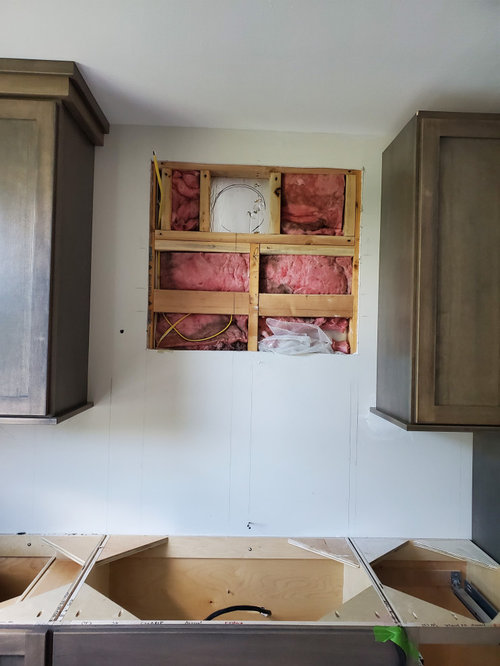
I need your feedback please. We are wrapping up our kitchen reno, we have purchased a wall vent hood form zephyr - venezia model. When trying to figure out the ducting, I am able to connect the vent to the outside using a 90 degree elbow and nothing else (of course and a wall cap). 1) Would that be acceptable? I know it is not ideal, but at this point don't have many options and don't have the room for (2) 45 degrees. 2) Originally, I was planning on setting the cfm at 590 ( where I live the code calls for makeup air above 600) or should I leave it at the highest setting of 715 cfm since the 90 degree is right at the opening? The pic I attached shows a circle in the between the studs where the 90 degree would exit. Thank you in advance.

Comments (8)

  • 6 years ago
    last modified: 6 years ago

    You don't have options if you are doing this to code. A new duct is something that is covered under a mechanical building inspection unless you live outside city limits, so yes, you must set that cfm to meet the 600 requirement to pass inspection unless you have a makeup air system, obviously, and the inspector must pass your ducting installation prior to being covered by sheetrock. I'm not sure where you are headed with the project, here. A 90-degree turn is perfectly fine and shouldn't incapacitate your blower's ability to function, though it may increase the noise, but what WILL hinder it is not having makeup air at that rate of speed or higher. Plan to open a nearby window every time you run it that high if you want the best extraction rate. What seems confusing about your original post is that you seem aware of and concerned with the building code but also seem to be asking advice here at Houzz on not following it. If you live outside city jurisdiction, you aren't obligated to meet code, but you may find some health hazards without makeup air if you are running that powerful of a blower

  • 6 years ago

    thank you for your reply. I guess I was more concerned with the 90 degree elbow. My HVAC guy was saying it will be ok but Zephyr tech support was saying I need at least 2 ft of straight duct before using the elbow which I don't have the space for (and which was never mentioned in their installation manual) and the Zephyr guy said if I use the elbow right on the opening will greatly hinder the blower suction and make it sound like a jet engine...not being experienced with this, I was getting worried and I guess needed reassurance from folks who have chimney hoods if they ran into any issues with 90 degree elbow right at the opening.

  • 6 years ago
    last modified: 6 years ago

    Pumps and fans and measuring devices all like nice linear non-turbulent fluid flow for best behavior. It is possible that mounting the elbow at the hood might cause an interaction with the blower, but what I would expect is just noise and reduced performance. Any interaction would be due to the finite number of blades and the fan designer's expectation that there wouldn't be "feedback" from dynamic pressure pulses in the duct.

    This is an issue that cannot be easily predicted and that would be expensive to model, so your goal of obtaining reassurance is the best approach, so long as the conditions are the same; that is, the hood model and elbow location are the same.

    Worst case for no change in elbow or hood would be to have to add some flow straighteners in the duct. That is too far outside my experience to help with.

    I'm only guessing at the dimensions of the existing duct hole, but it looks quite modest in diameter. Going up in duct size would surely help if there is an issue. It would require a bit more carpentry, and implies testing with the existing intended configuration before closing up everything.

    Another bail-out option would be to remove the blower in the hood and put an external blower outside in lieu of the wall cap.

  • 6 years ago
    last modified: 6 years ago

    @kaseki Is Houzz' s resident ventilation expert, so exactly what he says is correct. You'll get extra noise from the bend. If you have an option to place an exterior blower, that will lessen the noise, but that can be a much more complicated installation than what you are doing. Any ducted vent will work better than a recirculating vent, so making that transition from recirculating to ducted already puts you ahead. You might be surprised how much venting you could get from running the blower at a lower cfm to help with noise, or keep a pair of ear-protection headphones in the kitchen for when it is on high and you are searing meat, for instance.

  • 6 years ago

    A point of clarification: I will claim to be competent in synthesis of commercial cooking ventilation analysis reports toward requirements for residential cooking ventilation. I hope most mechanical engineers specializing in HVAC know more than I do.

  • PRO
    6 years ago

    @kaseki I wonder if you agree - A longer exhaust pipe (2' straight then 90 degree elbow) isn't going to create better flow than a shorter exhaust pipe (only 90 degree elbow). It would only bring the noisy elbow closer to the kitchen. I'll add that most of the country has a 400 cfm limit on exhaust without make up air, and for good reason. Your district is probably allowing 600 to appease the community but I wouldn't recommend pushing the limits. A primary reasoning behind the code requirements is to avoid carbon monoxide and other harmful gasses from being sucked back into the house from furnace/water heater/fireplace exhaust pipes.

  • 6 years ago

    A longer duct before the elbow will straighten the flow a bit and, if there is a reaction between the blower fan and the elbow, perhaps ameliorate it. Otherwise, the added duct will add a finite but likely inconsequential amount of pressure loss.

    Deliberate make-up air (MUA) is desirable for three reasons: (a) to allow the kitchen vent blower to achieve a better fraction of its potential flow rate, (b) to reduce or eliminate air flow through building cracks affecting wall humidity and dust movement, and (c) avoidance of low house pressure causing back-drafts in combustion appliances -- the reason for the code enforcement. Back-drafting can bring carbon monoxide (CO) into the house and cause heath issues, including death. The susceptibility of back-drafting vs. pressure depends on the design of the combustion appliances and whether they have their own MUA, or are otherwise not connected to the kitchen air supply. Natural convection gas fed devices that try to extract as much heat as possible are the most susceptible; air-blown oil burners are the least susceptible. Ideally, these devices should be tied to outside air with ducting so that even a failure of any deliberate kitchen MUA will not be a hazard.

Sponsored
Custom Home Works
Average rating: 4.6 out of 5 stars10 Reviews
Franklin County's Award-Winning Design, Build and Remodeling Expert