Software
Houzz Logo Print
danielj_2009

Foot Traffic and Soil Compaction

6 years ago
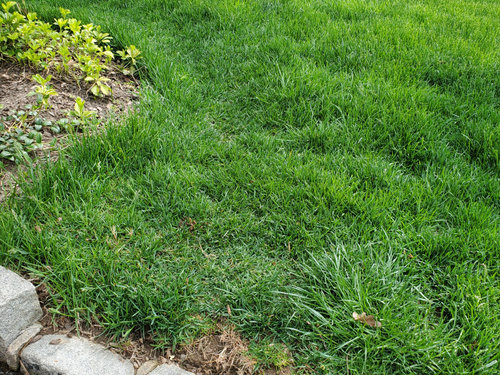
I've been in this forum for a long time and the idea has been floated widely that foot traffic cannot cause soil compaction unless maybe something extreme. I accepted this but something I noticed this spring makes me question that. Here's a section of my lawn where I have to walk in this area to get to the back yard. I am careful not to walk in the same area all the time but occasionally, very occasionally, I roll the wheelbarrow over this section. I've mowed the adjacent lawn 3 times so far but this small section is still not really even growing much. I'm not sure what to attribute that to. The only thing different is that I walk here more than other places. Any thoughts?


Comments (5)

  • 6 years ago

    " I roll the wheelbarrow"

    Wheelbarrows ain't feet. :-)

    Now mind, excessive foot traffic can certainly wear a path--we used that at a previous company to determine where to place a new walkway by simply not constraining employees and allowing natural wear to establish the new preferred pathway, then having the new walkway put in where the people had made the wear path through the lawn. QED and all that. (Thankew, thankew, my idea, since they'll simply step off the path in nice weather to use the path they prefer anyway, humans being cantankerous fools).

    But I digress, having just ejected a particularly cantankerous and maskless fool from Reopen PA off the property while planting. I'm still annoyed. Since I needed a medical test on Friday, there's actually a greater than average chance that I've been exposed, so...enjoy.

    I repeatedly walk the same path on the north face to no effect, but don't use a wheelbarrow, which concentrates its weight on the wheel--and on one small portion of the wheel. The physics is actually a bit complex due to the handles and angles. Seriously. http://physics.nmu.edu/~ddonovan/classes/ph201/Homework/Chap09/CH09P18.html

    Yeah. We should note that the force on the wheels differs as well; on the left, the design favors the weight to the wheel, but some to the man's feet. To the right, almost all of the load force is distributed through the wheel, while the man bears only some of the 'barrow's weight (even some of that is shifted past the fulcrum).

    And the inflation of the wheel matters. A "mushy" wheel will have lots of contact area with the soil and distribute weight, as damp soil will tend to fold around the wheel (and tend to deflocculate as well).

    ...OK, I'm going way too far down the rabbit hole again. I planted half the gardens and I'm meandering.


    NEWay. Sure, it could be compression damage from the wheelbarrow. Try some soap spray to loosen it a bit, and mix in a bit of dissolved sugar to kick-start the soil biology (just 1-2 tsp or so in a gallon of water will be fine), along with some fast nitrogen to move the system along--bacteria use nitrogen to carbon in a 1 to 9 ratio. Just make sure you're doing the math by element and not by compound, although mistakes are not usually serious as long as you stay under 1 pound fast N per thousand equivalent. :-) Don't add too much sugar, though, or it can get a little nasty smelling. A small handful over 5 square feet absolute maximum per month.


  • 6 years ago

    My dog has worn a path around our house. To some extent the soil is compacted. The reason is that he runs that path whether the soil is moist or not. When it is moist, the soil particles can slip and slide together forming a more compact structure. But when the soil is dry, he's mostly breaking off the plants along his path.

    Morph your paving idea following Nature's pathways was made famous by none other than 5-Star General Dwight Eisenhower. He probably did not discover it, but he used it.

    And since we're digressing with trivia, 5-Star General John Pershing was promoted by Congress two times after he was already a 5-star. So he's essentially a 7-Star General without the insignia.

  • 6 years ago

    It was the principle by which the first roadways were laid down, at least so we think. They were, literally, where the goat tracks were. The goatherds followed them, the people followed them, so we paved and cobbled them.

    We'll tend to follow the path of least resistance...unless there's a path of greater interest. 'Round here, the most efficient path is not the one I follow. I take a path that twines around the gardens instead.

  • 6 years ago

    eThere are many animals that may be using that "game" path. While you may not realize it you probably have dogs, cats, rabbits, squirrels, opossums, raccoons, deer, fox, and many other animals. Just because you don't see them or other traces of their activities does not mean you don't have them.


    With so much traffic the ground does not have to be compacted for the grass to wear out.


    Quit worrying about the grass, enjoy you yard, and get yourself a trail camera to see who/what is using the path.

  • 6 years ago

    We have chipmunks, squirrels, birds, foxes, skunks, deer (of course) and even a coyote once in awhile. We enjoy the wildlife, maybe too much. My wife insists on feeding everything, which I keep saying is a bad idea but she keeps at it. There is about a 20 foot long and 3 inch wide strip of nearly bare ground in the lawn that I call "chipmunk alley." It's where the neighbor chipmunks run across our yard to get to the pile of seed the wife throws out the back every day. In that case I doubt it is compaction but more just damage to the grass.


    @morph: thanks for the suggestions. I'll do that. I don't think it is damage from a wheelbarrow this year but it is conceivable that the damage occurred last spring. I just didn't notice. Last spring I had 15 yards of soil dumped on the driveway and I carted it around the yard, mostly at that location on the lawn. However, I laid down two 4x8 sheets of luan "plywood" in that area to distribute the weight. Also, I tried not to use the exact same path on each trip.