Software
Houzz Logo Print
claireplymouth

UMass Extension Landscape Message May 22, 2020

6 years ago
last modified: 6 years ago
Landscape Message: May 22, 2020

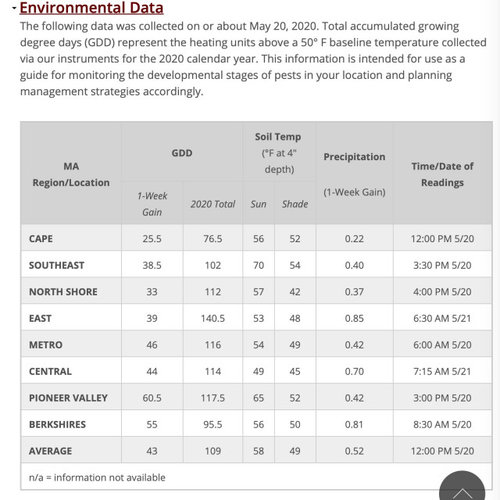
UMass Extension's Landscape Message is an educational newsletter intended to inform and guide Massachusetts Green Industry professionals in the management of our collective landscape. Detailed reports from scouts and Extension specialists on growing conditions, pest activity, and cultural practices for the management of woody ornamentals, trees, and turf are regular features. The following issue has been updated to provide timely management information and the latest regional news and environmental data.

While operations at the University of Massachusetts Amherst have been significantly reduced in response to the COVID-19 pandemic, UMass Extension has developed a listing of resources for commercial horticulture operations in Massachusetts to help keep you informed and aware of relevant policies and best practices for landscapers, turf managers, arborists, nurseries, garden centers, and greenhouse producers.

For our COVID-19 Information and Support for Landscapers, Nurseries, Turf Managers, Garden Centers, Arborists, and Greenhouse Operations in Massachusetts, go to https://ag.umass.edu/landscape/news/covid-19-information-support-for-landscapers-nurseries-turf-managers-garden-centers.

The Landscape Message will be updated weekly in May. The next message will be posted on May 29. To receive immediate notification when the next Landscape Message update is posted, be sure to join our e-mail list.

''''''''''''''''''''''''''''''''''''''''''''''''''''''''''''''''''''''''''''''''''''''''''''''''''''''''''''''''''''''''''''''''''''''''''''''''''''''''''''''''


''''''''''''''''''''''''''''''''''''''''''''''''''''''''''''''''''''''''''''''''''''''''''''''''''''''''''''''''''''''''''''''''''''''''''''''''''''''''''''''''

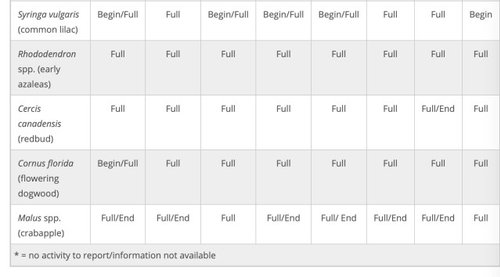
Gypsy Moth:(Lymantria dispar) thanks to the gypsy moth caterpillar killing fungus, Entomophaga maimaiga, the recent outbreak of gypsy moth in Massachusetts has come to an end! Most locations in Massachusetts will not see damaging or even noticeable populations of this insect in 2020. However, that does not mean the occasional egg mass won’t be seen in certain areas of the state. Egg hatch was observed and reported with photo evidence in Shelburne Falls, MA on 5/4/2020. Shadbush (Amelanchier spp.) was reported as in full bloom at the same time in that area.

''''''''''''''''''''''''''''''''''''''''''''''''''''''''''''''''''''''''''''''''''''''''''''''''''''''''''''''''''''''''''''''''''''''''''''''''''''''''''''''''

Comments (6)

  • 6 years ago

    Speaking of moths....has anyone figured out what happened to the winter moths? I was having awful infestations in all my trees for maybe 6 years straight and now for the past two the foliage has been clean without any damage.

  • 6 years ago


    PM2: Releasing a parasitic fly worked!


    "Entomologists Joseph Elkinton, George Boettner and Hannah Broadley at the University of Massachusetts Amherst are declaring victory this month over the invasive winter moth – which begins life as a leaf-chomping, tree-denuding caterpillar that had threatened widespread defoliation of coastal New England shade trees and blueberries until the researchers introduced a natural parasitic fly that has greatly reduced moth numbers.

    Elkinton says, “After 14 years of effort, we have successfully converted winter moth, a major new defoliator invading eastern New England, into a non-pest, presumably on a permanent basis. I’m pleased to report that we have now saved Massachusetts residents, who have been battling defoliation on their backyard trees and blueberry crops, millions of dollars of pesticide costs now and in the future. We have averted what was shaping up to be another major invasion calamity for the entire United States comparable to gypsy moth.”

    He adds, “We accomplished this success by introducing a parasitic fly that attacks winter moth and no other species, an approach called biological control. It has vastly reduced the density of this insect pest.” This approach has been tried many times around the world against many invasive insect pests, Elkinton says, but complete success like this is “quite rare, at least on forest trees,” he notes. “In fact, I can’t think of any other example involving a major forest insect in North America.”


    UMass Amherst Entomologists Report Major Progress in Reducing Populations of Winter Moth in New England

  • 6 years ago

    Wow - Thanks for posting that Claire. I am totally impressed with the sudden change. We had our maples show half eaten leaves over the entire tree for at least 6 years in a row. When I stood under my back Maple that used to have a very dense canopy, I looked up and could see a lot of empty branches. The Japanese Maple was so ugly with all the chewed leaves just as they started opening in the spring. This year and last, I look at the leaves and see no damage to them at all. The Japanese Maple has pristine leaves. I'm very happy about it. We're not saving money because we never used any pesticides but just having clean foliage is such a blessing.


    And that seems very true, that it's rare that they have success to this degree with any of these invasive pests.


    I'm wondering too, what happened to the Red Lily Leaf Beetle. Again, the last two or three years, I've barely seen one. I see one lily this year with some holes on the leaves that I suspect to be a RLLB, but I have yet to see one to pick off. And the rest of them are clean. Another mystery. [g]


  • 6 years ago
    last modified: 6 years ago
    PM2: The University of RI people have been releasing parasitic wasps that attack the Red Lily Leaf Beetle and they seem to be working too. I occasionally see a Red Lily Leaf Beetle but they haven't been a big problem here for years.

    "Research efforts to manage the lily leaf beetle have concentrated on classical biological control which acquaints natural enemies (from the pest’s native range) with their host in its introduced range. LLB came from Europe so European parasitoids were released with the intent of establishing and distributing themselves to provide long term control rather than needing to provide regular releases each year.

    Researchers at the University of Rhode Island and their collaborators have identified three parasitoids (wasps) that are specific to the genus Lilioceris and were approved by the USDA APHIS PPQ for field release. These parasitoids cause a high level of parasitism in lily leaf beetle populations throughout Europe. Tetrastichus setifer, Lemophagus errabundus, and Diaparsis jucunda have been a part of release, recovery, establishment, and distribution studies in New England from 1999 – 2016 and beyond. T. setifer is a gregarious larval parasitoid native to a large range in Europe and overwinters as mature larvae in host cocoons in the soil. Because of the large range of climatic conditions T. setifer survives in its native distribution, it is likely the best candidate for controlling lily leaf beetle in the Northeast. L. errabundus is a solitary larval parasitoid that overwinters as a teneral (freshly molted) adult in the host cocoon in the soil and is also native to Europe. D. jucunda is also a solitary larval parasitoid native to Europe and attacks all larval instars of the lily leaf beetle. Tewksbury et al 2017 reports releases of T. setifer in Wellesley, MA (and establishment and spread); Waltham, MA (establishment was not confirmed in Tewksbury et al 2017); and Cumberland, RI (establishment and spread). They also report releases of L. errabundus in Kingston, RI and Plainville, MA (establishment and spread were confirmed in Plainville). D. jucunda was released in Cumberland, RI (establishment confirmed) and Orono, ME (establishment confirmed nearby the release site).

    For More Information, Visit:

    The University of Maine: https://extension.umaine.edu/publications/2450e/

    Tewksbury, L., R. Casagrande, N. Cappuccino, and M. Kenis. 2017. Establishment of Parasitoids of the Lily Leaf Beetle (Coleoptera: Chrysomelidae) in North America. Environmental Entomology. 00: 1-11.

    Written by: Robert Childs

    Updated by: Tawny Simisky on 4/24/2020"

    Lily Leaf Beetle Biological Control Research

  • 6 years ago

    Claire you just made my day. :-). Being an organic gardener, not having to worry about some of these pests that make a mess out of some of your favorite trees and plants, is just a relief. I'd been thinking maybe it was a fluke and I was just not looking close enough and they would be showing up just when I stopped paying attention. [g]. That would be great if that particular beetle was history!


    Gee these New England Universities are on the ball!