Software
Houzz Logo Print
rodney_trotter90

New Lawn issues

6 years ago
Hi guys,


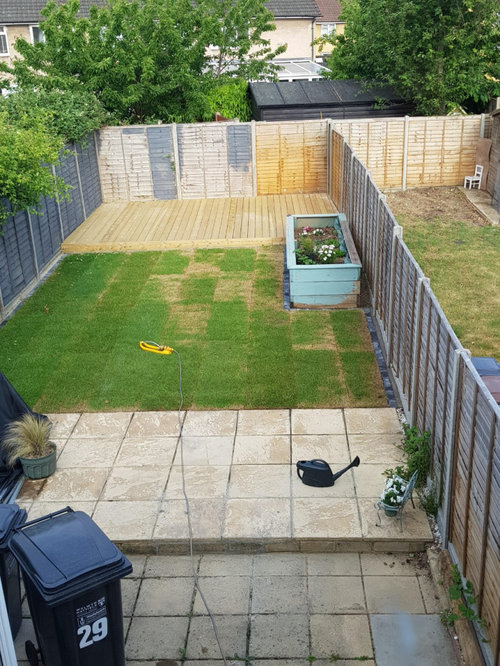
First time poster here and new homeowner. I've recently had new turf laid in my back garden, it's been down a week today. However, with the hot weather here (London, UK) i've read that it's been laid at the worst possible time?

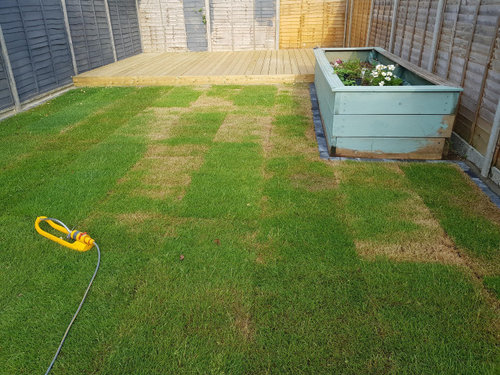
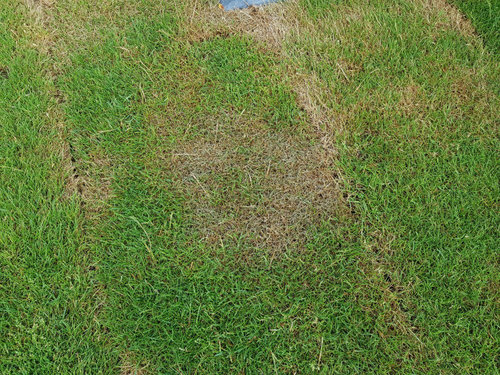
I've been watering every day and recently bought a sprinkler to get it watered for longer periods due to the weather and it looks like it is starting to die. I've attached images for you.


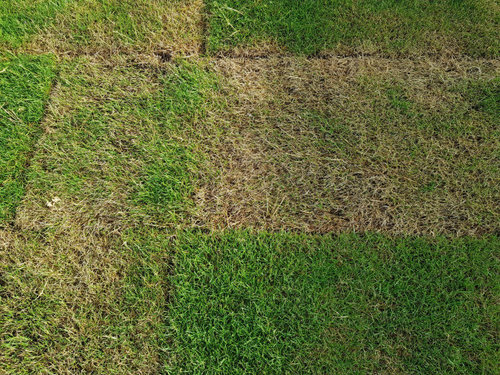
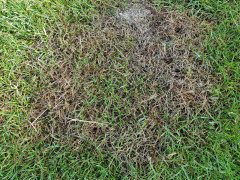
image 1 is an aerial shot, image 2 is from the ground, image 3 is a round circle that's appeared and image 4 is a close up of the grass. I was wondering if you could help me get it looking lush?


excuse the different fence colourings....working our way around the garden.


Comments (11)

  • 6 years ago

    Ouch. I guess the left is either in more shade or downhill?

    You're doing it right, though. Keep it damp, don't drown it--drowning it is as bad as letting it go dry! For the first 3 weeks or so, in hot weather immediately after laying it down, it should be damp to the touch if you push a finger in, although the surface layer can go dry a bit without being too much of a problem.

    Super squishy is a problem. Squishy grass won't throw roots as easily or quickly and drowns.

    Unfortunately, the hot weather is not helping you out here and is definitely doing some damage. Under normal circumstances, I might suggest a gentle feeding, but in this case, I'm going to suggest an incredibly gentle feeding. If you can get ahold of something like the equivalent of Milorganite or soybean meal--I don't know what's available to you in London--I'd put it down at about 5 pounds per thousand square feet.

    I'd absolutely avoid anything harsh in hot weather on week old sod, so synthetics are absolutely not recommended. Organics only here for right now--later on, though, anything goes.

    Er....how large is your back garden and do you use meters and kilograms? I can translate that for you if you like.

  • 6 years ago

    Thanks so much, yes the left side is covered in shade most of the day.


    I purchased this a few days back - https://www.amazon.co.uk/gp/product/B07B4SR992/ref=ppx_yo_dt_b_asin_title_o03_s00?ie=UTF8&psc=1 I spread some of that on it earlier, I forked holes into the grass and left the sprinkler on for around an hour...hopefully that won't spoil it.


    I'd use meters and KG. i'd say the grass area is around 5 by 5 meters.

  • 6 years ago

    So about 25 square meters. And wow, your labeling standards differ from the US! I can gather, I think, that this is a 14-0-5 fertilizer as we'd call it, with 16% iron, all of the nitrogen being fast.

    As a general rule, this would be exactly what I wouldn't recommend, but you actually did things right.

    The package treats 360 square meters, you have 25, so you should have used about 25/360 = 0.07, or seven percent of the package or so. You should literally be able to cover your lawn fifteen to sixteen times with that package.

    If that's what you did, you're done. Keep it damp, hope your heat wave ends soon (ours breaks tomorrow evening here in Pennsylvania with some spectacular storms and, hopefully, no tornadoes this time). If you do need to patch a bit, you can do that when summer starts to end in London, which will probably be in late August.


    If you severely overdid it, all is not lost by any means. Simply run the sprinkler several times to flush the nitrogen out of the soil. Go an hour or three at a time (if it's starting to runoff at the surface, the soil is saturated and can't drain out any faster, so you can turn off the sprinkler and let it drain for a while). Set out a tuna can or other can and apply at least four inches of water. A tuna can is 1" deep. Other cans may work better, but tend to fill up oddly.

    That'll flush the vast majority of the nitrogen well out of the soil profile where you'll never see it again. The potassium and iron will stay, but won't be as much of an issue.

    You'll probably have some burn, but wait it out and check back in once that develops. We'll see where to go from there.

  • 6 years ago

    Great stuff, phenomenal feedback. Much more than I was expecting.

    I'll apply your techniques and hopefully, pick up a few more things as I browse the forum for more tips.


    Thanks again

  • 6 years ago

    ...And feel free to ask with any questions you have. Just like me, most people are pretty long-winded when you ask a question that happens to be their specialty.

  • 6 years ago

    Hi dchall8 .


    Thank you for the feedback, you are right in saying us Londoners cannot handle the heat!


    I do not have a mulch lawnmower so do you have any other suggestions? (other than buy a mulch mower :)


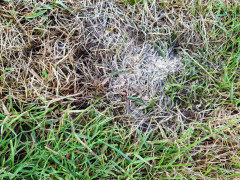
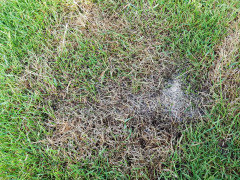
    Below are some closer photos of the circle, which seems to have gotten bigger overnight including a powdery looking white patch as seen in photo 2.


    Thanks again guys


  • 6 years ago

    That's a fungus, caused by watering which you're kind of stuck with for the next week or two. As to which one it is, let's see if somebody chimes in. If not, I'll recommend something.

  • 6 years ago

    Any mower is fine. Don't pick up the clippings. They should be small enough to sift down into the grass and decompose on the soil surface.

    you are right in saying us Londoners cannot handle the heat! - I used to live a mile from the Pacific Ocean in California where you needed a windbreaker and/or sweater every day of the year. Driving even a few miles inland was brutal.

  • 6 years ago

    Morpheuspa - argh shucks, I look forward to your suggestion if no one else does.


    dchall8 - I have a mower that collects the clippings in the back bin, should I just pour some of them back on the grass?


    I'd settle for a mile off the ocean in Cali, I've always fancied a trip to San Fran if you were near there.

  • 6 years ago
    last modified: 6 years ago

    OK, nobody chimed in.

    I'm not going to chase you out for stuff since, if you're like me, you're minimizing trips to the stores and we can try this first. It's wide-spectrum, but you're only doing it once and you probably have it at home.

    Do you have sodium bicarbonate (baking soda) around the place? Take 2 tablespoons (the exact measurement isn't critical, so a bit of a slip is not an issue) in a 1 gallon watering can, add about 1 tsp of any liquid dish soap, and water the whole area where that fungus is, making sure to damp the whole area and go wide around it, hitting every blade.

    Do this after watering so the sodium bicarb and soap sits on the blades either during the day or overnight for as long as possible.

    This will kill most fungi, good and bad, but at least you aren't going too far and wide with this treatment. But if not, you can pick up any wide-spectrum fungicide at the store--however, seriously, 99 times out of 100, this works and the grass stops dying instantly.

Sponsored
NME Builders LLC
Average rating: 5 out of 5 stars2 Reviews
Remodeling Company in New Albany, Ohio