

Can you name this sanseviera?
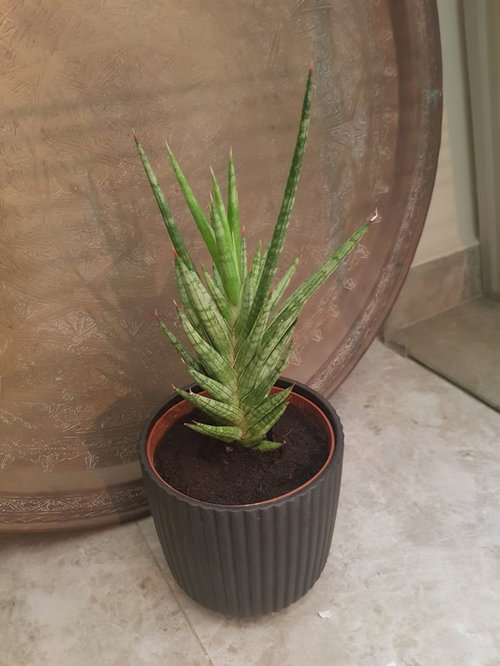
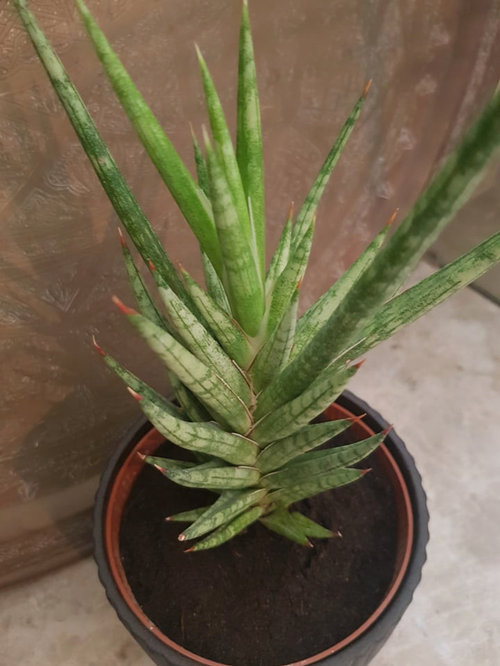
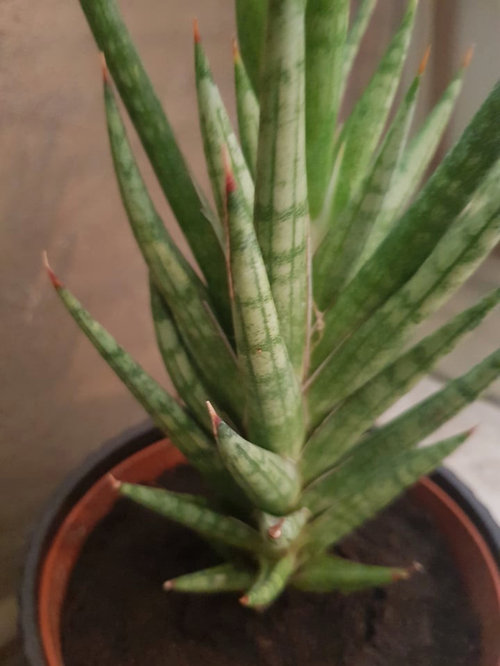
Just got this beautiful sanseviera. Unfortunately, the seller was unable to tell me much more about it. It reminds me of a pineapple, though the leaves are thin and cylindrical, not flat and wide. Would anyone know what it is exactly and if it has specific needs? The seller said it wouldn't be much different from other sansevieras, but checking just in case!
Comments (17)
 6 years agolast modified: 6 years ago
Congratulations on your handsome new Sans. I believe it's called Francisii, this one doesn't come around so often. In fact, I came upon one last year, & I scooped it up very fast, 'cause I recognized what it was. Am curious where you bought it if I might pls ask?
Pls ask your Seller what that soil is, it looks too finely particled & I would advise against using it. Sans need fast draining mix which is unlikely from the look of that mix. We usually recommend something like Cactus & Succulent mix (C&S) w/Perlite (or Pumice). 50/50 or equal parts each.
Also, that rather a snug fit of the plant's pot to the outer pot. You'll need to check that water doesn't accumulate btwn the pots, inside the outer one as that could make big problems.
Six Silver thanked User- 6 years agolast modified: 6 years ago
Am having trouble posting pix hum ... Houzz Photo Icon isn't working for me here, tho' the plain 'Photo' icon seems to work.
I believe my left plant is the same as your Francisii.
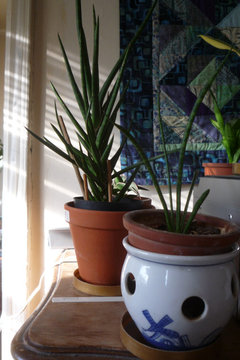
Another view, that's about 5 ft from a West window which gets good light.
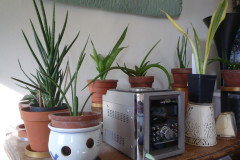
Also on the left. It's that distinctive shape that I refer to as shrub-like. I give mine regular Sans. care, tho' it seems pretty slow growing.
Good luck w/ yours & enjoy!
Six Silver thanked User Related Professionals
South Bend Landscape Architects & Landscape Designers · Mesquite Landscape Architects & Landscape Designers · Mobile Landscape Contractors · Springfield Landscape Contractors · Albert Lea Landscape Contractors · Hempstead Landscape Contractors · Utica Landscape Contractors · Honolulu Landscape Contractors · Tyler General Contractors · Lewiston General Contractors · Rochester General Contractors · Portsmouth General Contractors · Providence General Contractors · San Diego General Contractors · Eureka General ContractorsSix Silver
Original Author6 years agoYes, I just checked and it does look like it's a Fancisii! Thank you!
I don't live in the States, so I'm not sure how useful the small shop I bought it from will be useful. I can ask the seller where she ordered it from, if you'd like/if it helps.
I'll look into C&S mix. The plant was originally in a two inch pot and I knew it needed to be repotted... it was completely root bound. The seller gave me some peat to mix in the soil and I added some clay pellets. There's actually a layer of rocks at the bottom of the inner pot and some peat between the inner and out pots. I do check water levels between pots with my other plants, just in case, though I try not to over water them to start with. If you have any tips to avoid that, I'd be happy to learn :) 6 years ago
Nice plant you got! The potting mix is concerning as it looks like it would retain a lot of water, which is not good for succulents. By any chance do you have access to commercial cactus and succulent potting mix? That would really be best, and if you are able to repot in this mix, don't add peat. Also as for the peat between the two pots, I would definitely remove that because it will create humidity around your new plant. When you do water it, take it out of the outer pot, water thoroughly, let drain thoroughly. If you wonder when to water, insert a wooden skewer in the potting mix, wait a bit, remove skewer. If it's damp, don't water. But that potting mix is worrisome, ok?
Six Silver thanked socksSix Silver
Original Author6 years agoI haven't seen any cacti and succelent mixes in the shops I've been... seems like it might be tricky to get access to it. :(
This website suggest mixing potting soil with coarse sand and perlite/pumice. Would that be a solution?I'll take out the peat between the two pots. Would using rocks be better? (The inner pot needs to be elevated, the outer one being deeper.)
- 6 years agolast modified: 6 years ago
I guess your Seller didn't really know the plant they're selling.
I'm sorry to have to tell you this but almost every step you've taken w/ this plant is wrong 'cause they're the opposite of what it needs.
You're using inappropriate soil components for these succulents plants in incorrect ways.
Succulents needs fast draining soil, especially to protect them from root rot. All the things you've done slow & delay drainage instead. Peat is water retentive, clay balls are also used to retain water. I use them in my Hydro set ups so I know that's how they work. The layer of peat btwn the 2 pots as suggested above will likely further endanger the roots by holding moisture btwn the 2 pots.
Look at this mix, see how big the pieces are? That makes it fast draining. There's also some bark mix in there, I've been experimenting w/ abt 1/3 each Bark, 1/3 C&S soil & 1/3 Pumice. That makes it fast draining. One doesn't need other materials like rocks or layers to make the fast drainage as long as the materials are large & porous like this.
I understand abt having to raise the pot up. I use small cans, or spools from sewing threads & sometime the empty plastic ring from tape dispensers. To raise it up & keep it dry.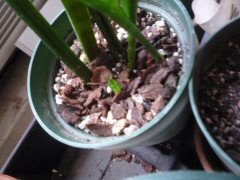
Also, look at this potting, see how it's a smaller pot in a larger pot, but there's room btwn the two? That's how I try to do it when I can.
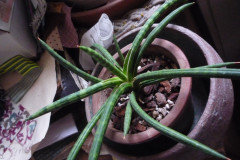
These are good ways to avoid root rot.
Six Silver
Original Author6 years agolast modified: 6 years agoUnfortunately, it is not uncommon for plant sellers not to know much about the plants they are selling, here. I'll spare you some of the some things I was told that. I live in a third world country, things are what they are.
Still, I'd like to make the best with what I have/can get for this plant. Other than the regular, fine potting mix I have, there's a way I can get my hands on some akadama and possibly citrus soil mix. Would either be a good replacement?
Also, what the Seller has given me may not be peat but bark (my bad, I'm not familiar with any of these things as it is so hard to get my hands on much, here):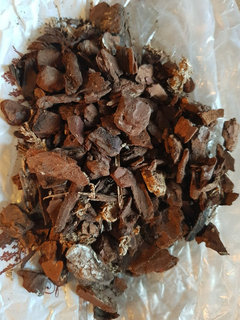
Would that be okay to add in the mix?
If nothing works, I suppose I can always try ordering the mix online. If there's anything worth recommending, I'd love to hear. But in the meantime, I still need a fix-it-for-now solution...- 6 years agolast modified: 6 years ago
Hi Six,
Not to pry, but what country are you in pls? I grew up overseas myself, so I kind of understand. But most countries have plants, nurseries & gardeners, likely someone, somewhere knows something. Do you know neighbors you can ask or any vendors w/ plants in their shops you might admire &/or ask about. Any vegetable growers or farmers you might ask?
That Bark you show is only so so, 'cause that too (like mine) can retain some water. But the size isn't bad if you try to stay in the medium size pieces, picking out the larger & the smaller ones. The more uniform in size, the better drainage will be provided.
You need some rock, Perlite or Pumice something inorganic. Construction companies have pumice, horse stables sometimes have a ground covering like Pumice (called here "Dry Stall'), similar larger size & drainage properties.
You've got some time if you raise the pot back up & water carefully while you check out your neighbors as I suggested.
Six Silver thanked User Six Silver
Original Author6 years agoHey Karen,
I live in Senegal, West Africa. And yes, there are gardeners and nurseries; but most learn as they go. They've got a global idea of what they should or shouldn't do... but some may not even care much. Plants aren't something most Senegalese people enjoy: they'll often take a cement yard over a garden. Not to say there are no plants at all — but that if mostly for those more well-off to enjoy. A bit of greenery around the walls. There are barely any trees in my neighborhood, and none give any real shade. It's mostly sand and rocks.
Not so say that there isn't anyone who knows anything; but I'm not sure where'd I'd find such person. I'm still looking.
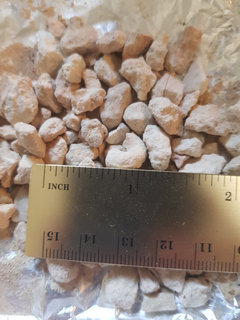
I got some rock from a nearby construction site: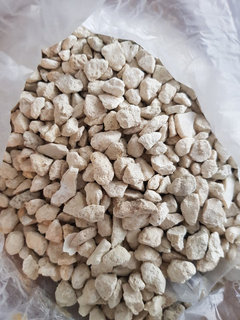
Most horses are kept outside for the night, at least, in my neighborhood. Not even in a field, just in an open sandy lot.
It does seem like I'll have to order some mix if I can't find a sustainable solution... but I'm a little scared it'll take a while to get here in out current situation...- 6 years ago
Hi Six,
Those rocks look pretty good tho' I can't tell their size. Can you take a pic w/ your hand or your fingers in there so I can tell scale pls?
So, If you're in Senegal, do you speak Portuguese? It happens I do & looked up translation for Pumice which is 'pedra-pomes'. Looks like that might be what you've found.
- 6 years ago
Six Silver
Those rocks-grit may be little on large side. Best for a well draining mix is approx. 3-6mm. But you can experiment. I would if that was all what is available. I would sift it, trying to keep uniform size (as much as possible). Pumice would be quite light; granite heavier. I would also test them, to make sure they are not calcareous. Use some vinegar; pour some over stones. If it fizzles, there is too much calcium - many succulents prefer slightly acidic substrate.
I would also consider bark you have shown: do you know what trees it is from? Again, I would try to screen/sift it if it is too variable in size. It could be bigger than grit, but not huge. I talked to someone that grows succulents (and hybridize them); most in a mix of 2 parts grit + 1 part bark, or 3 parts grit + 1 part bark. I think I would try 2+1 mix in your climate. Just my 5 cents...
Six Silver thanked rina_Ontario,Canada 5a - 6 years agolast modified: 6 years ago
Thank you Rina for joining us, especially as I'm not so good w/ sizing rocks. It seems that 3-6 mm = approx 1/8 to 1/4 inch, which seems abt the size of my Pumice.
Six: we're lucky Rina came along as she knows about rocks better than I & grows using rocks in her mixes more than I.
I'd avoid the Akadama as my reading suggests it's a natural form of clay, which I expect would retain water, which we don't want.
So I'd defer to her abt how to make this mix. I believe she grows most of her succulents in her rock based mixes, especially her beautiful Jades. I share this w/ you so you know she's very knowledgeable abt growing Succulents in grit / rock based mixes.
May I pls ask do you have prior experience in growing Succulents &/or Sans?
Six Silver thanked User Six Silver
Original Author6 years agoHi!
Thanks to all of you!
@rina_Ontario,Canada 5a I used the vinegar trick and you're right, they fizzled a bit. I guess they won't do. I found some other rocks, though: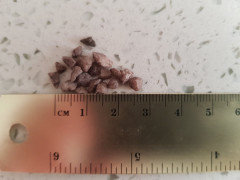
Those didn't fizzle. They are about 3mm. Would those be good to use?And could I mix crushed clay pellets and those, perhaps a 1:2 ratio? I haven't been able to find pumice so far.
@User I had a few succulents in the past, but I was not in a good mental place, at the time, and I sent quite few plants to plant heaven, as Rina put it.- 6 years agolast modified: 6 years ago
Those look quite good and I would use them. I am not sure what clay pellets you have, but start with less. How big are pieces? They should be closer in size to grit. They do not have to be exactly same size, try to make sure they are no more than double of size of grit. I wouldn't go much smaller thou. The idea is to keep ingredients more or less similar size. I often sift all inorganic materials using a child/play sifter that allows pieces up to about 4-5mm thru. I also keep bigger pieces - have piece of plastic with opening that are approx. 6-7mm in size. Here is photo of my 'smaller' mix of grit and perlite and little turface (there is black and white grit) :
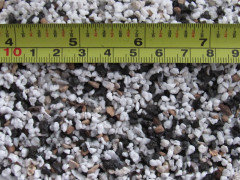
BUT do not be too obsessed...So I guess you have grit, some clay pellets (not sure what?); some bark. Do you have perlite or pumice? (I think you said no pumice so far). If you have perlite (and it should be sifted or rinsed to get rid of dust; same with pumice unless it has no dust), I would try perhaps 30% grit, 30% perlite (or pumice), and rest divided between bark and clay pellets (no more than half of rest for pellets). This is only a suggestion, best way is to try :) I use more grit, but I believe in your hotter climate 50% or more (of grit) could be too dry. 2 parts of clay pellets sounds too much, since it may retain too much water? I wouldn't be trying to get peat. It may become hydrophobic easily, especially in hot climate. And if you water more often, it could retain water for too long.
Here is example of few different mixes and their water-holding capacity:
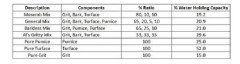
...and table for different ingredients:
I would stay away from sand completely.





rina_Ontario,Canada 5a