Software
Houzz Logo Print
webuser_854352415

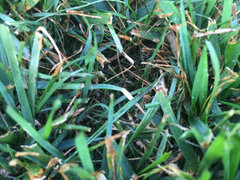
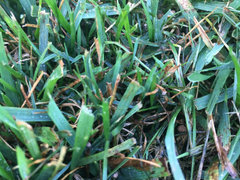
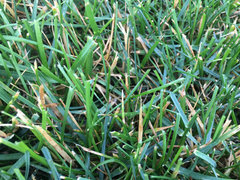
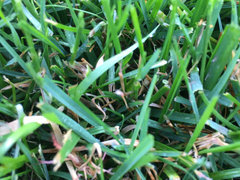
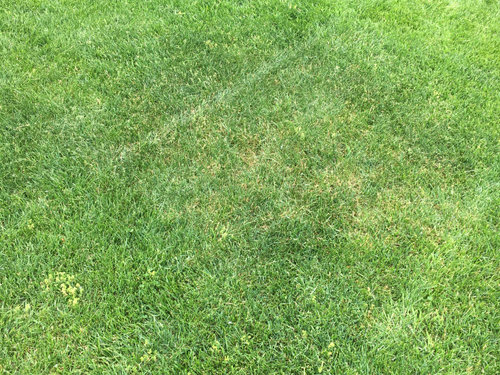
Dark spots in my TTTF Lawn

6 years ago
last modified: 6 years ago
Hi all,

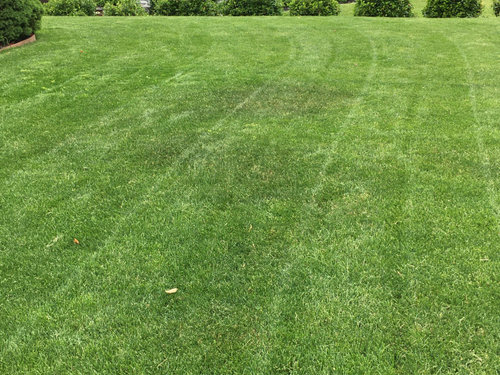
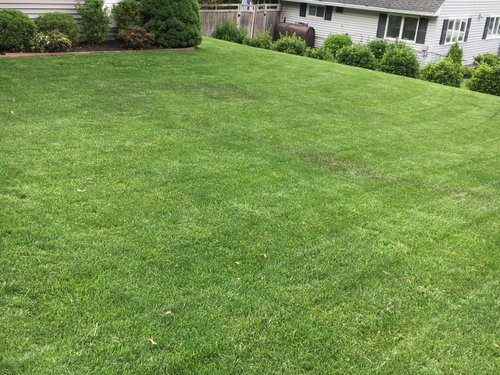
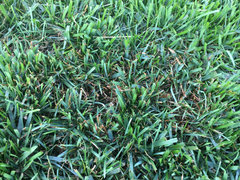
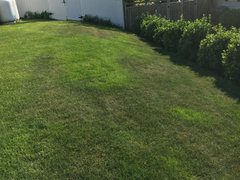
I’m new here but have read the forums as a long time as a guest. My front lawn is mostly TTTF, and I’ve been planting 4th millennium for about 2 years. I live in NY about an hour north of NYC. Lawn is in good shape except for several very dark spots. They almost look blue/teal to me and have a burned out look when you examine closely.

All I’ve done this year was some spot seeding, milorganite, and more recently some (new) scotts starter fert with weed and crabgrass preventer. I panicked and threw a few handfuls of Scotts DiseaseEx at the dark spots today.

thanks for any help in advance!


Comments (31)

  • 6 years ago

    Could the grass be overly dry or overly wet there? If they were overly wet the result is the same as overly dry due to lack of oxygen to the roots.

  • 6 years ago

    If i had to guess I’d say “overly dry”, as I’ve focused my watering on new lawn spots. Not sure why this would darken the area though.

  • 6 years ago

    Many grasses look deeper green when they dry out. Put some tuna cans all around the yard with one in each of the dark green spots. Turn on the sprinkler(s) and see what you get. I suspect the normal grass areas will fill the cans faster than the dark areas. That would indicate your sprinklers need to be adjusted.

  • 6 years ago

    I'd panic too. Looks like early disease. I'd also look closely and verify those patches are indeed fescue. Sometimes other grass types will be more conspicuous as stress of summer hits.

  • 6 years ago

    Dchall no sprinklers for me. Hopefully someday. I’ll try to water it hard and see if it bounces back

  • 6 years ago

    Mishmosh thats what I thought. Tbh I’m not very well versed in identifying grass types. I’m sure google can help. It’s a mixed lawn for sure but the TTTF has become the majority over the past few years. If it is disease what do you suggest I do?

  • 6 years ago

    " I'd panic too. Looks like early disease. "

    Agreed, but panic is, perhaps, a bit strong of a word. "Be concerned" is along the lines of what I'd use.

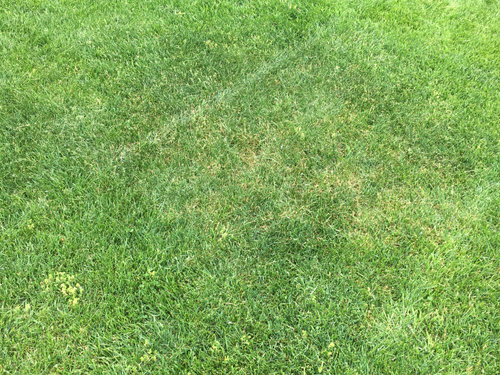
    This looks like it might be fungal, but it's very, very early and identification is beyond me. And it still could be something else as the shots are from a distance and the colors are a bit subtle. I'm seeing the red-brown tones that worry me (and scream fungal infection), but also the browner tones that say "dry grass."

    Red could be nothing more than a remaining bit of red thread from earlier in the season, which I also had, and is of no concern. Or a bit of rust which is, again, of no great concern.

    Casey, would it be possible to get a closeup, under shaded (better still, overcast) conditions of the brown-red grasses? Several, by preference; a foot away, a few inches away, and a macro shot of just a blade or two showing any lesions, white threads or puffs, or growth of any visible sporing bodies you might happen to see.

    I don't want to toss a wide-spectrum anti-fungal at a lawn that might not need it--it destroys too many good fungi that are doing their best to protect the lawn from other problems and symbiotically assisting lawn life processes. Plus, clearing the decks too much is just asking for yet more diseases to move in and set up housekeeping in the now-empty landscape...

    CaseyNY thanked User
  • 6 years ago

    morpheuspa thanks for the thoughtful reply! Your eye is much better than mine, but I’ll do my best to take and post the pictures you asked for. Should be cloudy tomorrow. I had planned to use disease ex preventatively in summer on 2 properties this year that i did a lot of spring seeding on, as I’ve read that grass planted in spring is more susceptible to disease. Bad idea?

  • 6 years ago

    " Bad idea? "

    If you're asking for an opinion, I'm not going to give you one. :-) Would I do it? Probably not, I'd work at controlling fungi using environmental controls first and treat an issue if it arose. But my circumstances would differ as I'd be working on my home lawn, which I would see every day, and my lawn care classification is "Expert" with trained color vision from other things. I'm going to notice a change very, very quickly and respond very, very quickly.

    So my opinion with regards to myself simply does not apply.

    Do I object to you applying Azoxystrobin once on a couple lawns one time that were spring planted and, as you correctly stated, weaker and more susceptible to disease this year? Not in the slightest. It's not a chemical I approve of throwing around with gay abandon (it and its breakdown products are terrible for amphibians, and not so hot for bees and earthworms, either). But once on lawns that might have issues that you can't watch like a hawk isn't so much of a problem.

    I would suggest applying later in the evening after the bees are settling down and, if possible, when rain is likely that night. That should solve the bee issue. The earthworms just have to take one for the team this time.


    Since it's already used in so many crop fields, it's not like a few lawns done once are going to make that much difference. And frankly, you're going to follow the bag recommendations. A lot of "licensed" "appliers" I know are...less than careful. And a lot are very careful. It just depends.


    It's not the best curative on the planet and very wide-spectrum, but if you happen to already have it, I wouldn't necessarily object to simply applying it here, either, at the bag rate. It has an effect for a period of up to about a month, so you'll generate a good shield through the remainder of spring.


    We might be able to nail down a more definitive diagnosis, but also maybe not. Really, what you have looks very early on and a preventative there might not be a bad idea.

    CaseyNY thanked User
  • 6 years ago

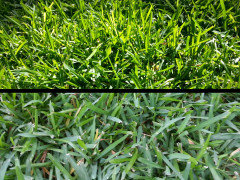
    Here's what he means by a close up picture, and why it helps to take in the shade.


  • 6 years ago

    It rained last night so the dark spots are much less noticeabl. some of the pictures i took are from the side of the house, where the disease looks the same but is farther along. while You guys generously assist me with diagnosis should I stop mulching my clippings and start bagging them? Thanks so much

  • 6 years ago


  • 6 years ago


  • 6 years ago


  • 6 years ago


  • 6 years ago


  • 6 years ago

    Thank you Jonathan. I’ll follow those guidelines for sure. Seems to be the standard approach for many fungus problems and diseases. I was planning to use Scott’s triple action around July 1? Will this be a problem?


    Side note: Will i really have to wait 4 months before seeding if I do use it?

  • 6 years ago

    I don’t have any personal experience using that, or using a combined fertilizer and herbicide. I know people on this forum recommend using them separately instead of as a combined product.

    Though if the bag says to wait 4 months before seeding I would follow that.

    Personally I’ve been able to just focus on growing the grass well and it competes well to keep out the weeds. I’ve hand pulled the few that do make it. But my weeds are different than your weeds so you may also need something for them.

    You could instead use just a fertilizer, something like Vigoro Lawn Food or Milorganite and then apply some seed at the same time. Without sending you down the deep end, I’d say just follow the bag rates on the fertilizer, or use both, with half rates.

    You will lose some seed but you can always toss a small handful of seed on the worst places at any time of year and it will germinate and fill in when it gets light and water (I.e., when the other grass starts thinning)

  • 6 years ago

    Ding, leaf spot. DiseaseEx is listed for leaf spot, so I'd use that immediately.


    " Side note: Will i really have to wait 4 months before seeding if I do use it? "


    Yes, but the triple action around July first would be a horrible idea and we're going to recommend you don't use it. It'll encourage problems with the lawn by adding nitrogen at the wrong time and forcing fresh, juicy growth that diseases like leaf spot are just going to love.

    Two, crabgrass has already begun sprouting by July first (it started when surface temperatures hit seventy, which they did a couple times already, actually). CG suppressant should go around now, if you're going to use it, metered so you can seed if you want to. Use Dimension or the like, or just skip it if you're going to seed and control crabgrass this year by spraying it with Weed B Gon Crabgrass Control.

    Three, the shield is good enough that it really will kill most of the seed you add. Since properly seeded grass will go less than two months later, the kill rates will be horrible.


    I'd advise skipping it. It's just not a good product and expensive to boot.


  • 6 years ago

    Ok thanks guys! I can’t put down crabgrass prevent now because i put it down mid May. I’d like to put more down 7/1 but if a nitrogen spike will wreak havoc in July then I‘d Like to use a nitrogen free product If there are any you recommend. If you prefer spray, fair enough. Normally weeds are not an issue for me, but i did a big grading job this year and the soil was loaded with broadleaf weed seeds. I guess I’ll just spray them. You guys are awesome. Thank you.

  • 6 years ago

    Makes sense about not putting down a heavy dose of nitrogen now. I've almost always always used light and frequent when it comes to fertilizing, and hadn't really thought things through. (I used 350g nitrogen/1000 square feet, every 3-4 weeks, with a balanced fertilizer I mixed myself with iron, sulfur, calcium, magnesium and not just NPK. 2 parts nitrogen to 1 part potassium.)


    We also have dry summers with low humidity, so what worked here may not work there. Humidity and leaf spot seem to go hand in hand.


    Also, unrelated, I didn't realize azoxystrobin was available from Scotts. TIL.


    Best of luck.

  • 6 years ago

    It does depend on the grasses, as well. Southern grasses should be fed monthly. Northern ones, Memorial Day, Labor Day, October 1, and when growth stops for the winter (done synthetically).

    Rather than dump N in July, any good crabgrass prevention without feeding, or with minimal feeding, would do fine. I'm not sure what your local stores will carry, but examples include Scotts Halts (4 month shield but...), Dimension Crabgrass Control (variable), Prodiamine (AKA many names, variable shield).


    You can vary the amount of time covered by altering the amount of product you put down. It's not sensibly double/half linear, but it can be done. In the case of Prodiamine, the equation I calculated is:

    5.2a + 0.2 = t (to a linear approximation, where a is amount in tablespoons applied per thousand square feet and t is the time of weed suppression in months of average weather...and good bloody luck getting that).

    If you were to buy and apply Prodiamine (sprayed if you get bulk, but it is available in a granular), and back-work this, it would be theoretically possible to target 6 weeks of coverage...but a bit difficult.

    A cessation of rainfall would stop the decay of the barrier. So does things like ground freeze and so on. So the math is only under decent weather, really.

    I do use that to calculate a 9-month barrier (not including winter, which actually did partially count this year) to suppress P. annua and P. trivialis sprout, as well as drop out some of the spring weeds in the gardens as much as possible.

  • 6 years ago

    Thank you. Should i be putting anything down in July/August? I was thinking a lower dose of milorganite

  • 6 years ago

    Also, what is the “but...” with the halts? That is probably the easiest product for me to obtain

  • 6 years ago

    July and August is Sit On Your Butt time as far as the lawn is concerned. Mow, if it's growing. If it's dry, it turns brown (unless you irrigate, which I don't) and you don't have to mow. There are exceptions for 100% organic with no fast release nitrogen people, but since you have a leaf spot issue, I'm going to recommend against any feeding at all during summer.

    On Labor Day, let loose with the Milorganite. About that time, the temperatures are dropping, the grass roots are waking up again from their summer nap, and they'd like a good early dinner.

    We're so used to our summer gardens being very, very hungry, but grass isn't a warm-weather plant. It likes spring, fall, and even some of winter. So we feed it in spring, fall, and very, very late fall so it can eat into winter.


    The "but" with the Halts is that you can technically manipulate the amount you put down to change the length of time the barrier lasts. There's a distinct limit, and it will also limit how effective the barrier is. It's nowhere near as manipulable as Prodiamine (2 months to 9 months with no problems).

    I don't have the chart on-hand, but it should be about as linear as Prodiamine (moderately). Put down half the Halts, get about half the amount of the time out of the barrier.

    So if you apply Halts at half rate, the barrier will only last 2 months. Drop it a bit lower and you might have an easier time seeding--say, 1/3 application rate.


    Might. Let's stress that. Because you're still going to be pushing it and Halts is targeted for grasses.

    CaseyNY thanked User
  • 6 years ago

    Thanks again all! New development, lots of mushrooms in the yard now. I assume due to lots of overnight rain lately. I put down diseaseEx tonight, rain on the way. I’ll mow tomorrow, leave it high and bag the clippings unless you all tell me otherwise. This post was an awesome experience.

  • 6 years ago

    We had a heat wave of 80s weather. It appears to have exacerbated the condition. It has spread like crazy on This hillside


  • 6 years ago

    Mushrooms you can ignore. They're the fruiting bodies of fungi in the soil and, 99.999% of the time, completely harmless. In fact, usually a symptom of a helpful fungi.


    OK, that is out of control. If it continues to spread and the DiseaseEx does not control it in a few more days, check back in...because we're going to jump the gun and send you off to the big box store for a fungicidal spray.

    Which one is up to you, actually--anything targeted for leaf spot will be fine that does not include Azoxystrobin as you've already used it.


    If you accidentally went out and got some now and used it, I wouldn't say anything...because that's spreading like a wildfire.


  • 6 years ago

    This is beyond my experience. I took a look at the area weather history and I haven’t dealt with TTTF in that combination of heat and humidity.

    So I would also be heading to pick up another fungicide...

    How are you watering it? I’m literally guessing so take that for what it is, but I’d back off on your watering a lot to lower the humidity of the grass canopy itself. If it’s not been getting regular light shallow waterings (rain or otherwise), TTTF can be very drought tolerant.

  • 6 years ago

    " This is beyond my experience. I took a look at the area weather history and I haven’t dealt with TTTF in that combination of heat and humidity. "

    If it's any consolation, this year is most unusual in terms of weather patterns. We've oscillated between record cold and hot and wet. 85 and steamy is not normal for early June in this area, but here we are. Tomorrow's thunderstorms and near-90, then a drop back to cool and wet.

    My gardens have grown explosively and even my desert roses have detonated into early season growth outside (they usually grow the most from late June through August when they can add almost three inches). Area grasses are less thrilled.