Software
Houzz Logo Print
seniorballoon

Identify Variegated Plant in Pot

6 years ago
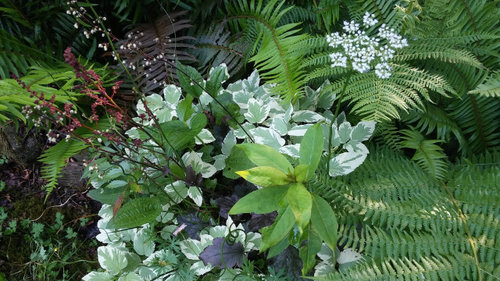
This year this plant put out a flower bud, flower is on the right. I have no idea what it is, but I like it.


Thanks.


Comments (20)

  • 6 years ago
    last modified: 6 years ago

    It is the dreaded variegated goutweed, Aegopodium podagraria 'Variegatum'. Also known as bishop's weed. It is an attractive but very aggressively spreading groundcover.

    I very much like this plant although I am sure I am in a small minority :-) But it does have an ability to takeover copious amounts of real estate so be warned. But if planted where you can just let it run its course or where it is hemmed in or restricted by unpenetratable boundaries - kinda like bamboo - it is quite nice!!

  • 6 years ago

    Very good to know. I will do what I can to keep it in check.


    Thanks!

  • 6 years ago

    These are pretty but GET RID OF IT. If it’s truly goutweed they will take over your garden and yard. They are almost impossible to kill because their root system can travel 30 feet down! My mom has been battling this plant for years. Even in a pot, it will seed and spread.

  • 6 years ago

    The above is a bit of an exaggeration :-) I've dealt with goutweed in several client gardens and A) it CAN be controlled and its spread restricted; and B) it - just like any other plant - can be successfully removed and stands killed off as needed or required. While it is an aggressive spreader as previously noted, it is far less problematic to control or eliminate than any number of other local problem plants like knotweed, horsetails, bindweed, English ivy.

    Thomas, would love to see some documentation that supports your statement about its root system. Plant roots rarely ever travel to such depths as there is nothing in the soil beyond perhaps a couple of feet that would attract them - zero nutrients, no oxygen exchange (plant roots need air!!) and unless in an extremely arid climate (which we are not), no need to delve deeply searching for water. Even the two major weeds that are well known and documented to have a deeply penetrating root system - knotweed and horsetail - rarely go deeper than 6 feet! 30 feet is unheard of!!

    In fact, virtually all websites that discuss this plant focus on its shallow but widely spreading rhizomatous habit. And that is why it can be successfully contained by planting in an area like between the house foundation and a sidewalk or driveway - its roots are easily contained. The difficulty in eliminating this plant from areas where not wanted has nothing to do with the depth of the root system but rather that any broken bits or pieces of root or rhizome that may remain in the soil after attempted removal will regenerate into a new plant.

    As aggressive plants go, this one rates pretty far down on my list compared to many others.

  • 6 years ago

    @gardengal48 (PNW Z8/9) I heard from A neighbor years ago that both goutweed and bindweed roots can travel up to 30 feet deep. This thread says goutweed roots can travel several meters. Several being more than two, that’s at least 9 feet deep. I wouldn’t consider that shallow by any means. https://laidbackgardener.blog/2016/05/20/getting-rid-of-goutweed/amp/ In regard to your request for documentation this isn’t a research paper. Comparing articles online is basically he said vs she said. Are you getting your information from peer reviewed journals? Haha. This article says bindweed roots can travel up to 30 feet deep, and tree roots most definitely can travel that deep, so you saying that it is unheard of for plant roots to travel to such depths is untrue. https://www.motherearthnews.com/organic-gardening/pest-control/garden-weeds-zm0z11zsto I disagree that there is nothing that would attract plants to that depth. Water tables and aquifers are at these depths and are full of nutrients. Climates that are not considered arid also experience droughts and there are water loving trees and plants that will seek water at great depths to survive.

  • 6 years ago

    That's it?? The best support for your argument you could manage?? A neighbor and a blog??

    LOL!! Sorry, not buying any of that. And none of those links are scientific sources. Mother Earth News is just reporting opinions gathered from other readers and we already have clear evidence of how opinions can take extreme viewpoints without proof!! I will put a lot more faith in my education, my hort degree and decades of experience dealing with invasive and aggressive plants personally and professionally. And those science based websites that actually explain how plants grow, how deep roots travel and what soil conditions exist at a 30' depth.

  • 6 years ago

    Thomas, you seem to be missing something here....I don't have to prove anything! You are the one that posed these preposterous assumptions so it is incumbent on you to provide the proof. Which you can't. You really excavate down 30 feet?? For what possible reason??

    All you are doing now is making yourself look silly and resorting to name calling which is noted and reported. And you have added nothing of value to this thread.

    bye-bye.

  • 6 years ago

    After all this discussion, I still would say get rid of it unless you are a meticulous gardener who checks on it’s’ boundaries daily or have a failsafe way to keep it inbounds.

    i have to agree it is a lovely plant and I once saw it underplanted in a grove of white birch and it was spectacular but now wonder how that fared over time.

    i have faced the fact that I will never be able to rid my garden of it - one of my garden regrets.

    Take gardengal’s advice and deadhead the potted plant. Otherwise you won’t have control over where it seeds.

    gardengal, this plant is the most aggressive plant in my garden by far. I am curious what other plants are more aggressive in your garden. A close second for me is Romneya coulteri. Guess this would be an interesting subject for a separate thread.

  • 6 years ago

    cercis, there are very few plants I don't find manageable :-) And goutweed is one of them. It can take some work and due diligence but now and again, it is just the right plant for the right place. And I certainly wouldn't stress overly about one being grown in a container!!

    In my previous sunny garden, I grew Romneya. It spread but never aggressively. But it got tough love - pretty poor soil and no supplemental watering. The only attention it got was an annual cutting back....when I got around to it :-)

    The most aggressive plants I've dealt with have been trumpet vine (took 5+ years to control that one!), Jerusalem artichokes, plume poppy (spreads an incredible distance - worse than bamboo!) and sweet woodruff. Of any groundcover, sweet woodruff is the one I avoid like the plague!!

    In my current heavily wooded garden, the two primary pests are English ivy and Himalayan blackberries. And I continue to make inroads on the yellow archangel that the prior resident thought was a good idea :-)

  • 6 years ago

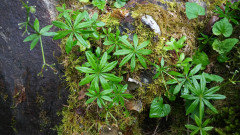
    Is this Sweet Woodruff? It's been in our garden for maybe ten years. It hitchhiked on some Solomon Seal we acquired at a plant trade. So far it has spread moderately, but I could see it becoming a pest. What kinds of trouble does it cause?


    Violets are the bane of my garden. that and the yellow poppies, but the poppies are pretty so i don't mind as much.


  • 6 years ago

    Yes, looks like sweet woodruff.


    Worse than bamboo? I have trouble imagining much worse than golden bamboo. The stuff runs like crazy and busts through things. Digging it out is shovel-breaking work (literally). Barriers ... and don't end the barriers! It will go around even if there's many, many yards of it.

  • 6 years ago

    Yes, that's sweet woodruff. It's a very mat-like, surface rooted groundcover and mine spread extremely vigorously. In open ground that was not much of a problem....you could just roll it up like you were rolling up a carpet. But if there were any other plants growing in the vicinity, the sweet woodruff just rooted and grew right through them. To get rid of it, you had to dig up both plants and then meticulously remove all the SW roots that intertwined with the other roots. Not a problem with some plants but it took hours to get it out of a very nice big clump of Japanese forest grass. And I gave up trying to remove it from around shrubs or trees....just not possible without bare rooting them!

    My old Shoreline garden was heavily populated with yellow and orange Welsh poppies. While I am a big poppy lover, those were just too weedy for my tastes and if you allow one to go to seed you would have dozens forever more!!

  • 6 years ago

    Yes, like bamboo, plume poppy (Macleaya cordata) is rhizomatous and shoots can spring up at a significant distance from the mother plant.....like 10-20 yards away!! It was an even more aggressive spreader in my garden than the trumpet vine.

    The thing with running bamboo is one knows it is going to spread....and you can prepare for that by using bamboo barrier (which needs to encircle the entire plant). Plume poppies or trumpet vines are not as widely recognized as being so aggressive and it is only firsthand experience or word of mouth that can prevent one from making a big gardening mistake!!

  • 6 years ago

    One can prepare ... until the neighbor plants more and has the theory of "snip it off" when it runs, which makes it just run further! Guess how we know. We're going to have to drop more barrier and pray the stone wall isn't already doomed.

  • 6 years ago

    So I take it the Woodruff grows from any little bit of root? So far it hasn't created any mats of growth, it's kind of sprinkeled here and there in the area it's growing, and like I said it's been around for about ten years. On one side it has a thick clump of Solomon Seal and the bed its growing into is mostly hellbores and hosta. I don't think it will hurt those, but I'll be keeping an eye on it.


    Thanks.

  • 6 years ago

    I believe that lots of times, the spread of these aggressive plants is either encouraged or discouraged by growing conditions. Apparently I had just the right conditions for the SW to spread and take over significant amounts of real estate :-)) OTOH, everyone seems to complain about lily of the valley taking over in a similar manner, yet I cannot get a clump to survive more than a season! Apparently I do NOT have the right conditions for those!

    I think when one is growing any plant that has a reputation for aggressive spreading, keeping an eye on it and monitoring its rapacity just makes good gardening sense.

  • 6 years ago

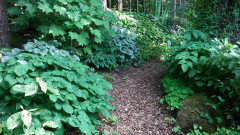
    We had some bamboo and after a few years it began running. We had a track hoe come in and dig it out. I still had several years where it would sprout up and I'd have to dig up to 2 feet down to get the root. Glad it's gone. That same year we had all the Laurels ripped out. Best decision we've made was getting rid of those. Now is this path exists where they were removed.


  • 6 years ago

    btw, I was at my local Safeway earlier today and noticed that they were selling preplanted patio containers that all contained the variegated goutweed. They didn't look half bad!!

  • 6 years ago

    Sweet Woodruff is a big problem for me in Portland. Lily of the Valley and Spanish bluebells in the same bed. They grow into the other plants and crowd them out. Impossible to control. My friend has goutweed and yellow archangel. She hates them both with a passion. Has not been able to get either under control.

Sponsored
Schlabach Woodworks
Average rating: 5 out of 5 stars21 Reviews
Franklin County's Reclaimed Wood Professionals