Software
Houzz Logo Print
webuser_566048487

DIY cork tiles in kitchen?

6 years ago

How easy is it to do a DIY install of cork tiles in a kitchen?

We are looking at using 12” x 12” tiles that would be either 5/8” or 3/8” thick. They do not have a hard material on back or click together. They’re literally just pieces of cork floor tiles. The flooring company is charging three times as much to install then as it costs for the tiles ($4500 for a pretty small space, of which 75% is installation cost).

I am wondering if it’s possible for us to install them ourselves? They sell the same glue that their installers use. How hard could it be?

Comments (8)

  • 6 years ago

    I would think the problem would be that the underlayment would need to be completely smooth and flat. I'd go on Youtube and watch flooring installation for cork.

    Brooklyn thanked KARYN STONE
  • 6 years ago

    As a cork flooring expert, I'm going to offer what I know. And I have educated MANY a wood-floor professional over the years. The one's that asked THESE following questions BEFORE they began the install are the one's who did NOT owe their clients new floors afterwards.


    The actual work of laying cork glue down tiles is diddly squat. It's the REST of the building industry that you have to learn in your situation. So...what is your subfloor material ALLOWED to be? How thick should it be? What's your transition strip going to be?


    What is the flash time for a water based contact cement adhesive? Do you know how much is enough glue? How much is NOT enough glue? How much glue can you spread on the subfloor AND the back of the tiles, allow to flash, and then lay before your glue goes stale and you need to add more? How do you apply the glue? Trowel or brush (its a trick question...you don't use either...you need a paint roller but not just any one...you need one that doesn't shed and is NOT foam or rubber)?


    How are you going to seal the cork once installed? How do you prep the cork tiles before you seal them? How many coats of finish? How quickly are you allowed to recoat? What's your spread rate? Brush or paint roller?


    Whew! And I haven't even gotten 'technical' on you yet! I have taken HOURS to explain (in minute detail) the TECHNIQUES for each and everyone of these questions...and still people have gotten it wrong (so wrong a woman called us with the opening statement, "So my husband's an idiot.").


    A cork glue down tile SHOULD COST the SAME as a HIGH END porcelain or STONE tile installation. It should be $12-$15/square foot just for labour. Cork, adhesive and finish are extra. Subfloor preparation is extra.


    A cork glue down tile is NOT a cheap fix. It is a LUXURY finish (just like Italian marble floors).


    If you want cheap and chearful, simply install a cork floating floor and seal it with 2 coats of Loba 2K Supra AT...allow to cure and move in. But you STILL need subfloor prep. And if you want to put the cork over the PLANKED subfloor, you have to add another $2-$4/sf for the plywood (the RIGHT STUFF = expensive stuff) and the labour. Now you start the $12-$15/sf labour costs once you start the actual install.


    Last question: How handy are you? How much will the flooring company offer you in 'technical' support so that you can start with the subfloor and end up with the installed tiles (acclimation, acclimation, acclimation) inside of two weeks?


    There are VERY FEW cork flooring experts in N. America. I know of half a dozen others. Hopefully you have found one of the other 6.

  • PRO
    6 years ago

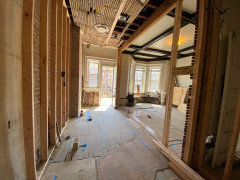
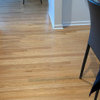
    I would never use cork for flooring as mentioned the reason it is expensive to install is there. What is the picture showing ? If that is where you plan to glue any flooring think again . What is that beautiful flooring on the left ? If that is going to be covered shame on you. The rest will need proper sub floor IMO you are way over your head. Either choose a different flooring for DIY or pay the bucks for install. Very often homeowners do not know what they don't know.

  • 6 years ago
    last modified: 6 years ago

    @SJ McCarthy Phew, that was an exhaustive (and exhausting!) list of very good questions! No, I don't know any of that! I am handy, but for this particular topic, my knowledge is limited to the several DIY videos I watched on YouTube. Sounds like professional installation is the way to go!

    @Patricia Colwell Consulting Lol, goodness no! The original parquet floor is staying. It is intact throughout most of the house and will be professionally sanded down and varnished. But the kitchen had old tiles and crumbling linoleum, which we ripped up, and now that we've removed an adjacent wall, need to find a floor covering that is thin enough to meet the 5/8" edge (or thinner once sanded again) of the old flooring. There would be a 1/4" plywood subfloor installed by our contractor. In my original post, I was merely wondering how feasible it would be for us to install the cork tiles ourselves over the plywood.

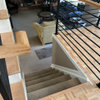
    We have very limited options for what flooring is thin enough to line up with the adjacent parquet flooring, but I suppose I should have asked that as its own question before asking about cork tiles specifically! We were also considering Marmoleum. Do you have a recommendation? It's a 1910 brownstone. Here's a picture of the space in question:


  • 6 years ago

    The easiest way to do this is to use a flooring transition strip (uneven T-molding) and put down a cork floating floor (if you want cork). The subfloor planks are in HORRIBLE condition which means they need to be covered up with something a bit more than 1/4" plywood.


    I'm sorry but I really don't like the idea of thin plywood going down over these planked subfloors. I worry about the structure.


    And the good news is: once you get your head around an uneven T-molding, your flooring choices open up considerably.

  • 6 years ago
    last modified: 6 years ago

    Brooklyn, I’m with you. No transition strips. Keep looking ‘till you find something that will work. 5/8” solid hardwood flooring might be your best option.


  • 6 years ago

    Oh it’s beautiful. I think continuing hardwood into the kitchen will be a triumph.