Software
Houzz Logo Print
shebabee

Growing in sandy soil -- your thoughts, advice?

6 years ago
last modified: 6 years ago

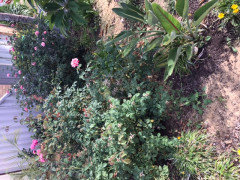
I'd like to hear from those of you who are growing in sandy soil. My very small garden bed is basically -- sand. Over the years I have attempted to amend it and am still at it. Originally I sheet mulched, adding lots of compost, and I dig in compost a few times a year where I can and side dress plants as well. I give the roses some fish hydrolysate a few times a year, to boost the nutrition. And yet -- it seems as sandy as ever! And barely a worm to be seen (just a million earwigs). I'm a renter and it didn't occur to me early on to have the whole mess dug out and replaced, and I can't do that now. But is there something else I should be doing? Why does the soil not improve?!

I've had Buff Beauty in the bed for @6 years, doing great, and GMH for @3 years, doing well (especially now after that pretty hard trim a month ago); most of the perennials are doing OK.

But still -- I am puzzled by the sand problem.

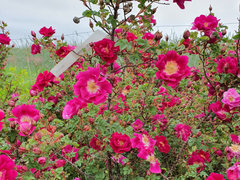
I am planting a few more roses in the bed -- I managed to make room for two or three more. I've just planted my Maggie and my FBPT. I figure that as Maggie seems to grow all over the world, and FBPT also seems to be a survivor, they should be OK. But before I plant another one or two in the last bits of space -- are there some classes or varieties of roses that will likely do better than others in sandy soil? Some possibilities from my "pot ghetto" are Mons. Tillier, Gruss an Coburg, DdB, MIP, Portland from Glendora, Rose de Rescht, Benny Lopez, Lady Hill, Reine des Violettes, Bouquet d'Or. Any that will be fairly OK in containers for a long while (like RdR, I assume) will stay in containers. I know it's a problem planting roses that will want to get huge, as I would have to keep cutting them back . . . . so they might be best staying in the pot ghetto and living their sort of "bonsai" lives there until I finally -- find them new homes. William R. Smith is one that will probably have to be rehomed soon.

Comments (20)

  • 6 years ago

    When Sherry from Florida posted, she was always struggling with sand allowing nutrients to wash away and replenishing organic matter. Any soil amendments disappeared quickly. She had to constantly add organic matter and manures to counteract her sandy soil. I wish I could help more.

    shebabee thanked Sheila z8a Rogue Valley OR
  • 6 years ago

    Sheila -- Where does it all GO??!

  • 6 years ago

    shebabee, I visited my daughter in Western Australia a couple of times, in a place where the soil was basically sand, and the roses there were outstanding.

    As for which to plant from your pot ghetto, I had a Ms Tillier planted in a spot that received a lot of water, and it did way better, in growth and blooms, than one I've got planted in a dry spot.

    shebabee thanked titian1 10b Sydney
  • 6 years ago

    You can increase the water retention of that sand by using unscented clay cat litter mixed in with it prior to planting. Unfortunately, you will have to continue adding organic mulches forever. That's the "curse" of sand. The Santa Maria Valley is thousands of acres of sand under irrigation for all manner of food and flowers and they dump TONS of animal manure on it annually. I'm surprised you can't smell it from SF! LOL!


    shebabee thanked roseseek
  • 6 years ago

    Hi shebabee! At the farm in the Central Valley the soil is sandy, but the roses love it! They grow huge. I don't know if varies by location, but I thinkt the roses would grow well in sand. The varieties we have are "Bill Warriner," "Crimson Glory," "Climbing First Prize," and 3 other e unidentified ones. I think rugosa roses would do well in sandy soil as well. I think someone posted awhile back about a tea rose that did especially well in sandy soil but I cancan't remember the name. II'll see if I can look it up when I get home. Gardenweb doesn'tdoesn't work on my phone with autocorrect coconstantly malfunctioning. It's driving me nuts! Sorry about the weird spelling.

    Have a nice evening,

    Damask_rose : )

    shebabee thanked damask_rose_zone9b
  • 6 years ago

    I live in Perth’s northern suburbs, and am basically growing in yellow builders sand.

    When I plant, I blend in a bag or two of cow manure, then mulch with cow or sheep manure. I think the most important thing is rose selection. Tea and China types seem perfectly happy in sand, particularly if grafted on fortuniana. You will never stop the soil from being sandy, you are just trying to improve it by adding organics to inarrate moisture and nutrient retention. And of course, mulch, mulch, mulch. It’s only the top 30 odd cm of soil that matters for feeder roots, so don’t worry that it’s just sand below. I haven’t added bentonite clays in my current garden, but they might be worth considering. Monsieur Tillier is loving life in the sandpit.


    shebabee thanked User
  • 6 years ago

    Sheila, Dr. Manners, Titian, Damask Rose, Kim, Adam --


    Oh, thank you ALL! for your feedback! Super informative. I realize that the kind of amending I've been doing--while trying to follow general guidelines I had read--wasn't NEARLY as aggressive as it should have been for sandy soil. (That being said, amazing to me, the few roses in the ground seem happy -- especially Buff Beauty. I will start stepping things up as much as I can.

    I will start adding much more compost and manures to the garden bed. I've learned to leave all the dropped leaves and petals (which agrees with my lazy nature, anyway).


    It's also very encouraging to hear that so many of your roses, and especially the teas, seem nonchalant or even happy to grow in sand!


    So a few follow-up questions, for anyone with time and patience for more:


    1. About the kitty litter -- I assume this should be the non-clumping clay, as well as unscented, etc, correct? Would the other litters now available be useful -- corn, pine, newsprint -- if they are also free of scents and other additives?


    2. I have quite a few large bags of fir bark mulch on hand -- the pieces are about 1 to 2 inches. Is this a useful additive to sandy soil, or would it make things worse by promoting faster drainage?


    3. My container plants are growing in some version of the famous "Al's 5-1-1 mix" -- mine is a mix of small (@1/2 inch) fir bark, compost, and small (@1/4") lava rock pebbles. When I re-pot or pot up, I add what's left to the garden bed. Again -- is this good or not helpful? Also -- should I leave old roots and matted roots from re-potting in the bed, or should these be composted first?


    Really appreciate your help with this. I have heard and read so many comments about how to deal with clay soils but really have found very little regarding sand. I would really like to see earthworms in my garden bed one day -- they are in my compost bin and in my containers but they sure don't seem to like the garden bed.


    All best to all you rosy people!

    Sheba


  • 6 years ago
    last modified: 6 years ago

    The fir bark is a great mulch. After you spread manure or compost and water in well, just spread it over the soil surface In a layer about 10cm thick. As it slowly degrades it will also improve the soil.

    the only kitty litter I ever added to the soil was a bentonite Clay and pine shaving blend (Previously used by my cat). I bought this brand because bentonite is used commonly here to improve soil. The newspaper and ceral based ones were smelly and horrible, and the newspaper one took ages to degrade because it’s so compacted.

    it is a common practice here to mulch each year with sheep manure. The balls act as a mulch, retaining moisture in the soil. but as they Decompose they improve the soil structure. lupin straw is also great for this. You just spread it out and let nature break it down and work into the soil. You don’t dig it in as it damages the feeding roots, just let it rot down slowly.

    shebabee thanked User
  • 6 years ago

    Yes, the clay kitty litter. Anything else is organic, and like the organics you've been using, it will digest and filter out of the sand. The clay will get wet and stick to the sand, creating more of the "clay loam" you read you need for gardening. Ideally, unscented, untreated, non clumping clay litter with any and every organic material you can find. The more you use, the happier your soil and plants will be. You'll have fun! Good luck.

    shebabee thanked roseseek
  • 6 years ago

    Rosa Pimpinellifolia grows in sandy soil (beaches and dunes) and I would assume that Pimpinellifolia-hybrids grow ok in sandy soil. Some of these are known as Scots-roses. Amazing display of flowers once a year, e.g. William III.

    Re-blooming classics are Stanwell Perpetual, Mon Amie Claire, Prarie Youth and Frûhlingsduft.

    shebabee thanked MetteBee_Copenhagen8b
  • 6 years ago
    last modified: 6 years ago

    MetteBee, thanks from ShebaBee! These are roses I'm not familiar with aside from Stanwell P. Interesting to hear of more sand-happy roses.

    Kim and Adam, thanks much for the added info. This is encouraging! I've ordered several bags of non-clumping unscented clay litter, and I will get to work on this over the weekend. Glad to know also that my bags of unused fir bark mulch will be of use -- I was about to offer it to my neighbor.

    I so appreciate this amazing group and your expertise. I've learned so much here from the enormous wealth of cumulative experience and your generosity.

    Sheba

  • 6 years ago


    William III, mid-June in Denmark.

  • 6 years ago

    Lovely, MetteBee!

  • 6 years ago

    Kim, Adam, everyone --

    I dug in some of the clay litter around my plants and into the bed on Saturday. And dang! I've never seen my sandy soil behave this way. The water doesn't immediately drain away, and even the next day, you can see that I had watered! My sand almost looks like actual garden soil! I know this has to be an ongoing process, and I'm also adding compost, manure, bark, etc -- but what a great idea! I, and my roses, thank you for the help.

    Sheba

  • 6 years ago

    Congratulations! The best part of the clay is, IF it washes through, it will take a long time and a ton of water. The organics still need to be applied copiously, and they will digest and disappear, but the good stuff from them will get trapped by the clay and the plants will continue thanking you for it!


    shebabee thanked roseseek
  • 6 years ago

    Thanks, Kim! Such fun to see the change. Can you give me a sense of how much I should use / how often is OK? I kind of just dug a handful or so around each plant and throughout the bed. I didn't dig down more than a few inches. I assume I shouldn't go crazy adding pounds and pounds of the stuff at once, right?

    Cheers,

    Sheba

  • 6 years ago

    You're welcome! Ideally, you mix the clay with the soil before planting so it is deeper in the soil where the roots will find it lower, rather than toward the surface of the soil. If what you have done appears to be holding the plants well and not letting them wilt in the "heat", then just keep applying organics as mulch and carry on with your normal routine. If it appears you need more clay to hold more water, you might do more of what you've done. It's difficult to advise you how much to use as that would depend upon the heat, wind, aridity, water requirements of what you're growing, etc. Some roses demand more water than others, Austins being particularly "thirsty". And, you don't really want to do that much disturbing of the rose roots. If you have budded plants, that's a great way to encourage suckers. Whether they are budded or not, breaking and damaging the roots is also a wonderful way to help result in crown gall issues.

    shebabee thanked roseseek
  • 6 years ago

    That makes sense. I will work in deeper for any new planting, but most of the bed is planted up already. I will kinda play it by ear, which is my typical MO. I appreciate the advice, Kim.

  • 6 years ago

    You're welcome! I'm glad it helped!