

BERMUDA GRASS SPROUTS TURNING PURPLE! PLEASE HELP.
Hi Everyone,
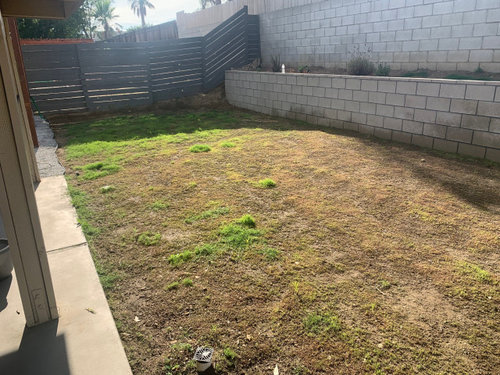
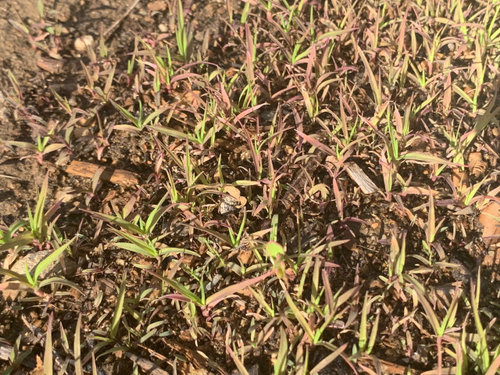
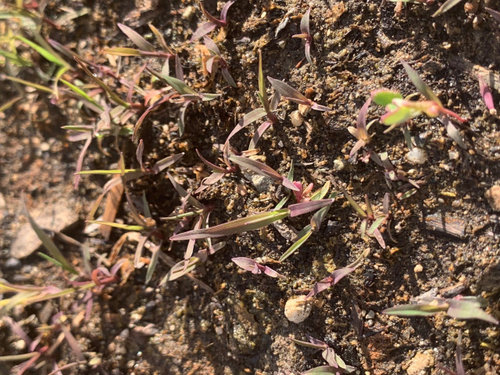
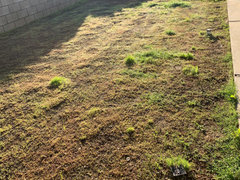
I recently started from scratch and planted Oasis Bermuda Grass in my backyard (1100 sq ft). Today makes day 25 since I seeded. I am in Zone 10 (Southern California). I've been keeping the soil watered and moist and have been tending to my grass often as I am working from home. The left side of my yard started coming in pretty good... patchy, but nice, but then I noticed that the right side and now the center of my yard is starting to stunt and is not really growing. Most frightening, the sprouts are beginning to turn purple. I've posted some photos below. Again, this is day 25. I did drop some Simple Solutions Liquid Fertilizer 16-4-8 about 12-13 days ago.... I don't know what to do as I do not know whether my grass is thriving. I am continuing to water as normal (its been pretty hot lately). Usually AM, Mid day, if needed, afternoon/evening. I've put a lot of time, love and money into seeding and was praying for a positive result. How can I save my grass? Any help, tips, or would be greatly appreciated! Thank you everyone.
Comments (28)
 6 years ago
I do have an answer but I was waiting for a Bermuda person to chime in as I'm decidedly not a Bermuda person. This happens in many grasses and other plants.
The purple is not a critical problem and, while you should do something about it, you don't have to go into hysterics about it. Right now, the grass is running out of resources and not able to synthesize enough chlorophyll to turn the grass green. What you're seeing is the "helper" and secondary coloration of the grass, mostly red and blue pigments, that help capture the red and blue photons in sunlight and move it to the chlorophyll molecule to turn it into energy.This doesn't mean the grass isn't receiving energy, there's still chlorophyll and a surprising amount of energy production can take place using just the secondary pigments and pathways. Chlorophyll's far more efficient, however.
What to do: On Day 25, the grass doesn't have much root yet, so it probably ran out of nitrogen. Give it a half-strength feed with any good fertilizer. I'd recommend Milorganite at full strength since it only has a modest amount of fast nitrogen and a modest amount of slow nitrogen. It'll kick the grass along pretty fast, plus provide a slower trickle of nitrogen for another month (but don't count on that, more later). It'll also kick in iron to stimulate chlorophyll production, and most other chemicals on the Periodic Table that the grass will need, in small amounts.Try that first, water it in. If it doesn't work, I have other tricks up my sleeve. Consider getting a soil test through Logan Labs if your old lawn always looked like crap. There was probably a reason for that...
Those longer strands? Those have longer roots and can access deeper resources in the soil, hence why they're green (microbial action is important, hence also the reason for the Milorganite--see, I told you more later). Grow the shorter stuff in and end of problem, but let's get this lawn moving.
In another...oh, 20 days...hit it with full-strength Milo again. It's soon, but that plot is fairly small so it won't cost much and the lawn is young and hungry (and yet more on the Milo as promised earlier...) That'll get a bit more fast nitrogen, and more slow nitrogen, and more bacterial action going.Related Professionals
Platteville Landscape Architects & Landscape Designers · Saint Cloud Landscape Contractors · Sedalia Decks, Patios & Outdoor Enclosures · Chicago Decks, Patios & Outdoor Enclosures · Madison Decks, Patios & Outdoor Enclosures · Charleston Landscape Architects & Landscape Designers · Plattsburgh Landscape Architects & Landscape Designers · Ashland Landscape Contractors · Greenville Landscape Architects & Landscape Designers · Muncie Landscape Architects & Landscape Designers · Worcester Landscape Contractors · Spartanburg Home Builders · Youngstown Home Builders · Bakersfield Home Builders · Missoula Home Buildersspazemouze
Original Author6 years agoHi Morpheuspa, thank you for taking the time to comment. I really appreciate it. Yes, that is what I have used thus far. I didn’t want to burn my lawn during its infancy and the seed growing phase. I’ve read a lot that the purple can be caused to a phosphorus deficiency as well? do you suggest the problem is the underfeeding of nitrogen, or the deficiency of phosphorus. Either way, do you have any recommendations on products I should buy or do to restore it and help it grow again? Thank you again.
- 6 years ago
Oh, my, yes, this is salvageable; that Milorganite I recommended should solve the problem quite swiftly and contains both nitrogen and phosphorus. This isn't really even a problem, it's just amusing.
I actually suspect that both are partially to blame, but I lean more toward quick nitrogen availability as the momentary issue with possible phosphorus deficiency due to the soil being rather wet for the last month or so as a secondary issue.
So go bag rate on Milorganite (1 bag per 2,500 square feet) and water it in well and that should clear it up in a week or so with some good sunshine. As I mentioned, if not, I do have another trick up my sleeve, but I doubt you'll need it.
spazemouze
Original Author6 years agoGreat advice! Amusing for you. Terrifying for me! Lol. Well, I’m truly glad to hear that this is salvageable. I’ve only recently (with my new and first home purchase) starting learning about lawn care. Lots of years and experience to go! I’ll go ahead and purchase the Milorganite and get it in ASAP. Stay tuned, I’ll comment back with some updates and news in about a week or so. Hopefully this does the trick and we don’t need to bother your sleeves. Thanks again, I do value your advice.
- 6 years ago
No trouble. It may, with wet soil and ill weather, take a bit more than a week, but you should see improvement. And never mind my sleeves, they're always covered in paint anyway.
 6 years ago
Since you are still learning, your zone means nothing except in helping to select plant varieties for winter hardiness. What would help me is to know where you live. SoCal runs from about Bakersfield to San Diego and Newport to Blythe. If you are in Big Bear that's different from being in Indio.
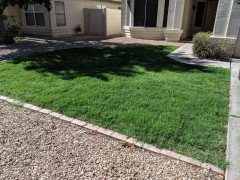
After a month, assuming you are somewhere hot, I would expect to see full coverage of a seeded bermuda lawn. Here's a picture of a friend's bermuda planting on July 8 from last year. He seeded on June 23.
So I have some questions about the seeding.Of course, where are you?
What did you do to prep the soil? (Raking? Tilling? Digging? Watering? )
How many pounds of bermuda did you put down?
Did you roll the seed down?
What was your watering schedule for the first week?
spazemouze thanked dchall_san_antoniospazemouze
Original Author6 years agoHi Dchall, thanks for taking the time, and please excuse my rookiness, this is all new to me but I’m diligent to learn as much as I can from experts like yourself. Im in Rialto, CA (zip 92376). To prep the yard I used a gas tiller to loosen and rotate the soil. I purchased 7 cu yards of compost/top soil mix and dropped that down and then tilled that with the existing soil. We installed the sprinkler system, leveled best could, used a lawn roller to flatten it, dropped 4 lbs of Oasis Bermuda Grass from Outside Pride. After seeding I rolled it once again with the lawn roller and I have one big thing of peat moss that I threw down, it did not cover the entire yard but I covered as much as I could. I am watering every morning at 7 am for 10-15 mins and throughout the day by hand when I see it drying up. I’m trying to keep it moist and wet at all times so it does not dry up or die. I usually run sprinklers again right before it gets dark for another 15-20 mins. The left side of my yard somehow seems to be coming in fine with no problems and no purple, and the middle and right side of the yard doesnt seem to be growing much at all, and it sprouting purple as shown in the photos. With random patches growing quickly and others not growing at all. Here’s a picture from today..... let me know if you need more information. I dropped a whole bag of milorganite yesterday. Spreader wasn’t working well but I did the best I could. Do you have any suggestions on what I can do to get this growing? Thank you!!
spazemouze
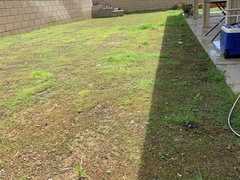
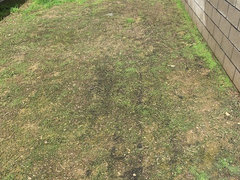
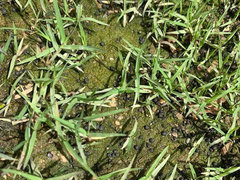
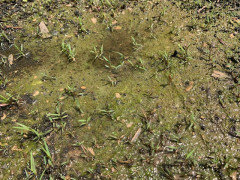
Original Author6 years agolast modified: 6 years agoUPDATE: Hi guys! Its been 4 days since my last update. It seems as if the milorganite is helping with the purple, but I still feel as if the grass is not growing at the rate that it should. Sticking with my water schedule of 15 minutes in the AM, 10-15 mins mid day and another 10-15 minutes in the afternoon/evening. Is there anything else I can be doing to help this grass thrive and grow? I also seem to be running into a new problem here as well. I am noticing that the soil is taking on a green tint. Am I developing a fungus issue? Will this be harmful to growth? Posting pictures below for reference....
- 6 years ago
At this point, you're overwatering if the grass has sprouted (and you're growing a beautiful crop of cyanobacteria and green algae there, which are harmless and fun to watch, but not really what you want).
You can definitely step back to watering once in the morning. Possibly every other day if your soil stays moist.
spazemouze thanked User spazemouze
Original Author6 years agoOk! I’ll pull back to mornings only. Am I just letting the milorganite work its magic at this point? Do I need anything else to help the grass?
- 6 years ago
I don't see evidence of too much trouble right now, but David might disagree. I'm not a Bermuda expert. When this happens on tri-mix or most other plants I have experience with, it's a resource shortage--nitrogen, phosphorus, or magnesium, usually in that order. You just added some of all three, in that order, with the Milo, and poured on iron besides as a helper ion to produce chlorophyll.
It all just needs time to work, and the soil time to dry out to damp as waterlogged soil binds phosphorus, and iron and renders them inaccessible to the plant and washes out nitrogen so that the plant can't get it before it's gone. :-)
spazemouze thanked User spazemouze
Original Author6 years agolast modified: 6 years agoYou're a lawn guru! Thank you Morpheus. I'll see if David has anything to add to what you've said previously. I'll update in a couple of days here.... hopefully, with good news, less cyanobacteria, and more grass! Last question - how long should I be water every morning?
- 6 years ago
This is not an easy question to answer because "it depends." If it rains that day, not at all. If the soil is holding water and is staying very wet, not at all.
There's an old Zen koan, "Why does the turnip have no root?" And the real world answer is, "Because water is plentiful." (The philosophical answer is quite another story, but we'll leave it for the realm of realism for now. Besides, I was never much one for the airier realms of philosophy anyway).
The same is true of grasses. Too much water? There's no reason to grow roots. They'll stay shallow and never drive deep looking for water (and for phosphorus, calcium, magnesium, and so on). Keep it far too wet and the soil loses its oxygen, which means roots can't grow into it at all.
Start backing watering off. The surface should only be damp, never soaking wet, by the time evening sets in. Even a little dry is OK as long as it's damp an inch down. Make the roots work a bit.
spazemouze thanked User spazemouze
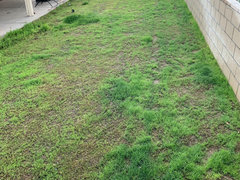
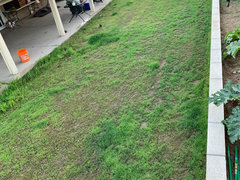
Original Author6 years agolast modified: 6 years agoHi Morpheus and friends, here is an update on the yard (photos below). The grass seems to be coming in quite slowly, but looking so much better when compared to my first post, thank you guys for that. It seems that pulling back on the watering has helped with the fungus. Not seeing much purple, I’ll be doing another milorganite in a couple weeks. I have a few questions.... now that it is starting to come in, I do notice that it is still patchy. Will it spread on its own or will I have to consider overseeding or other options to get this to fill in? If I am not mistaken, this is week 7 since seeding. Second question is... I feel that some areas are getting high, should I wait to mow until everything comes in or can I begin to mow the areas that are already getting tall? Any other suggestions? Thank you again! You are helping save my grass!
- 6 years ago
You can begin to mow (low, as Bermuda prefers) whenever you like. And yes, that's losing the purple tones nicely, although it's not as green as I would like (but I'm a stickler; sap green and Hooker's green are not my preferred colors).
It's almost time to feed again (monthly with Bermuda, and young Bermuda is especially nibbly stuff). Now that it's aging a little, you can use a synthetic if you want, or go with Milorganite again if you prefer. Or another organic if you'd rather--whatever works for you is great. With a younger lawn, I'd recommend a light hand on the synthetics if you choose to use those (spoon feed at half rate every 14 days in July and August) or go full rate organics in July and August, every 30 days (or even more, it's really hard to overdo organics and I've tried).
Feed that well and that Bermuda will spread like crazy once it's growing and being mowed. It does have to mature a little yet for that to happen--tillering happens on grasses that are established.
spazemouze thanked User - 6 years ago
Bermuda in full sun spreads several inches per week. You'll see that as it creeps over sidewalks and driveways. If you still see thin spots, that's usually due to not enough sunlight. Your situation looks suspect unless the back of the house faces north or south. If it faces east or west, you're getting too much shade from the house and block wall.
spazemouze thanked dchall_san_antonio spazemouze
Original Author6 years agoHi Dchall. We get very little shade. The back yard is facing North toward the mountains. The sun will come up East and go over our home, and the majority of the yard receives ample amounts of sun, minus that edge along the concrete (patio) as there is a slight shadow that is cast on that line from the patio itself. Based on what you can see can I continue to water and let it spread itself, or will I need to consider alternatives?
- 6 years ago
Six or more hours of sun is tolerable for Bermuda. Eight or more is perfect. Yours sounds perfect.
spazemouze thanked User spazemouze
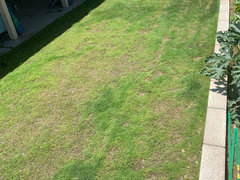
Original Author6 years agolast modified: 6 years agoHey guys! Update from a week ago... I've been mowing every 3 days, grass seems to like it. I am noticing that the grass is taking on a much more yellowish tint compared to my last update. It seemed much more green after comparing last week and this weeks images. We’ve been experiencing some hot 102-104 degree weather in Rialto, CA though. Summer is in full effect - I’ve been sticking to morning sprinklers and a couple minutes in the afternoon by hand if it is looking dry. I’m seeing some very prominent yellow spots as well, should I increase on watering? Also, I’m not noticing much more, if any spreading in the bare spots. Have not yet applied the second milorgranite feeding. Planning to do that sometime this week/weekend. Still trying to figure out how to get this lawn to thicken up and spread, wife keeps saying she wants to have a picnic back there when it’s ready! can’t let her down! I’m putting my best foot forward!
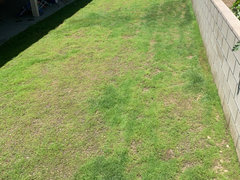
- 6 years ago
That's pretty normal. You're coming up on...a month or so since the last feeding and watering a lot? You're simply washing the nitrogen out of the soil and the Milorganite is running out of kick. Hence some yellowing.
Time to feed.
And the whole thing is getting old enough and Milo is gentle enough that you can exceed bag rate by a little and target 1 pound of nitrogen equivalent instead. For Milo, that's 100/6, or 16 pounds per thousand. The bag will cover 2,500 square feet or so at that rate (2,250, but close enough).
- 6 years ago
Looks like I missed a lot beginning 17 days ago. Sorry. One family crisis after another. No new health issues, but lots of normal equipment breakage, etc.
So, Rialto! We used to drive from Riverside to Rialto to go to a steakhouse my dad liked. Ahhh, the 50s. Good times.
So, catching up...To prep the yard I used a gas tiller to loosen and rotate the soil. I purchased 7 cu yards of compost/top soil mix and dropped that down and then tilled that with the existing soil.
Tilling and compost were both mistakes in the prep. Compost introduces undecomposed organic material which will decompose ever so slowly. Normally that stuff decomposes out in the air on top of the soil, but when it is buried, it starts to rob nitrogen from all possible sources - including fertilizer. The fungus that decomposes woody material needs nitrogen, so that's going to be a long term issues - months if not years. Tilling is a separate problem. As you know from doing the job, the tiller tends to buck up or dig in depending on whether it hits a root, rock, wet spot, or soft sand. What you end up with is a rolling profile of untilled ground under a layer of fluffy soil. When you level the surface you create a flat on top layer of fluff with an undulating bottom. As the fluff settles, beginning immediately, it will settle to match the undulating profile underneath. What that means is your surface will become bumpier and bumpier from now on for the next 3 years until it finally settles into a permanent structure. So while bermuda loves to be mowed at the mower's lowest setting, your lawn will have to be mowed higher so that you don't scalp it when the mower wheels fall into the low spots. If there is any good news in all this, it is that you have bermuda - it's bullet proof. The solution to the bumpy surface is to level it with sand. You could get a head start on that next summer even though the surface will not have finished settling. Basically you feed the bermuda heavily, water it deeply, scalp it low as you can go, cover it with sand, level the sand, and let the grass come back up through it. It's a weekend job for two people. You will notice a huge improvement the first time you do this, and it will be encouraging enough that you want to finish the job and turn it into a putting green. You can do that, but I'd wait until I was certain the setting had stopped.
I have a question about the lawn. Along the red line there is a noticeable green line and less green line. Is there a sprinkler pipe running down there?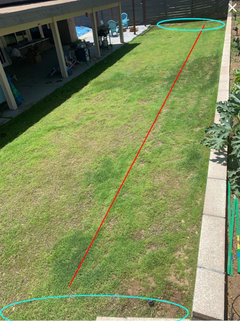
The blue ovals indicate future thin spots. Bermuda needs full sun, as has been mentioned. Since your yard runs east/west, the grass on the west/east sides of the fences and walls will suffer with not enough sunlight to become very dense. Just keep that in mind and plan for a flower bed or something at the ends of the yard. I would not finalize where those go until the grass actually thins out. Also if you plant tall flowers like zinnias, those will cast still more shadows bringing the thinning in farther.
I think the lawn is ready to jump toward deep and infrequent watering. If it were not bermuda I would hesitate, but this is a jump toward, not a jump into. Get some tuna or cat food cans and place them around the yard. Place one next to every sprinkler and some out where you think the water might not be reaching. Also put one or two where you think the water is heavy. Turn on the sprinklers and time how long it takes to fill all the cans. Note which cans fill the fastest and which the slowest. If there is a big discrepancy in the time between those cans, then your sprinklers need to be tuned up to get better coverage. The time it takes to fill can be long or short. Mine takes 8 hours. My old neighbor's took 20 minutes. Everyone has to figure this out for themselves. If you start to get runoff before filling the cans, stop watering and wait 15 to 30 minutes for the water to soak in. Then resume watering. Stop as many times as you need to but keep track of the stops and times. When you have finished timing your can filling, you will have watered a full inch of water. That's the "deep" part of deep and infrequent. When you water deeply the grass develops deeper roots which can get nutrients and moisture from deeper in the soil. The grass looks a LOT better when you're doing deep and infrequent. Morpheus is shy about sharing his lawn pictures, so you have to be patient. I harvested this one from about 10 years ago and use it often to make this point about deep/infrequent watering.
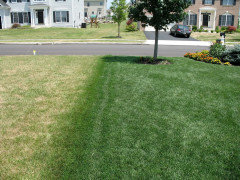
D and I on the right, shallow and frequent everywhere else. With temps above 100, for a mature bermuda lawn in Rialto, I would normally suggest deep watering every 5 days. Since you have a new lawn, I would suggest watering 1/2 inch (half your 1-inch timed event) every other day. If the soil gets soggy, then move to every 3 days, but I think it will be fine. When the temps come back to the 90s, then do 1/2 inch every 7 days. In mid August I think you can go to fully mature thinking on watering and fertilizing. Deep water once a week and fertilize with a high N fast release once every 6 to 8 weeks. And I strongly suggest using Milorganite or other organic fertilizer as often as you care to, but at least once a year. I use alfalfa pellets at 15 -20 pounds per 1,000 square feet. You can use soybean meal or corn meal. Call your local feed stores for pricing and availability. I've found feed stores in SoCal to be very quirky in what they carry. Since you have so many nearby, you'll probably have better selections and prices. Soybean might be as high as $40 for 40 pounds where normal corn meal "should" be under $10 for 50 pounds. Corn gluten meal might be as high as $30 for 40 pounds. I get alfalfa at $12 for 50 pounds. All are applied at the same rate.
Apologies for missing the important messages almost 3 weeks ago. Sometimes life comes at you fast and you have to prioritize.
- 6 years ago
That's weird, my account got logged out and I can't get it logged back in. No matter, until I figure that out, we'll use this one. It's been a heck of an afternoon so I'll worry about that one later when I have time. Frankly, that last Windows 10 update is kicking butts and taking names all over the place, including with me.
Fortunately, N lock won't be too much of an issue if that compost was fully finished. A bit, perhaps, but nothing serious. The settling, however? Yeah, that's gonna happen. Sorry I missed that. But you can certainly fix it with sand or any other convenient local soil, up to a quarter inch at a time. Bermuda can even tolerate a little more adjustment than that, but don't push it!
And no, I don't tend to show a lot of my own photos. I let others do it for me and post the testimonials. :-)
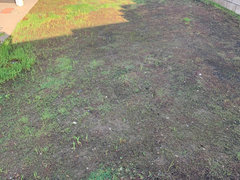













User