Software
Houzz Logo Print
lukkirish

Trying to figure out full house standby generators.

6 years ago

I would like to have a standby generator installed next to my 1700 sf colonial. So far I’ve spoken with two companies. The first company quoted the job with a 13KW Generac. He said that would be sufficient and that our larger sized (3 ton) A/C would not be a problem. But he was only here for a few minutes, didn’t look at our panel in the basement, didn’t explain much about the process or the warranty and talked so fast that I had a hard time keeping up. I decided to get a 2nd quote, so this morning, I spoke to one company over the phone using the feedback from the first guy. He told me the 13KW unit would be the minimal he’d recommend because it would only provide about 11KW and in his opinion, that was kind of pushing it. He said that it depends on the panel we have, but that a 16KW would most likely be more appropriate. That’s for a ”whole” house installation that includes AC/Heat, a well pump, gas water heater, gas dryer and stove. There is about a $600 difference in price for the larger unit which is fine, if that really is the right call. This is something my husband would have understood and known what to do, but he passed away a couple of months ago and I’m out of my element trying to figure it out. Can someone please offer their thoughts? We don’t have power outages very often but with our Michigan winters, I’m looking for some peace of mind. Thanks!

Comments (21)

  • 6 years ago

    I am so sorry for your loss. I hope your getting along okay. We have a 17KW standby generator. Have a heat pump for heating and AC. Also a gas furnace, gas hot water heater, gas stove, well pump and septic pump. At our age late 70’s I have been learning as much as I can about how everything works. I talked to my husband about his thoughts. He said for a 1700 sq ft. House a 3 ton heat pump was heavy duty, per him on the heat pump your looking at 35 amps. Now I can’t remember if you said you had a gas backup furnace or if you had an electric strip heating furnace. Here’s the kicker...if the furnace is gas you could get by with the 13kw generator. If your furnace is electric you will need the 16kw. I hope this helps and you get the generator. I love ours. It tests itself every other week for 5 minutes, I go out and give it a little pat. Also I’m assuming this will be either a natural gas or propane. Ours is propane since we are in a rural area with no natural gas. If you are propane the minimum size tank is 125 gallons. Let me know how things go.

    Lukki Irish thanked jalarse
  • 6 years ago

    Hi there we are in Ontario purchased a house in the rural 2.5 years ago, we have a sump pump that had a back up with it but since we work and we are gone all day , if the power goes out our basement would be flooded in 20 minutes. This scared us so we had a gas 11k generac installed along with a new panel . We have an electric water heater and gas furnace. Our house is 1300ft plus basement , we were told that this is big enough for everything as long as the dish washer is not going if the dryer is going. We haven’t used it much but when we have had it come on we are very happy we invested in this. This was $10,000.00 Cdn.
    We have it serviced every year and the service man told my husband the smaller The units have better track records then the larger ones. There isn’t that much money difference in a 15k but we didn’t need this size .

    Lukki Irish thanked poorgirl
  • 6 years ago

    Hi Jalarse, Thank you. I’m am doing my best to get along and learn everything I can before the winter (I didn’t realize how much he did until he didn’t do it anymore!) It’s the A/C that’s 3 ton, I wasn’t sure if that would be an issue though. The furnace is GAS and yes, it will be run w/gas as well. I really appreciate your feed back and I’m so glad you love yours. I’m really looking forward to having this one put in.

  • 6 years ago

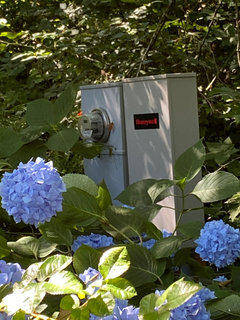
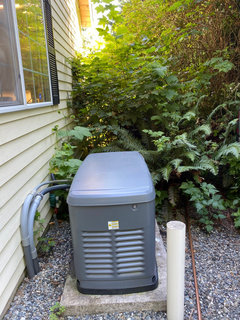
    Just a thought per Mr. Man who is retired HVAC (commercial) they don’t need to see the electrical panel in the basement. Just the one that’s outside with the meter. They will install another box next to it with a switchover. The generator will hook up to those two panels which are tied in together. When your electricity goes out the switchover panel automatically starts your generator. EASY PEASY. The first pic is the electric meter and the one next to it is the switchover box. I’m sure it has a more technical name but I sure as heck don’t know what it it. The other pic is the generator. I put a PVC pipe in the ground and filled it with concrete just in case someone backs up, let them hit that not my generator.

    Lukki Irish thanked jalarse
  • 6 years ago

    Poorgirl - Thank you for your feedback, so much money! I’m very fortunate in that 13 years and our sump pump has never needed to turn on. That said, my DD & SIL just bought a home down the road and theirs has similar issues to yours. I will show them your post. It may be a fix they could use as well, so thank you!

    Jalarse, thank you for the help, pics and explaination. Very very helpful!! It seems to look much harder than it really is. Scary when you don’t know and easy when you do! Smart idea with the pole but more importantly, your hydrandea’s are gorgeous and I love your garden! Also please thank your DH for me!

  • 6 years ago
    last modified: 6 years ago

    The peak demand for what you've described is fleeting and will likely be when your air conditioning first comes on because it takes a surge of power to do that. Just how many watts are needed varies from specific model to model but that spec is easily obtained. I would think a conscientious generator contractor would survey the power users in the house to be certain. Maybe a glance at the panel is an accepted short cut, I don't know.

    The other items you've mentioned, besides the AC, are not significant power users. Is your heat a gas furnace? Unless your gas water heater is power vented (which is just a fan), it uses none at all. Oven - same thing, if gas. If electric, still not that big of a deal but something to add up. A gas dryer uses electricity for a motor to turn the drum, again, not a high user.

    If you want to be certain, get a third bid and ask them to explain how they determine the size of generator needed. It should be a good time of year to investigate this and have the work done.

    Good luck.

    Lukki Irish thanked Elmer J Fudd
  • 6 years ago
    last modified: 6 years ago

    When you discuss options with the generator salesman, ask a couple additional questions.
    (1) What is the maintenance required to keep it in good condition and reliable? How often does it need to be started to ensure it will work when needed (monthly?), and do they offer a service to check it periodically (yearly?).
    (2) Is there an option to install a subpanel and have only part of the house powered by the generator? Since you have several gas appliances, you don't need much power to keep adequate heat, hot water, and a few key lighting systems and receptacles operating. It may not be an easy retrofit because of the way your house is wired, but its a common solution when you want to reduce the size of the generator.

    Bruce

    Lukki Irish thanked Bruce in Northern Virginia
  • 6 years ago

    Most of the whole house Generacs have a controller that fires it up weekly. Mine runs every Thursday at 1PM.


    The problem is that Generac has their head up their posterior on maintenance these days. They want to insist on you buying services from them and have encrypted the monitoring interface on later models to bust the ability to use third-party monitors. Fortunately, mine is running 15 yo firm ware and is going to stay that way.


    Lukki Irish thanked Ron Natalie
  • 6 years ago

    I think you need to ask "What is the purpose of a standby generator? Is it to provide full functionality of your home during a 2 week power outage, or simply to provide you with some conveniences during a short outage?" I used to live on Long Island and went through many power outages - remember Sandy? I had no standby, and just lived with it. Fortunately I had a natural gas boiler which required no electricity to run, so was able to heat my home. Since it was October, that wasn't too hard. Since then, I upgraded my boiler with a more modern one, and electricity is required to run the controls.


    My current situation is that I moved to northern NY and my primary concern is to prevent my house from freezing if we have a long outage. That is quite rare, but not impossible. So, how big a generator do I need? My heat source is an electrically powered resistance 20kW boiler, plus some more for the pumps, etc. I also have an electric well pump. At a minimum, I would need these to be protected. However, the house is super insulated, so it takes a long time to cool down; I could probably survive a 2 day outage with no problems.


    Fortunately, an error on the part of the builder meant that I have two 200Amp services with separate lines from the meter (200 feet away) to separate load centers. One is devoted exclusively to the heating system, so maybe I could just power that.

    Lukki Irish thanked mtvhike
  • 6 years ago

    You have two services? I thought you said you just had two "main" panels. I've got grave doubts about your electrician. More than one service to a structure is ILLEGAL.


    You need to get an electrician with a clue. He can do a load analysis to determine what you actually need (both with regard to service sizing and to your generator).


    Your next question is whether you want an automatic transfer switch. If you want automatic, then you must size the generator for the actual expected full load of the house. At 400A service you're talking a generator like mine (80 KVA). If you go manual, then a smaller generator is permitted as they expect that you'll be smart enough to shed the load to not exceed the generator capacity before you start it. Either way, you need an appropriate interlock to disconnect the generator-powered loads from the commercial mains while the generator is running.


    Lukki Irish thanked Ron Natalie
  • 6 years ago
    last modified: 6 years ago

    Ron, everything you say is correct, except, full description: The power comes from the street on an overhead line to a pole on my property with a transformer. From the transformer, the service goes down the pole underground to a meter stand about 50 feet away, where the meter and cutoff switch are located; this was all done by the POCO. Initially, it was a 200 Amp meter with a 200 Amp underground service to my house, about 180 feet away. At that time, there was also a receptacle mounted on the meter stand (and, I assume, a breaker somewhere). When they discovered their mistake, the meter was changed to a 400 Amp meter and a second 200 Amp underground service ran to the second 200 load center, which now services primarily my boiler. I got my CO after all this was done. My initial plan for a generator was to locate it next to he meter stand, so I had a large propane tank installed nearby with a line, again underground, to the house where it services my gas cooktop only. My thought was to put a generator near the propane tank and feed it to one or both of the services which start at the meter panel. These ideas were all approved in principle by the builder and his electrician.

    If this generator were to feed only the second 200 Amp line, I might move my more essential circuits from the first load center to the second.

    Last December, I had solar panels installed. The very professional installer ran his line from the roof down to just outside my utility room, in to the two inverters in that room, then to two cutoff switches (one outside), to the second load center. I discussed this whole thing with him and he suggested I consider one or two Tesla Power Walls (Tesla was NOT involved with the solar installation).

    Lukki Irish thanked mtvhike
  • 6 years ago

    OK, the service ends at the pole with your meter. What you have is two FEEDERS running to your house. It's still not legal in my opinion. There needs to be some way of disconnecting the service (a switch, or breaker, or in your case two 200A breakers). There doesn't need to be an overall 400A breaker. Each line from the pole to the house needs to have a breaker at the pole.


    At the house end, I still feel this is illegal. Just as with multiple services, multiple feeders are not permitted (there are exceptions, but none seem to apply here). The feeders need a disconnect (though it doesn't have to be a breaker) near where they enter the house.


    I don't see any problem with putting the generator at the pole and having it feed only one of the two feeders. You just need a suitable interlock.


    Lukki Irish thanked Ron Natalie
  • 6 years ago

    There is one disconnect at the meter. It's secured by the POCO. At the house end, there are main breakers in each load center; I don't know if they count. But it was all "inspected" by the local building inspector, so it passed.

  • 6 years ago

    Kohler, Onan, and Generac are the larger generator producers. Contact the local companies that represent each of these producers. Get each of them to provide a written recommendation and proposal. If they aren't willing to answer all your questions and your follow up questions, move on to the next company. Part of what the salesman should do is to educate you about your options. I would prefer to pay a little more for professionalism.

    Ask for references from each of them and contact the references. You can also ask neighbors for their experiences. YouTube will have lots of educational information, too. Spend a few hours watching videos. You will be a pro before you know it.

    The most important question to ask about generator usage is what do you want power? There are a bunch of ways to approach your answer, but that's where you start. Ask yourself I want to power either the whole house, partial house, or critical systems only. That determines how much generator you need to install.

    From my research the Kohler and Onan units are superior to the Generac. You are right to ask questions. No one knows everything. Never be afraid to ask a question. It's a new world for you. Listen to your intuition. No one was born knowing this stuff.

    Lukki Irish thanked homechef59
  • 6 years ago

    That's even more illegal. You need to be able to readily access it.

    Are you saying there are no breakers protecting the feeders?


  • 6 years ago

    So, being as bad as you say, what should be my action? The box on which the meter is mounted is very large, about 40" high by 18" wide, with only the meter on it. The meter is mounted on the cover which can't be opened, because there is a security clip holding it closed. I misspoke earlier in that, in fact, there is no disconnect there, so I agree it's dangerous (if there were an electrical fire in the house, there's no way to turn off the power except to run out to the meter panel, cut the POCO's clip and pull the meter off!). Should I have an electrician pull the meter, open the box, and install a disconnect? Should this be done by the POCO? Is it their responsibility?

  • 6 years ago

    Pulling the meter is not a disconnect under the terms of the code. I would suggest you find a good electrician to look over this mess.


  • 6 years ago

    Should I go back to the original electrician, or cut my losses and find another?

  • 6 years ago

    I'm tending to believe what the AHJ approved is two services (i.e., the two main breakers you have are the service disconnects). I still think it's kind of crappy that they decided to pull an illegal second service just because they screwed up on the first. I can't imagine it was cheaper labor wise (and only mildly material wise) to do it WRONG.


    Did anybody actually do a load analysis? Did you really need 400A?


    Anyway, be that as it may, your idea of feeding only one panel with the generator still sounds good.


  • 6 years ago

    Actually, Ron, I tried arguing with them. There seems to have been several points during the calculations that requirements were "rounded up": The 20kW boiler says 89.3 Amps, but they put in a 125 breaker, then there's a 40A breaker for the oven, a 30A breaker for the 4500 Watt hot water heater, etc. No AC or any other hi-draw devices and 30 20A lighting and receptacle circuits. The main thing is that I think the boiler is over sized. While they were building, with window and door openings blocked by plywood, the only source of heat was this same boiler using the 200A service only. It was in January with temperatures down to -20F and comfortable inside (I visited once).