Software
Houzz Logo Print
rick_craven67

Need backyard revamp (Southern California)

6 years ago
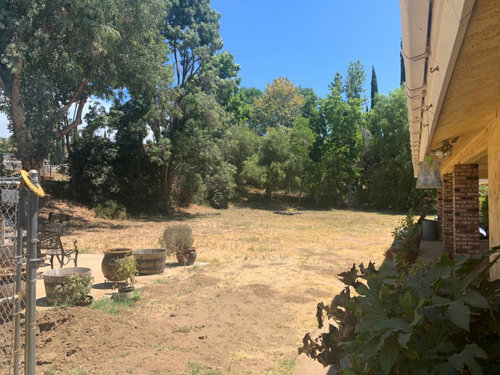
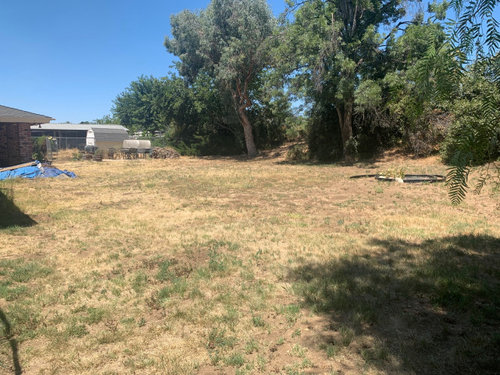
What can we do, to make this place look more family friendly? This is southern CA, so water is not plentiful & very expensive, yet we like grass (and hate Bermuda!). Another issue, is gophers. Regarding the present irrigation system, we have Hunter spray heads (they spray ~30 feet), so water coverage isn’t even (lots of brown spots), and the grass under the eucalyptus struggles even worse (likely the grass under the trees compete for the water - and loses out to the trees). So we’d likely need to “redo” the irrigation for the yard (more zones for the grassy area, and adjacent garden beds/growing areas around the peripheral of the yard). Suggestions: type of grass/ground cover for the main area - walking & dog use - yet water conservation, ways to deter gophers, modifying water zones around established trees (while again being water conserving - meeting the water needs of the trees adjacent to the yard), ways to improve the soil (dig it up vs just enriching the soil)…. Water bills, w/o watering the back yard run in the $500+ every 2 months, with rate hikes underway for the next several years).
We have a 3,000 sf home, so creating a water catchment system is a consideration (w/ 5,000+ gallon storage system).

Back yard (facing west)
Back yard (facing east)

Comments (10)

  • 6 years ago

    You have a region specific situation where you are trying to go against the grain - probably best to seek guidance from qualified service providers operating there where you are.

  • 6 years ago

    Can you home in on your location? All I can tell from the pictures is "not Big Bear."

    If you don't want bermuda, you have almost exhausted the drought tolerant turf types for the area. Actually if you hate bermuda, you have not been exposed to the hybrids like Tif 419 or TIF sport. The last choice, which might be my first choice, is UC Verde buffalo grass. It needs a good 5+ hours of direct sunlight to thrive. That means it won't do well on the north side of anything and will suffer adjacent to fencing that runs north/south.

    You can either replace the sprinkler heads (easy enough once you know what to get) or water with a hose and oscillator sprinkler. To test the sprinklers you can put tuna or cat food cans around the yard. I would make a radius line away from one of the sprinkler heads to see how far it's throwing water what areas are getting skipped. Oscillator sprinklers don't skip anything and don't need any fiddly adjustments. If you decide to get an oscillator, I have a few more tips for you.

    So let us know exactly where you live. It makes a big difference if you are east or west of the San Jacinto mountains or northeast of the Saddleback range in OC.

  • 6 years ago

    We live in Cherry Valley.
    The back yard orientation runs East/west, getting plenty of sunlight.

  • 6 years ago

    ...and plenty of smoke and fire right now.

    But also plenty of wind and heat. You live in an exceptional place where the temps are in the high 90s to 100s, humidity is the low teens, and winds of 20 to 30 most of the time. I would go with UC Verde buffalo. I don't think an oscillator sprinkler would be appropriate there, either. It shoots the water too high where the wind will take it away and the aridity will evaporate too much of it.

    I typically talk about watering deeply and infrequently where deep means 1 inch all at one time and infrequent means no more than once per week with temps in the 90s. If you can get some deep water penetration going, you might be able to water once every 4 days in your summer environment. Looking at what your soil looks like now, I'm betting you don't have much water penetration. If you tried to stick a screwdriver into the soil it might not penetrate at all. After watering for an hour you would have mush down 2 inches and then hard pack. Am I about right?

  • 6 years ago

    Portions of the soil are hard (when dry), portions of it are dry/powdery (thanks to the gophers). When digging, it’s much easier after watering. Not sure of the soil composition. Before the house was built in 1981, it appears if used to have the old concrete irrigation system - but that doesn’t mean the soil in the back yard is the rich soils left over from that.

    The soil ph is 6.8 (just under 7), using a little electronic meter. We gave up watering the back yard, after attempting to use a sod cutter to remove the bad grass & reseed it about 4 years ago w/ Marathon grass seed. Looked good ~4-6 months.
    I’ve tried watering it since, but didn’t get good even coverage & it deteriorated.
    Now I’m ready to try something new.
    Am wrestling between doing the work myself, vs hiring someone who knows way more than me about yards/landscaping in this dry environment.

  • 6 years ago

    So “UC verde buffalo” grass has rhizomes, but not the deep/invasive/never able to get rid of issues as with Bermuda? Don’t want to go chasing the edges of the grass runners into flower gardens & up into my woods. (My wife is presently determined to keeping an edge on the grass, so as for it not to get into our other gardens adjacent to the grass…)

  • 6 years ago

    I’ve tried to deep watering, but it seemed only the Bermuda grass really appreciated it! The other grass, which I UNDERSTOOD, was to be a drought tolerant variety, but that didn’t work, and gave up on deep watering the lawn, as I was only establishing the Bermuda grass deeper into the soil & more difficult to remove/overcome when I co e up with a better solution later (as I am attempting now)!
    Thanks for the advice this far. Getting me to consider more options, better solutions!

  • 6 years ago

    Study the native vegetation in your area and take your cue from that.

  • 6 years ago

    In my earlier post, I didn’t explain myself well, re the remnants of a concrete irrigation system: it appears it used to be orchards here at some time past, so assumed some good soil had existed. The back half of the property is a horse(less) pasture, so there had been some rich soil created there. Am looking at enriching the soil in our immediate back yard.

    Also appreciate the post on studying the native vegetation (varieties). That’s where looking at a good sustainable grass variety is helpful. We still want a somewhat traditional back yard, to be able to move about w/o all the dirt tracking into our house & back porch area.

    Will look more into the UC verde buffalo grass as a viable option. I have a contact out for an organic landscaper, waiting to hear back from them, as we lean towards more organic gardening anyways & want to have a more environmentally (& financially) sound yard, from the soil, irrigation system, on up to the type of grass & greenery.

  • 6 years ago

    Cherry Valley used to be a destination for locals to get apples, so likely an apple orchard used to be there.

    Marathon was entirely the wrong grass for your area.

    Turffalo used to be the go-to variety of buffalo grass until UC Verde came out. This picture shows the big advantage of UC Verde against Turffalo.


    Virtually all other varieties of buffalo form the seed heads. UC Verde stands alone on that.

    Yes UC Verde spreads. I think you'll find that all the warm season grasses will spread. You have to use a mechanical border to keep the grass out of gardens. We use a metal landscape border to keep St Augustine out. We also have rock borders. We use Round Up to keep the grass from penetrating the rocks.


    Note that there's no grass against the rocks - only weeds at the time of that picture.

    Your soil is very likely only lacking in healthy organic content. If you have time, the best thing you can do for the bare soil is to cover it with a few inches of mulch for 3 months. Water it once and let it go. The mulch covering will completely bring your soil back to health. It won't be perfect, but it will become soft enough to stick a screwdriver in.

    As for the gopher, you might take a quick trip to TJ and get a few M80s. Light them and drop in the hole. The contained thunder has an immediate effect, but the after smell of sulfur also has an effect. Or you could roll your own with black powder and fuses.

    As for organic fertilizers: Cherry Valley Feed should have all you need. My favorite organic fertilizers are corn meal and alfalfa pellets (rabbit chow). Apply at 15 to 20 pounds per 1,000 square feet. These are a lot less expensive than commercially bagged organic fertilizers.