Software
Houzz Logo Print
webuser_580068935

Range Hood Vent - Y duct adapter

6 years ago

I have two existing unused 4'' ducts in my kitchen going to outdoor. Each of them is too small to connect to a range hood (~300CFM). But I was wondering I could connect them both to a 6"x4"x4" Y-adapter with the larger 6" branch connected to the hood and the two 4" one going to outdoor.

Can you please give me your thoughts or prodcuts recommendations on this?

Appreciate your help.


Example of a 6"x4"x4" Y adapter (I could not find a 7"x4"x4" or larger online):

https://www.supplyhouse.com/Fantech-FY644-FY-Series-Sheet-Metal-Adapter-Y-Connection-6-x-4-x-4?gclid=CjwKCAjwjqT5BRAPEiwAJlBuBcNuGy9kVrwOjMlyAEr9wLUwNexwnlGEj7xb20B_HxmZ2p1JglMwYxoCH_cQAvD_BwE

Comments (11)

  • 6 years ago

    To flesh out @User's response, the dual 4-inch ducts will present more resistance than a single 6-inch duct. Also, these 4-inch ducts will have to have caps on the outside, and dampers. How long are these ducts? Are they steel?

    How much the restriction from dual 4-inch ducts will reduce your hood's flow rate depends on several variables that we don't know. The rated 300 CFM of your hood (which applies to hanging freely in the air) is likely only 200 CFM with a 6-inch duct, whatever hood filters are installed, and nominal house leakage make-up air. 200 CFM itself is too little for a hood that is large enough for proper capture from a 30-inch range or larger unless the goal is to not cook anything that generates hot grease cooking plumes.

  • 6 years ago

    @kaseki I am thread hoping, but will you be able to let me know if this Best Hood will be strong enough for my induction Bosch NIT8669SUC cooktop for my main kitchen.

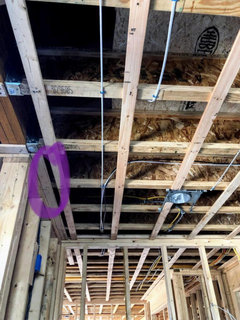
    Running into issue with the 2nd kitchen. GC said he cant vent the hood through the area circle in purple since is a structural beam. It didn't look like it to me, but the original plan was to vent it out to the attic from the 2nd floor. What CFM would I need for a 30in induction range? Thinking of one of the Frigidaire ones. Is there really no way to vent it straight up?


  • 6 years ago
    last modified: 6 years ago

    @kaseki I will be using the induction for wok cooking.. damn it. What CFM would you recommend instead for both the 36in induction cooktop and the 30in induction range?

  • 6 years ago

    To echo the first response: you can't do this. Even IF it were to work right now for your particular fan without issues, creating odd branched exhaust configurations of differing duct diameters in combination is just straight up not allowed by code in residential settings. Whatever you end up working out with your architect in terms of routing, it has to be a properly sized single duct leading to a single exhaust vent on the exterior of your home.

  • 6 years ago

    OK, wok cooking: This requires the highest level of residential ventilation if you want all of the grease and water to be expelled instead of condensed on the interior.

    Start with capture. The plumes from pans expand as they rise. We believe that a good approximation for hood capture width is the cooktop width plus six inches. For a wall hood, the front-to-back opening should be wall to 3-inches past the cooktop (toward the cook). Lights and switch panels add to this, depending on how the hood is configured.

    Continue with containment. Given these aperture dimensions, modified by the reality of whatever products are actually available/affordable/aesthetic, and how the cooktop is installed in the counter, one computes the area of the hood entry area in square feet. Multiply by 90 CFM/sq. ft. (equivalent to an intake air velocity of 90 ft/min). This is the required or actual CFM. Multiply by 1.5 (if you don't want to do a complete analysis) to get blower-rated CFM, which is only valid when the blower is hanging in free air.

    Next is ducting: This is usually specified by the hood manufacturer, but the goal in cold climates is operation near 1000 ft/min, and otherwise in the range of 1000 to 2000 ft/min. This is given by duct sectional area divided by actual CFM.

    Don't forget noise: Best blower noise reduction is achieved by using a roof blower or in-line duct blower, with a silencer mounted between the blower and the hood. Silencers are about 4 inches larger in diameter than the duct, so silencer installation needs to be considered ab initio.

    Last, but really contemporaneous, is make-up air. MUA must be supplied such that the house internal pressure does not fall so far that combustion appliances, if any, are back-drafted. Some such devices, if not supplied with their own MUA, can be very sensitive. Even without such devices, one wants MUA pressure loss to be a small fraction of the cut-off pressure of the blower (top left of the fan curve). Review MUA related threads on this forum for more information.

  • 6 years ago
    last modified: 6 years ago

    @kaseki any recommendation for induction wok?

  • 6 years ago

    Is this an induction wok by itself, or a wok being used on induction? I think my previous messages should cover the wok on induction question, because you explicitly called out induction in the "5 days ago" message. [Don't forget to expand messages by clicking on the "Read More" links at the bottom of the longish ones.]

  • 6 years ago

    @kaseki Sorry I wasn’t being clear. I saw the message, but I was wondering if you have any recommendation for a wok brand that would work well with an induction cooktop. Based on your past post I know you are pretty knowledgeable in this area. For example- I saw that la Creuset has a wok, but I’m not too certain if the side will be heated enough for wok cooking.

    Regarding the duct. For Duct sectional area, is it length of duct x r^2pi divided by actual CFM per your calculation.

  • 6 years ago

    Ah! the wok itself. First, I only have the wok that came with my Cooktek that is fitted to the curvature of the Cooktek Ceram bowl and, by inference, its internal ~conical coil. For flat induction cooktops, the wok should be a mild steel or a magnetic stainless steel. It may be best to have a flat bottom and sort of give up on the hot on the bottom, cooler on the sides scheme that is the underlying principle of a standard wok. It will still be hotter in a ring shape, depending on steel thickness. A wok with a very large radius of curvature may exist such that the field lines can reach more of it. (A large diameter induction cooktop coil can probably effectively reach up an inch, or about 3/4 inch above the Ceram surface.) For any curved wok, a flat induction surface will need some sort of support, and one shouldn't be banging the wok on the cooktop.

    I found some ancient email on this topic that probably started here. "The Wok Shop" was mentioned. The context, however, was hammered woks fitting the Cooktek, so that doesn't answer your question directly. You might do a search for induction capable woks and see what is available. Someone may have come up with a good compromise for flat surfaces.

    The sectional area I refer to is the cross-section of the duct given by r^2 pi converted to square feet.