Software
Houzz Logo Print
webuser_553096608

Is this considered rootbound?

5 years ago
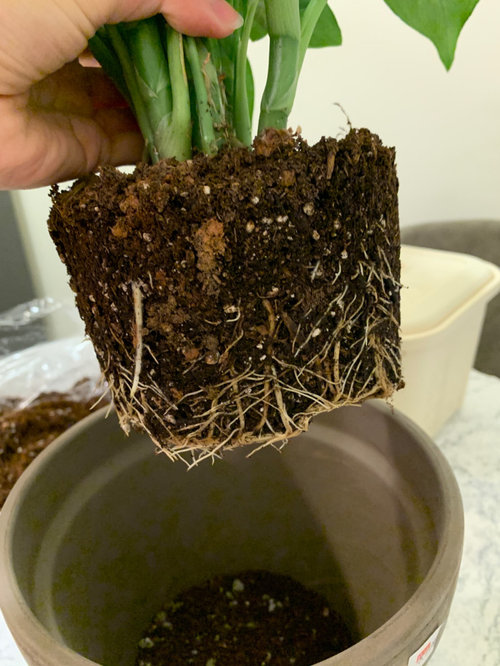
Hi everyone, I thought my dieffenbachia was getting rootbound because I saw roots coming out from the bottom of the planter. I took it and repotted it in a bigger container but now my plant seems to be struggling (slower growth, its new leaves are less green).

I am wondering - should I have kept it as is? Is this even considered rootbound?

Thanks

Comments (6)

  • 5 years ago

    It depends on how much you potted up. Usually an inch or two wider pot is fine. If it's in a pot too big, it won't thrive. Also, sometimes plants take some time to recover from repotting. Make sure you don't overwater and the plant gets plenty of bright light, not direct sun though. When dry, water until the water comes out the bottom in a sink or outside.

  • 5 years ago

    You don't say where you live, but the change in growth rate is almost certainly related to a reduction in photo loads (light).

    Your plant is currently at the point where root congestion will start to make a conspicuous impact on things like growth rate, vitality, and appearance. The visible tell is the fact you could lift the root/soil mass from the pot and it remained largely intact. This doesn't mean there is sufficient cause to ignore the fact now isn't a good time to repot, but you should repot when the time best favors fastest recovery. That would be in the 2-3 weeks bracketing the summer solstice (June 21). Remembering Father's Day is a good way to remember when it's time to repot houseplants.

    Avoid advice to repot in "spring" unless the advice is accompanied by the qualifier "LATE" spring - as in immediately before summer. Plants not afforded supplemental light are usually at their weakest in early spring after a long winter under low light conditions, which makes them particularly vulnerable to insect herbivory and disease pathogens during longer than necessary recovery periods.

    What have you been doing insofar as supplementing nutrition? If the plant is to be/remain healthy, fertilizing regularly is an obligate part of the care regimen.

    Al

  • 5 years ago

    Commercial operations seldom act strictly in the best interest of their crop. Their strategy is to minimize their outlay in delivering a crop to its POS in saleable condition. Since labor is most often the largest controllable expense, it's not surprising when labor intensive operations are intentionally minimized. The commercial grower doesn't ask, "What can I do to ensure this plant is realizing as much of its potential as possible", the question is almost always, "If I do this, how will it affect my return on what I will have invested".

    We all know how to ignore plants, cut corners, and save time for priorities we value more than caring for plants, but we don't all know how to optimize the opportunity our plants will have to realize as much of their inherent potential as possible.

    "What matters after putting any plant in a bigger pot is that the light exposure, potting medium characteristics, watering routine and fertilization regimen provided afterward are suitable for the kind of plant being grown." Though said with conviction, the statement completely ignores the fact that even if every cultural influence (nutrient levels, temperature, soil moisture/air relationships, light) was perfect, save one, it would be the one which is not perfect, which is most stressful which would serve as the limiting factor; and, only by rectifying that stressor, will growth improve. IOW, you cannot eliminate the stress/limitations imposed by root congestion by increasing the factors (individually or collectively) which are not stressors or in short supply ("..... light exposure, potting medium characteristics, watering routine and fertilization regimen").

    Read up on Liebig's Law of the Minimum for a more thorough understanding of why more light can't cure a N deficiency and more fertilizer isn't a cure for temperature extremes. As long as a plant is suffering from the very real limitations imposed by root congestion, the only complete fix is to eliminate the root congestion by way of a full repot. Potting up is not a fix as it ensures increasing congestion as the o/a size of the root mass increases. It's a half measure which temporarily allows a plant to grow a little closer to how it would normally be growing if not for the congestion.

    Al

  • 5 years ago

    You appear to be arguing with something I didn't say.

  • 5 years ago

    Vickie, I didn't see anyone actually answer your questions. 1) Yes you should have repotted. 2) No that is not rootbound, but it would be by next spring if you had waited to repot.


    If you give it decent light, water, & fertilizer like Embothrium mentioned, it will be well ahead by next fall compared to if you had waited to repot. Struggling a little in the way you described after repotting means your conditions could be better. Good light for this plant, in most areas in the fall/winter, is an East or West window, or perhaps with supplemental lighting in a North window. I like to fertilize lightly straight thru the winter, if the plants are getting enough light. And no you don't need to know anything about "Liebig's Law", LOL. Ignore all that. ;)

Sponsored
Peabody Landscape Group
Average rating: 3.5 out of 5 stars8 Reviews
Columbus' Reliable Landscape Design & Contracting