Software
Houzz Logo Print
christian_major

Large Eastern Redbud - To Pollard or not, that is the question...

5 years ago

From the off, I'm in the UK, so keep that in mind as I don't think the Eastern Redbud is common here.


I moved earlier this year into a property with about an acre of mature gardens, some of it in an overgrown state. In Spring, we noticed some beautiful Pink flowers emerging above a thick and dense border, at a height of around 30 feet. The area was very difficult to explore, with twisted branches of various large bushes and trees (Laurel, Fig, Rowan to name a few). However, right in the depths we found 3 large trunks, absolutely overwhelmed by Ivy, but leading up eventually to the pink flowers we had seen.


We were the proud owners, it would seem, of a very large Eastern Redbud. It had grown in an area where there was no light, on the North side of the property and so dense in vegetation. The poor thing had to grown long leggy limbs to reach through the top of the canopy, which it had made a valiant effort to do.


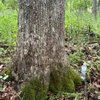
The 3 trunks that emerge from the ground are around a foot in diameter each, but sadly one has had Ivy penetrate right into it's core. I have removed all the Ivy from the bottom and mid sections of the tree, it made me warm in my heart to do so as I felt that I was giving this poor old girl a chance at life, but sadly the Ivy left a fairly substantial cavity.


Then the worst happened. We had some high winds last week that result in one of the long limbs becoming torn away from the trunk. It hasn't completely fallen, but came to rest on an adjoining tree. Now is the time to decide the fate of this tree.


We have cleared the area, not fully, but sunlight can bathe the area. The Redbud itself has become dependent on several conifers close-by, resting on their branches and in at least 2 places, it is obvious that removing the conifers would result in the Redbud failing drastically. Ultimately I'd get rid of the Conifers, which would allow more light into the area, but it's a chicken/egg situation at present.


I know these respond well to pollarding, but how to tackle this on such a large specimen? Should we systematically cut all 3 trunks back to around 8 feet in height (or just above the damage on the limbs that are wounded), with a tidy, sloped face and hope for the best? If it makes it, I can only imagine what it'll look like, having 3 substantial trunks each with it's own crown, but all merged into one. It could be stunning and it's put in so much work to thrive in adverse conditions, I want to give it a chance. Please take a look at the vid...


Comments (18)

  • 5 years ago

    could we have a pic or 2 of the leaves ... im not sure its an eastern redbud ... so the answers might differ


    ken

  • 5 years ago

    Now you're asking!! Let me see what I have in my phone. They're a long way up!!

  • 5 years ago

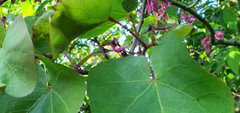
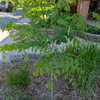
    The tree currently has brownish/red Seed pods, but here's a photo I took in late May...


  • 5 years ago

    well lets see if those work .. and they probably will ... but they are deciduous.. so soon enough.. they ought to all be on the ground ...


    meanwhile.. any pic of the seed pod ....


    ken

  • 5 years ago
    last modified: 5 years ago

    The leaves are not quite what I'd expect of our native redbud nor are the flower clusters as thick or tight, but perhaps a weird selection? 30 ft is within the upward tolerances, but you don't typically find that foliage is high even in those?
    Over here, they're not a particularly long-lived tree and I find them best as either a single crown and let them be, or a multiple crown forming a nice mound.

  • 5 years ago

    Ours has nothing low down, the first foliage it easily 20ft up. It has had some pink blossoms growing directly on the trunk, something I gather the Redbud is known for. Could it have grown a little differently due to our climate here in the UK?

  • 5 years ago

    location should not change genetics ...


    i agree its way to big to be an eastern RB .... as they grow here ... as noted.. they usually dont live long enough to get that big .... but when they do fail ... thats what is can look like ...


    i also feel that the leaves are nearly heart shaped.. and yours arent ... and they usually come to a distinct point ...


    https://duckduckgo.com/?q=Cercis+canadensis+leaves&t=ffcm&iax=images&ia=images


    wonder if a post in the tree or name that plant forum.. might not get us some of the botanists to chime in ...


    ken

  • 5 years ago

    It's dark here at the moment, but I'll pop out in the morning and see if I can get some other pics. But I'm now wondering if it's a Cercis Siliquastrum Tree, which is also known as the Judas Tree. I thought the Judas Tree and Eastern Redbud were the same, but maybe that's where I've got confused...

  • 5 years ago

    Nope, eastern redbud (if you google'd you'd know) is cercis canadensis.

  • 5 years ago

    Point taken, but they're VERY similar. I have them both open in separate tabs on a specialist tree site and it's very hard to tell them apart. The leaves on the Redbud are, as was pointed out, a bit more heart shaped.


    Anyway, now we know that we're dealing with a Cercis of one sort or another, can anyone throw any suggestions in about the original problem?

  • 5 years ago

    Since I'm not familiar with that species (assuming it is the Judas tree), I leave you with my opinions regarding cercis canadensis. You may generalize if you think it appropriate and perhaps someone will actually know this species growth pattern in a bit.

  • 5 years ago

    OK, but let's assume the Redbud and Judas are similar (until someone tells us otherwise), are you able to add anything about how I should rectify the broken limb and whether I should consider somehow altering the other 5-6 equally long at-risk limbs? Speak as though it were a Redbud...(please).

  • 5 years ago

    Then if it's broken cut it off..not much else you can do really. I don't really like pruning most trees, preferring their natural form, but if you don't mind pruning, then prune. Especially if it's to avoid future likely trouble. That said, I have weed mulberry trees in my fencerow that had limbs on the roof, I cut them today. I'd be as happy to cut them ALL down..but that's neither here nor there.

    If I need to shape a tree, I try to do it as needed while young, to make tweaks, and not major lopping. Most trees (not all for sure) have a lovely branching pattern all on their own (that's where I'm coming from). And interfering often just looks unnatural. Some people don't mind if their holly looks like a balloon on a string or a lollipop.

    If you don't like the looks after pruning, cut it down and replace it.

  • 5 years ago

    Jeez Floral, you've got a keen eye. I'll take a look at the one you commented on. The previous owner was my Grandmother, her Husband was a keen gardener in his day (he passed in 2004) and yes you're right, we have inherited some wonderful plants, which we are working our way around trying to sort out as the garden became overgrown since my Grandmothers age advanced. She sadly died last year at the grand age of 90.


    Not far from the area in question is a beautiful Koelreuteria Paniculata (we think), otherwise known as a 'Pride of India'. It's old and a bit knarly, but everyone that has seen it comments on it's beautiful canopy.


    We also have a Catalpa Bignonioides (Indian Bean Tree) that produces both flowers and pods, something that they apparently don't do until they're advanced in age.


    Anyway, thanks for your help all. I'd love to be able to leave this Cercis alone and if it weren't for it's vulnerability I would. Clearing the area has made it more at risk I guess, but we can't leave the area overgrown, it's a devil/deep blue sea scenario. I value mature trees because I know how long they take to grow and the sheer number of trees here is one of the reasons we fought hard to keep this property in the family, against the narrowest of odds.

  • 5 years ago

    Actually redbud trees grow quickly (which usually means fairly weak wood and relatively short-lived), I still think they're worth it. Also (at least here) Catalpa grows fast :0, though it seems to live about 2x as long as redbuds.

    Tree time varies from species to species. There are trees you plant for generations to come, and trees you plant because they'll be full-sized in ten years (but may not last more than thirty).

  • 5 years ago

    ken, there's a 30 ft tall eastern redbud just over my lot-line in the forest. Granted, it's in the understory & so isn't open grown.

  • 5 years ago


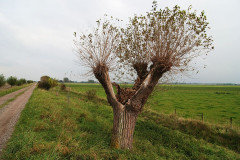
    Christian Major, this is what I think of when I hear pollarding, is this what you mean? You stated

    "I know these trees respond well to pollarding" Regarding redbuds, I've never known them to be pollarded, show us some examples.

    I'm guessing that pollarding sacrifices the flowers, right?

    Cercis spp, can in fact have a desirable, picturesque habit with just a nip and tuck here and there. I saw your video, Next winter cut your tree at ground level, let it resprout and develop into a new tree which in time will have a nice habit and abundant with flowers. Also, be sure it is not crowded and gets plenty of sun.