Software
Houzz Logo Print
webuser_555653410

Dealing with half sod, half old grass new lawn

5 years ago
last modified: 5 years ago

Hi all,I hope this is the right sub forum to ask this question. My recently acquired property has some interesting quirks to it's lawn that I'll likely be dealing with fixing over a number of years, bearing in mind that I've not had to deal with a lawn up to this point. The first noticeable issue is that the former owners appear to have either repaired or extended their front lawn such that half is newly laid sod and the other half is an odd blend of grass I cannot identify.
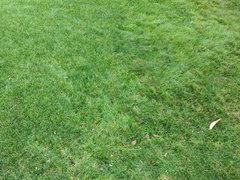
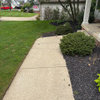
There's work to do sorting out the issues with the front (and older) half of the lawn, such as potential drainage and shade issues causing moss growth and fairly weak roots (as my recent raking revealed grass easily being pulled up), though I'm curious what opinions folks have on dealing with a lawn that is half sod and half something else. I'm not sure if progressively aerating and reseeding to blend the two or just tearing up the front half will make sense long term but it might help me determine the correct path to head down in sorting out the other issues mentioned.I've attached a few pictures hopefully showing the demarcation between lawn halves pretty visibly.
Thanks for your opinions!

Comments (13)

  • 5 years ago
    last modified: 5 years ago

    The lawn in question


  • 5 years ago

    Where do you live?

    What kind of grass do you think you have in the new area? ...and would you like to have that in the entire yard?

    Many people will use a triple mix of rye, fescue, and Kentucky bluegrass in their lawns. Generally the three look close to the same during the growing season. In the non growing season they tend to show their differences. It could be you have the triple mix on the right side and a monoculture of fescue (or rye or KBG) on the left side.

  • 5 years ago

    Thank you for the quick reply. I'm north of seattle, so pacific northwest with plenty of perpetual rain outside of summer with shaded areas likely promoting the moss. I have no idea what that new grass, as I'm pretty new to dealing with grasses at all, being a new homeowner... But this grass of course looks much better than the old blend. Stiffer, springer, and much healthier with no moss (yet). I'll ask the former owners about the new grass.


  • 5 years ago

    The old lawn is likely the typical NW blend of ryes and fescues - rarely any KBG as it is not advised for this area. The sod is most likely just a single species. For whatever reason, few sod farms in the area grow blends.

    The sod looks better because it's new :-) No weeds, no moss (yet). And it looks very uniform and dense as a result. Overseeding is the easiest way of getting the two to blend but that will take some time before it all melds together. In the meantime, I would just focus on beefing up and making the old lawn healthier. Do a fall fertilization and address any weeds. You can start the overseeding in April.

    HU-555653410 thanked gardengal48 (PNW Z8/9)
  • 5 years ago

    Thank you GG. Listen to her, HU-555... She knows your area better than anyone else here.

    By overseeding I believe she means to mix in some fescue seed with rye and redo both sides (??) of the lawn. The more you do that the more uniform it will look.

  • 5 years ago

    Actually, many sod farms are in the PNW, including KBG, and on--another site--we have plenty of recommendations for various places within the states of Washington, Oregon, etc. for KBG. It does very well in areas of moderate climate and isn't dissimilar to any other northern grass in that way.


    It may be that few sod farms in the area grow blends, but it's not true that KBG doesn't do well in the area. It's a great grass for there.

  • 5 years ago

    From the WSU extension service publication: "Kentucky bluegrass is the most commonly used lawn grass in the United States. Kentucky bluegrasses, in general, are not well-adapted to western Washington’s soil and climate."

    From OSU discusson of seed blends suited to PNW lawns: "Kentucky bluegrass is the most common lawn grass east of the Cascades, but disease susceptibility makes it poorly suited to locations west of the Cascades."

    And from article written by Tom Cook, Professor Emeritus, OSU on Poa pratensis (KBG): "Kentucky bluegrass use in the Pacific Northwest reads like a ‘Tale of Two Cities’. In areas east of the Cascade Mountains it has always been the dominant turfgrass. With a climate defined by hot summers, low humidity, cold winters, and calcareous soils, bluegrass grows incredibly well. West of the Cascades, bluegrass has been tried repeatedly without much success. The first major effort to use Kentucky bluegrass in western parts of Oregon and Washington started around 1960 when sod production began. Following the lead of sod growers around the USA, farmers planted mixtures containing ‘Merion’ bluegrass to increase sod strength. Early plantings were noted for their susceptibility to Stripe rust. They typically failed in 3-5 years being replaced by indigenous grasses and often with annual bluegrass. Gradually, people quit trying to plant pure Kentucky bluegrass and today you will generally find bluegrass only in seed mixtures marketed nationally and in some sod blends."

    Despite what some east coast responders may erroneously assume, KGB seed or seed blends are NOT recommended for this area!! Local seed mixes - and regionally prepared mixes are highly recommended over national brands - rarely include any in their blends and local sod farms do not grow it.

    The climate and growing conditions of the PNW are pretty unique, especially west of the Cascades, and it is highly unusual for anyone who has not lived or gardened there to speak to them with any kind of knowledge or accuracy.


  • 5 years ago

    Despite what others may assume, the area is not unique and cultivars have been suggested and do very well out there. One cannot, of course, universally write off the entire species carte blanche.


    And, of course, there are certainly bluegrass farms out in the PNW...as stated. I'll allow the OP to do their own research on that as I'm sure they're capable.


    As far as "has not lived or gardened there to speak to them with any kind of knowledge or accuracy," I say...well, we can insert any number of things some posters have said which they can't possibly take any offense to since they've said them themselves. Let's start with "Big Whoop." That one works here just fine.


    There's also a logical fallacy by this name. Don't invoke it. Oh, too late on that one.


    Living in a place does not, of course, give you perfect knowledge of it, and does not invoke criticism when commenting outside of it, unless, of course, you'd like me to start following those critical of that point in others around and stating that on every comment made regarding areas where they do not reside.


    Now there's an idea... Wouldn't that be fun?

  • 5 years ago

    Reading through the bluster, I am learning something about grasses in the PNW east/west of the Cascades.

  • 5 years ago

    Zip over and check Mallory's listings for the KBG variants recommended both east and west of the Cascades. That woman was an expert on KBG.


    Online research will show it's a bit of a love/hate relationship towards the coast--but carefully unspoken was the fact that this is true of TTTF and rye as well. The entire area is transitional/maritime, a la Brittany or the northern Aquitaine coastal region.


    Where, we should point out, all three are very popular grasses as the climates are rather similar.


  • 5 years ago

    All,


    I've definitely received plenty of good info from all, so many thanks for pitching in. I've procured a locally sourced blend and will eventually be working this into the soil everywhere. Some of the moss growth is extensive enough that it's removal in early spring will likely leave plenty of open canvas, whether this is fortunate or unfortunate...


    In the mean time, I was torn between tearing out the old section and sodding or progressively reseeding, the latter of which has been recommended both here and from local gardeners who work across the street and we're willing to take a look.


    Thanks again, and I'll likely to have more questions in the future!

  • 5 years ago

    Local advice is always best :-) Feel free to message me directly if you wish but it sounds like you are getting the input you need from neighbors.....can't get much more local than that!

    HU-555653410 thanked gardengal48 (PNW Z8/9)