Software
Houzz Logo Print
doug_wagner82

Indoor light levels

6 years ago
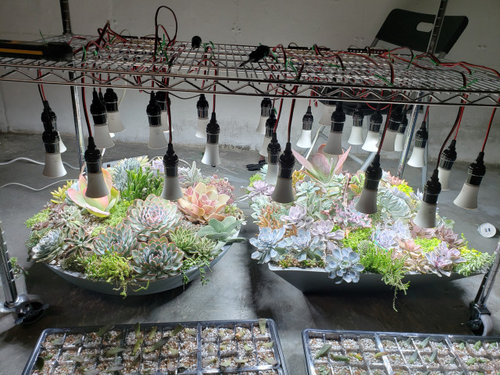
I've been searching for a decent starting target in lux or foot candle levels for my indoor setup. I know it has much to do with the type of succulent. This is where I got myself into trouble by including so many different types in my arrangements with different needs. I have made a diy setup and they are getting too much light and have some sunburn. Raising lights and decreasing the number of lights but would like to know a general target if one exists.


I'm getting up to 5k foot-candles in spots which must be too much. In the center I'm getting over 65k in lux readings as well.


From what I can gather you want to stay within the 3-4k foot-candle range. I would like to borrow a par meter but I can't seem to find a ppfd level range anywhere.


I guess it's trial and error. Any input would be great.

Comments (3)

  • 6 years ago
    last modified: 6 years ago

    Depends on the succulents, yes. You should go between 7-15 PAR DLI. It's better not not mix so many units of measurement because it's kind of confusing as they have very different meanings! My lights are around 150-200 μmol/m2s PPFD at their current heights.

    In my opinion, lux/fc isn't a very good measurement because the amount of light relates to how long you run your lights each day. The spectrum is also not the same (phototropic vision) and is highly dependent on the tool used. It's okay if you want relative measurements in light intensity, depending on the spectrum, but beyond that it is difficult to make decisions purely on the number. If you have the same model of lux meter as another person, that can be helpful provided you understand the accuracy provided the application is similar.

    I guess a good amount of light would be around 3000fc? 5000fc would likely be too much if your plants are not used to that amount of light. The instantaneous value isn't really the whole story.

    What are you using to take your measurements?

    (I have a calibrated par meter and several lux meters)

    Doug Wagner thanked ewwmayo
  • 6 years ago
    1. I bought 4 lux meters off Amazon to compare. The LED Dr. Meter and their standard one with the sensor that is detached. They both give similiar readings. I started with AOPUTTRIVER AP-881E which is giving me much lower numbers. I added lights because the numbers were so low. A comparison rated the cheap $18 Dr. Meter lux meter most accurate so I ordered that as well. It's giving me numbers similiar to the ap 881e. Theres no way to know which ones are even close but I'm going to go with the Dr. Meter readings, LED version.

    A video showed reasonable guestimation by multiplying by .015 with the Dr. Meter. My lights are supposed to be 6500k 13.5 watt LED bulbs but I have my doubts. They are incredibly cheap Amazon 6 packs with poor reviews on life span and if they are truly 6500k.


    Like I said, I can't find a lux or ppfd recommendation after hours of searching. Most likely because it probably varies so much between varieties there is no blanket number.


    A direct quote from a succulent website is "Succulents do best when exposed to between 3,000 and 4,000 fc (foot-candles)" -- Leaf and clay. So when I was using the meter giving me low numbers I thought I was ok.


    The plants are coloring like I've never seen, even outside. I'm getting tip burn and some bleaching effect on almost all. From what you're saying 3-4k foot-candles will be too much as well.


    So I should shoot for around 200 umol and 7-15 dli. That means in the 15000 lux range. I'll give it a shot thanks. Wish I had a par meter. I've actually been checking reef clubs in the area because they have a member par meter you can borrow.

  • 6 years ago
    last modified: 6 years ago

    You will find it is very difficult to find DLI or ppfd for growing succulents because needs vary greatly per species and growing conditions. Quality meters are very expensive, not that intuitive, and can be cumbersome to use. The spectral response can also vary depending how good the sensor you have and what spectrum the LED lights have. I have been using them over 5 years now for growing indoors (T5HO and LED) and outdoors.

    Lux and FC are the same measurements for human vision, just the USA unit versus metric unit. In my work over the past 10+ years, I have done industrial lighting analysis/design/calculations and we use lux meters for that (although this is only a small part of the many things I do in my job). The benefit of lux meters are that they are cheap to buy and use even if they aren't the "correct" measurement to take. For this reason, I do think they are a useful tool for indoor growers.

    I am actually working on determining a conversion factor for a lux sensor on an outdoor anemometer (on my roof) to get PPFD/DLI from that. Let me tell you that this has been a very difficult task taking lots of experimentation, data analysis, and even understanding of the exact lux sensor chip used and how it functions. Unfortunately that information will really only be applicable to my specific location and hardware.

    Honestly speaking, the vast majority of information regarding lights, LED lights, and grow lights on the internet is wrong/misguided/misleading. So if that site says 3000-4000fc for succulents we really need to know how long they have their lights on for and what they are growing. Or if they took the measurement properly or even used the right tool!

    That is the whole idea of DLI is plants are light collectors and a single instantaneous reading is not the whole story. The current PAR meter I'm using is the Apogee SQ-520 (new full spectrum blue housing version) and it is really fantastic. If you have some reef enthusiasts they may be using the same one!

    Doug Wagner thanked ewwmayo